Pain when inserting a tampon. Burning with intimacy. Stinging during a pelvic exam.
When gentle contact at the vaginal opening hurts, it can affect much more than your sex life. It can change how comfortable you feel in your body - and how you approach activities that other women may take for granted. These are recognized symptoms of a condition called provoked vestibulodynia.
A 2025 study offers an encouraging finding: low-level laser therapy/photobiomodulation, reduced local vulvar pain more than a sham treatment.
Why Can Gentle Touch Feel So Painful?
Nerve endings normally help you recognize touch, pressure, temperature, and potential injury. With vestibulodynia, those nerve endings can become unusually sensitive, so contact that would not normally hurt may produce a strong pain response. The nerves are literally overreacting.
Studies of vestibular tissue have also found increased nerve fibers and inflammatory changes in some women with PVD. These findings help explain why researchers are interested in treatments that influence both inflammation and pain signaling. They do not mean that every woman has the same underlying changes - or that vestibulodynia is always caused by an injured nerve.
Think of it as a pain alarm that has become too easy to trigger. Treatment aims to reduce that sensitivity while also addressing other contributors, such as pelvic floor muscle tension and the wider effects of living with persistent pain.
What Is Low-Level Laser Therapy?
Low-level laser therapy, or LLLT, uses specific wavelengths of red and near-infrared light to influence activity within cells. The broader term for this approach is photobiomodulation, often shortened to PBM.
Sometimes called “cold laser,” this treatment is designed to produce a biological response without deliberately heating, cutting, or removing tissue. It is not the same as a procedure that uses a laser to burn or resurface tissue.
The light interacts with light-sensitive components inside cells and can influence cellular energy production, inflammatory signaling, and the way nerves transmit pain. The response depends on the wavelength, dose, treatment area, and delivery method—not simply on whether a device produces red light.
How Could LLLT Help Nerve-Related Pain?
The aim is not to numb the entire area or destroy sensitive nerves. Researchers have investigated how appropriately delivered therapeutic light can make the environment around those nerves less irritating and alter pain signaling itself. Several mechanisms work together.
1. Reducing inflammatory signals around sensitive nerves
Inflammatory chemicals can make pain-sensing nerve endings easier to activate. Laboratory and animal research suggests that PBM can influence these chemicals and reduce some pro-inflammatory signaling. That may help lower the sensitivity of the surrounding tissue.
In plain English: if inflammation is keeping the pain alarm on high alert, reducing those signals may help dial its sensitivity down.
2. Changing how pain signals travel
Research suggests that certain PBM doses can temporarily inhibit activity in pain-transmitting nerve fibers. This offers a possible explanation for pain relief that does not depend entirely on healing a visible injury.
3. Supporting cellular energy processes
Mitochondria are the tiny structures inside cells that help produce usable energy, called ATP. Red and near-infrared light can interact with mitochondrial components and influence ATP production and other cell-signaling processes. These changes support tissue recovery and the function of cells involved in the pain response.
“More energy” is only part of the explanation, however. PBM is better understood as influencing cellular communication than simply charging cells like a battery.
4. Engaging the body’s own pain-relieving pathways
Researchers have also found that low-level laser may influence endogenous opioids - your body’s own pain-relieving chemicals. This is another potential contributor to its pain-reducing, effects.
What Did a 2025 Study Find?
Researchers at the University of Ottawa and Queen’s University in Canada studied 30 women with provoked vestibulodynia. Sixteen received real PBM and 14 received a sham treatment. Participants and the research team were masked to allocation until the analyses were complete.
The sham device was set to 1% of maximum output rather than being completely switched off. Both groups also received pain education and were offered mindfulness recordings during treatment sessions. This means the study tested the additional benefit of the active light protocol within that shared treatment setting.
My experiences working with women with Lichen Sclerosus (a painful autoimmune condition that affects vulvar tissues) makes this an exciting addition to the growing body of research using low level laser for women’s intimate health and well-being.
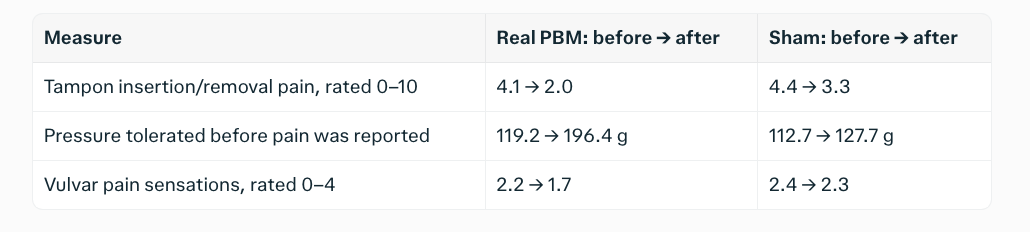
The researchers assessed the primary outcomes within one week of the final session and this is what they found.
Women receiving real PBM had greater reductions in local pain.
The pressure result is worth explaining: a higher threshold means that more pressure was needed before women reported pain. The tissue had become less sensitive to that particular test.
On the tampon test, the real-PBM group’s average pain score fell by roughly half.
Is This the Same as Using a Red Light Panel at Home?
No.
A consumer LED device does not automatically reproduce the treatment. My handheld home laser provides targetted low level laser therapy to the tissues (along with a full protocol of how to use your device).
Where Could Low Level Laser Fit Into Your Care?
Care for vestibulodynia may include pelvic floor physical therapy, topical or oral medications, and psychological or sexual-health support, depending on your symptoms and needs. A multidisciplinary approach recognizes that pain, muscle responses, and sexual well-being can affect one another.
The study authors suggest that reducing local sensitivity with PBM might help some women better tolerate other approaches.
What This Research Means for Women
These encouraging findings are very useful: a targeted course of PBM reduced local pain sensitivity more than the sham protocol.
For a woman whose vaginal opening hurts with touch, explore the gentle, non-invasive approach of low-level laser to improve comfort and quality of life.
Order your Solasta home laser and protocol here and find comfort sooner.
Tracy
https://blog.tracydonegan.org/blog/red-light-therapy-and-vulvar-lichen-sclerosus
https://blog.tracydonegan.org/blog/lichen-sclerosus-treatment-guide
This article is for education and does not replace an individual medical assessment or treatment plan.
Resources
Antonio FI, Pukall C, McLean L. Photobiomodulation therapy for the treatment of vulvar pain among those with provoked vestibulodynia: a randomized controlled trial. The Journal of Sexual Medicine. 2025;22:579–587. doi:10.1093/jsxmed/qdaf011.
American College of Obstetricians and Gynecologists. Vulvodynia. Patient frequently asked questions.
American College of Obstetricians and Gynecologists. Persistent Vulvar Pain. Committee Opinion. September 2016.
Cleveland Clinic. Vestibulodynia: Causes, Symptoms & Treatment.
British Association of Dermatologists. Vulvodynia and Vestibulodynia. Patient information leaflet.
Etiology, diagnosis, and clinical management of vulvodynia. 2014. PubMed Central article: PMC4014358.
Mechanisms and Pathways of Pain Photobiomodulation: A Narrative Review. 2021. PubMed Central article: PMC8277709.
Chow R, Armati P, Laakso EL, Bjordal JM, Baxter GD. Inhibitory effects of laser irradiation on peripheral mammalian nerves and relevance to analgesic effects: a systematic review. Photomedicine and Laser Surgery. 2011;29(6):365–381. doi:10.1089/pho.2010.2928.
Chung H, Dai T, Sharma SK, Huang YY, Carroll JD, Hamblin MR. The nuts and bolts of low-level laser (light) therapy. Annals of Biomedical Engineering. 2012;40(2):516–533. doi:10.1007/s10439-011-0454-7.