WARNING FOR GRAPHIC WOUND HEALING IMAGES IN LINKS
Recovery After Mastectomy: Can Low-Level Laser Therapy Help Wound Healing and Scars?
A mastectomy can change more than the appearance of your body. It may affect how you feel when you look in the mirror, get dressed or share an intimate moment. For some women, scars and the loss of a breast can bring grief, alter your sense of identity or leave you feeling less confident in a body that once felt familiar. Others may feel relief, acceptance or a mixture of emotions that changes from day to day. There is no right way to feel - and gratitude for cancer treatment does not mean having to feel comfortable with every change it brings.
Recovery deserves to make room for all of these experiences. Wanting a scar to feel softer or look less noticeable is not vanity, just as choosing not to pursue scar treatment does not mean caring less about yourself. What matters is having support and choices that reflect your own needs, without pressure to look or feel a certain way.
With that in mind, this article explores low-level laser therapy, also known as photobiomodulation, and the evidence for its role in wound and scar care - alongside the wider physical and intimate concerns that can be part of recovery after breast cancer treatment.
Understanding how healing works - and where light therapy might fit - can help women make informed choices without adding unnecessary pressure or expense to their recovery.
How does a mastectomy wound heal?
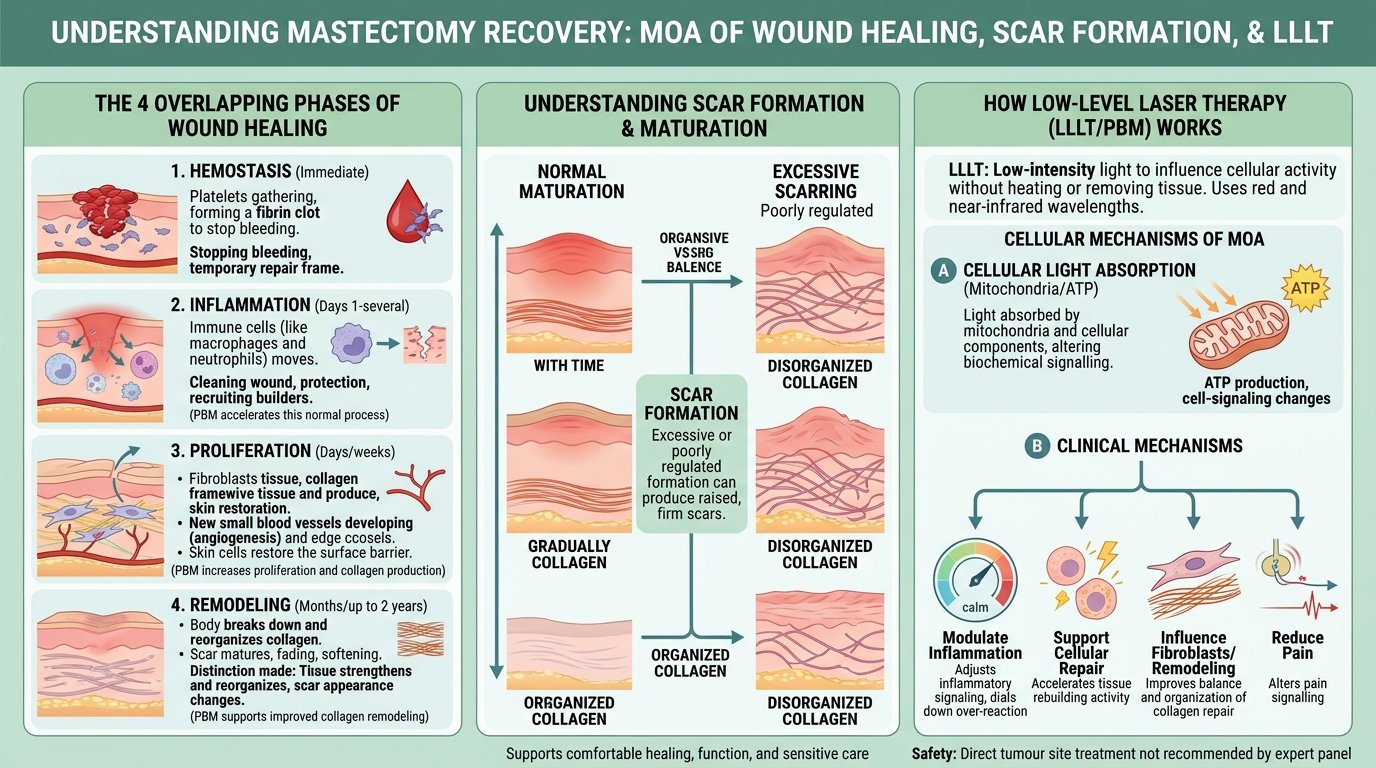
After surgery, the body repairs the wound through four overlapping stages. Although we often describe these separately, cells and tissues move between them rather than following a strict timetable. Closing the skin is only part of the process: the tissue underneath continues to strengthen and reorganize long afterwards.
1. Hemostasis: stopping the bleeding
Healing begins immediately. Blood vessels constrict, platelets gather and a fibrin clot forms, helping stop bleeding and creating a temporary framework for repair. Surgical stitches and other closure materials hold the wound edges together while this biological repair begins.
Following a mastectomy, drains may also be used to remove blood and tissue fluid from the surgical space. They serve a different purpose from wound closure, and the surgical team decides when they can be removed.
2. Inflammation: clearing and organizing the wound
During the first several days, immune cells move into the area to remove damaged tissue and help protect against infection. They also release signals that recruit the cells needed for rebuilding. Some early swelling and tenderness reflect this normal inflammatory response. Photobiomodulation accelerates this process.
Inflammation is not something the body should eliminate altogether: it is an essential part of healing. However, increasing redness, heat, swelling, discharge or pain, particularly with fever or feeling unwell, needs prompt medical assessment rather than being dismissed as normal recovery.
3. Proliferation: building new tissue
Over the following days and weeks, fibroblasts - the cells that build connective tissue, produce collagen and other components of a supporting framework. New small blood vessels develop, and skin cells restore the surface barrier. Photobiomodulation increases proliferation and collagen production.
4. Remodeling: maturing the scar
In the remodeling stage, the body breaks down and reorganizes collagen as the scar matures. This process continues for months and sometimes up to two years. A scar that initially looks red, raised or firm may gradually become flatter, softer and less noticeable. Photobiomodulation supports improved collagen remodeling.
This distinction matters: early wound healing and long-term scar appearance are related, but they are not the same outcome. A treatment that improves wound closure in the first week has not necessarily been shown to improve the final scar a year later.
Why recovery after mastectomy can be more complex
A mastectomy creates a larger area of surgical change than the visible incision suggests. Recovery may also involve lymph-node surgery, reconstruction, and further cancer treatment. Some women develop fluid collections, infection or delayed wound healing; reconstruction can introduce additional concerns, including the health of the skin and the possibility of implant infection.
Scar appearance is therefore only one part of recovery. Comfort, wound integrity, arm function, and timely assessment of complications take priority over cosmetic improvement.
There is also no single “normal-looking” mastectomy scar. Its shape depends on the surgery performed and whether reconstruction was undertaken and other factors.
What is low-level laser therapy?
LLLT uses low-intensity light to influence biological activity without deliberately heating or removing tissue. The broader term, photobiomodulation, includes both suitable low-level lasers and light-emitting diodes, or LEDs. Red and near-infrared wavelengths are commonly used in clinical PBM.
This is different from surgical lasers that cut tissue or ablative cosmetic lasers that create controlled tissue injury.
Researchers investigate PBM because light absorbed by cellular components can alter biochemical signalling involved in inflammation, repair and pain. Its effects depend on the wavelength, dose, treatment timing, tissue condition and delivery method - not simply whether a device produces red light.
How LLLT supports wound and scar healing?
PBM research examines several potentially useful effects:
Modulating inflammatory signalling rather than simply suppressing all inflammation.
Supporting cellular activity involved in tissue repair.
Influencing fibroblasts and connective-tissue remodeling.
Reducing pain in some treatment settings.
For scars, the aim is not merely to “make more collagen”. Collagen is needed for wound strength, but excessive or poorly regulated scar formation can produce a raised, firm scar. A useful treatment must improve the balance and organisation of repair, not just stimulate tissue growth indiscriminately.
What have studies in other surgical areas found?
Thyroid surgery: scar quality and pain
A randomized, double-blind, sham-controlled trial investigated an 830-nm LED device after thyroidectomy. Forty-three patients completed the study. Treatment began one week after surgery and continued for four weeks, with follow-up assessments extending to six months. (Getting light on or around the wound as early as possible is ideal).
At six months, the treatment group had better patient satisfaction, global scar-assessment scores, Vancouver Scar Scale scores and pain scores than the sham group. However, differences in instrument-measured colour, height, pigmentation and vascularity were not statistically significant.
Cardiac surgery: evidence for early incision healing
A randomised, double-blind study involving 120 people undergoing coronary artery bypass surgery examined light treatment of sternotomy incisions - the chest incision used for open-heart surgery. Treatment took place between the second and eighth postoperative days.
At the eighth-day assessment, the light-treatment groups had less redness and less incision bleeding or separation than the comparison groups.
What this means for women after mastectomy
LLLT may be a useful adjunct for wound healing - not that it is an established solution for mastectomy scars.
Note: Graphic wound healing images
https://blog.tracydonegan.org/blog/ultimate-guide-to-red-light-therapy-for-wound-healing
Is LLLT safe after breast cancer?
This question deserves a more careful answer than either “light feeds cancer” or “red light is completely safe”.
PBM is used in supportive cancer care, particularly for certain treatment-related complications. The World Association for Photobiomodulation Therapy’s 2022 position paper describes reassuring human clinical findings, including a breast-cancer-related lymphoedema study that found no difference in recurrence rates between treated patients and controls.
Importantly, its expert panel does not recommend direct treatment over a tumour site.
PBM is not a treatment for breast cancer, and it should not delay investigation of a new lump, changing skin, unexplained swelling or a wound that is not healing.
When could treatment begin - and does the device matter?
There is no universal starting date that can safely be taken from another surgical study. However experts who use PBM outside of clinical trials in real world circumstances agree that this gentle treatment should begin in the first 24 hrs after bleeding has been controlled.
The device and its settings matter.
More light is not necessarily better. PBM has a dose-dependent response, and increasing exposure can reduce benefit or produce unwanted effects.
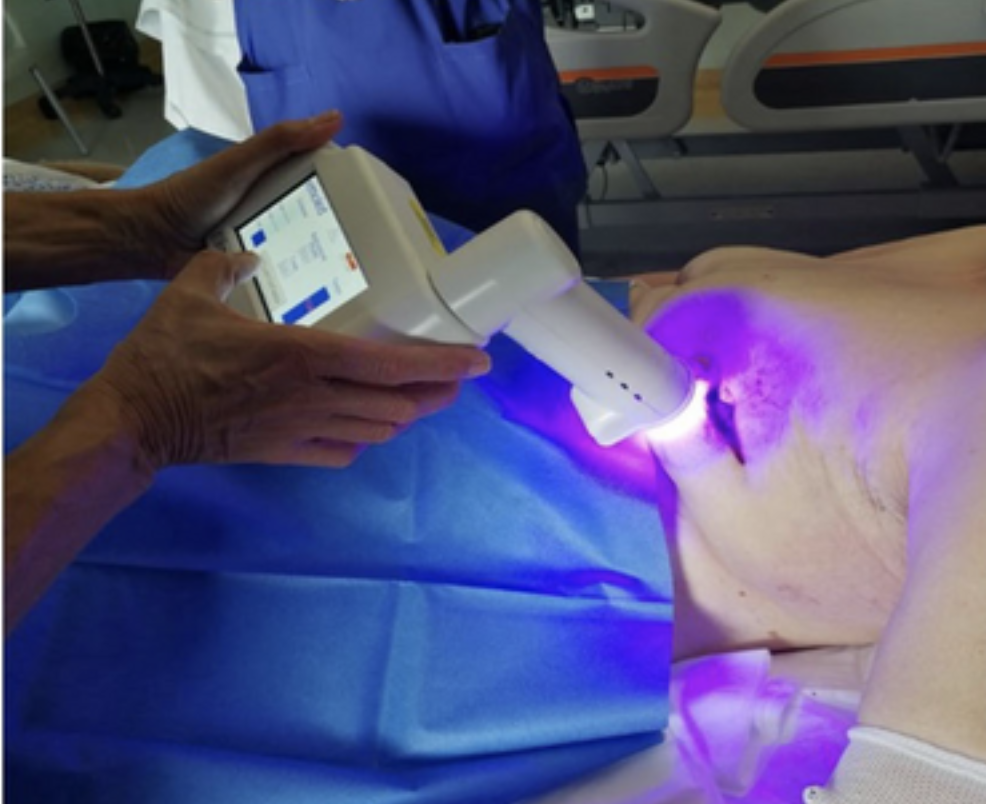
Blue light during surgery.
The use of blue light therapy accelerated and optimized the healing process in complicated postsurgical breast wounds.
What about lymphedema, tightness and radiotherapy-related skin changes?
Breast-cancer-related lymphoedema
PBM has been studied for lymphoedema following breast cancer treatment. Some studies report improvements in symptoms or swelling, but protocols and outcomes vary. WALT’s recommendations in this area are based on a lower level of evidence than its recommendations for oral mucositis, with an important role for clinical judgement.
Women with arm, breast or chest-wall swelling need assessment by an appropriate clinician or lymphoedema service. PBM, where offered, should sit within a broader management plan rather than replace established rehabilitation.
Radiotherapy skin reactions and fibrosis
PBM is also being investigated for radiotherapy-related skin reactions and later tissue fibrosis. These are different conditions from an uncomplicated surgical scar and require different assessment and treatment planning. Evidence is less established than for some other supportive oncology uses.
Recovery also includes vaginal comfort and sexual wellbeing
Vaginal dryness, burning and painful sex may seem unrelated to a chest wound, but they can become a major part of life after breast cancer treatment.
Chemotherapy, ovarian suppression and endocrine treatment can contribute to low-oestrogen symptoms. These may include vaginal dryness, irritation, discomfort with penetration and urinary symptoms, often grouped under the term genitourinary syndrome of menopause, or GSM. These symptoms are consequences of hormonal and tissue changes—not of the mastectomy incision itself.
Women should not have to accept discomfort as the unavoidable price of treatment. In the podcast below I discuss red light therapy and sexual health after cancer treatment (this was a very exciting study).
Start with established non-hormonal options
NICE recommends non-hormonal vaginal moisturizers or lubricants as first-line options for women with a personal history of breast cancer. Moisturisers are generally used regularly for ongoing comfort, while lubricants help reduce friction during sexual activity.
Persistent symptoms deserve a clinical review rather than repeated trial and error with products. Treatment should reflect the woman’s symptoms, preferences and cancer treatment.
Vaginal estrogen is an individual discussion - not an automatic yes or no
When non-hormonal treatments do not provide enough relief, NICE advises considering local vaginal estrogen after discussing the potential benefits and uncertainties. Women taking an aromatase inhibitor should work with their breast cancer specialist to identify suitable options.
Vaginal estrogen is different from systemic HRT, but some absorption into the bloodstream occurs. NICE states that its effect on breast cancer recurrence risk remains uncertain, making personalized decision-making particularly important.
Can LLLT help vaginal dryness?
Low-level red or near-infrared PBM should not be confused with vaginal CO₂ or other heat-based laser procedures. They are different technologies with different mechanisms and evidence.
In my experience working with women experiencing vaginal pain and dryness after cancer treatment pelvic light therapy at home can improve quality of life significantly.
Supporting the whole woman - not only the scar
Alongside wound care, it is reasonable to ask your breast care team about rehabilitation, persistent pain, emotional support and access to menopause or sexual-health expertise. NICE specifically recommends information about management options and referral to a clinician with menopause expertise for people with a history of breast cancer who have menopause-associated symptoms.
Scar care can also be worthwhile without becoming another obligation. Scars often soften and fade naturally over one to two years, so early appearance should not be treated as the final result.
A realistic place for LLLT in recovery
For a woman interested in LLLT, the most useful conversation is specific: What problem are we treating? What evidence supports this approach? Has the oncology team approved the treatment area? What improvement would justify continuing?
The goal is not to erase every sign of surgery. It is to support comfortable healing, restore function where possible and ensure that concerns - from a tight scar to vaginal dryness - receive appropriate sensitive support and information.
If you’d like to learn more about how PBM may be a helpful self-care support for recovery after a mastectomy please feel free to email team@tracydonegan.org
Resources:
Chhabra S, Chhabra N, Kaur A, Gupta N. Wound healing concepts in clinical practice of OMFS. Journal of Maxillofacial and Oral Surgery. 2017;16(4):403–423. doi: 10.1007/s12663-016-0880-z.[pubmed.ncbi.nlm.nih]
Kim YH, Kim HK, Choi JW, Kim YC. Photobiomodulation therapy with an 830-nm light-emitting diode for the prevention of thyroidectomy scars: a randomized, double-blind, sham device-controlled clinical trial. Lasers in Medical Science. 2022;37(9):3583–3590. doi: 10.1007/s10103-022-03637-6.[pubmed.ncbi.nlm.nih]
Lima ACG, Fernandes GA, Araújo RB, Gonzaga IC, Oliveira RA, Nicolau RA. Photobiomodulation (laser and LED) on sternotomy healing in hyperglycemic and normoglycemic patients who underwent coronary bypass surgery with internal mammary artery grafts: a randomized, double-blind study with follow-up. Photomedicine and Laser Surgery. 2017;35(1):24–31. doi: 10.1089/pho.2016.4143.[pubmed.ncbi.nlm.nih]
Photobiomodulation therapy in management of cancer therapy-induced side effects: WALT position paper 2022. Frontiers in Oncology. 2022;12:927685. doi: 10.3389/fonc.2022.927685.[frontiersin]
Pereira SRdS, Mesquita-Ferrari RA, Salviatto LTC, et al. Photobiomodulation in post menopause genitourinary syndrome—Study protocol for a randomized, double-blind, controlled clinical protocol. PLOS ONE. 2024;19(12):e0313324. doi: 10.1371/journal.pone.0313324.[journals.plos]
Pereira SRDS, Lanzafame R, Mesquita-Ferrari RA, et al. Photobiomodulation therapy in the treatment of genitourinary syndrome in postmenopausal women—a placebo-controlled double-blind clinical trial. Climacteric. 2026. PMID: 42060269.[read.qxmd]
Rezende LF, Vilas Boas VF, Lenzi J, Carvalho RL. Evidence for the use of photobiomodulation in sexual dysfunction in women with breast cancer undergoing hormone therapy: literature integrative review. Revista Brasileira de Cancerologia. 2026;72(1):e-015333. doi: 10.32635/2176-9745.RBC.2026v72n1.5333EN.[scielo]
National Institute for Health and Care Excellence. Menopause: identification and management. NICE guideline NG23. Accessed 29 October 2026.[nice.org]
This article provides general education, not an individual treatment protocol. Decisions about PBM after breast cancer should be made with the treating surgical and oncology teams.