The Half of the Fertility Story Almost Nobody Is Telling You
Why your partner's sperm may respond to red light, and what the research actually says.
Let me ask you something.
When a couple sits down to talk about "trying," where does the conversation almost always go first? Her cycle. Her hormones. Her egg quality. Her stress levels. Her supplements.
And listen, I love supporting women. It's my life's work. But here's what I want you to know today, and I want you to really hear me on this: male factors are involved in roughly half of all cases of couple infertility. Half. Yet the man in the story so often gets a single semen analysis, a shrug, and a "just keep trying."
That never sat right with me.
So I went looking. Not for hype, not for a miracle - but for the actual research on whether photobiomodulation (that's the fancy word for therapeutic red and near-infrared light, sometimes called low-level laser therapy or PBM) can support the male side of the fertility equation. And what I found is genuinely fascinating, honestly nuanced, and worth your time.
Grab your tea. Let's talk about it.
What we'll cover
- How red light actually works on sperm
- What the research suggests - and what it doesn't
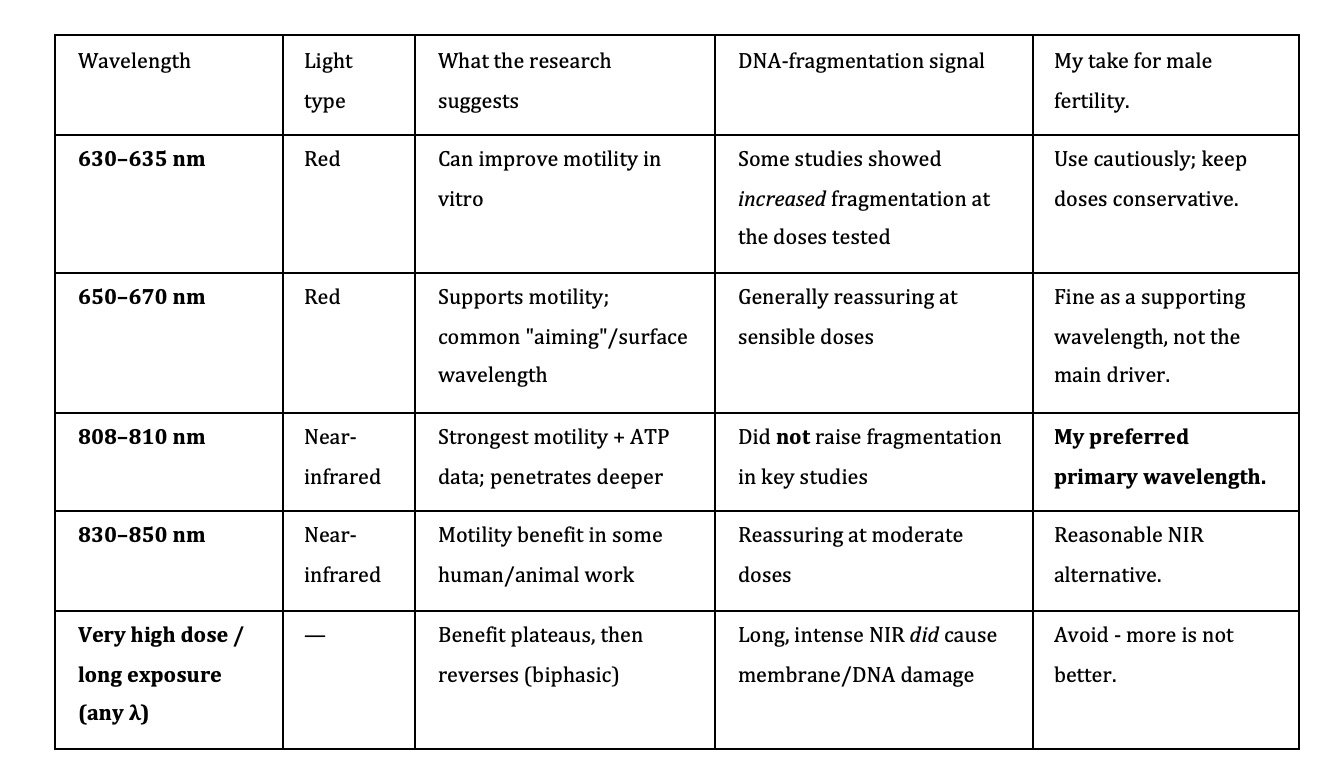
- Wavelengths, dose, and DNA fragmentation
- A caution about high-powered whole-body light
- Where the mechanism is strong (mitochondria, motility, prostatitis)
- How I actually think about the Solasta laser
- Silent infection, the shared microbiome, and probiotics
- Baseline testing and rechecking your progress
- Frequently asked questions
First, let's demystify what's actually happening
Here's the thing about sperm that most people never learn: a sperm cell is basically a tiny, high-performance swimmer, and its whole tail is powered by mitochondria packed into the midpiece - the little "engine room" right behind the head.
Those mitochondria run on a process called oxidative phosphorylation, and the final step of that process depends on an enzyme called cytochrome c oxidase.
Why do you care? Because that exact enzyme happens to absorb red and near-infrared light beautifully. When the right wavelength of light hits it, the engine room revs up - more ATP (cellular fuel), more oxygen use, a better energy balance inside the cell.
And when a sperm cell has more fuel? It swims better.
This isn't a wishful theory. In one 2024 study using 810 nm near-infrared light on low-motility human samples, researchers measured about a 50% increase in ATP production and oxygen consumption, and a 3.5-fold jump in the cell's energy ratio - with no rise in the markers of oxidative damage. That's the mechanism, measured. This is the part of the science that is genuinely solid.
Now - here's where I have to be really transparent.
What the research proves, and what it doesn't (yes, both)
I'm not here to sell you a fairy tale (unlike most device manufacturers). I'm here to give you the truth, clearly, so you can make grounded decisions. So let me draw a line right down the middle of this research, because the distinction really matters.
Category 1: Light applied to sperm in a lab dish (in vitro). This is where the evidence is strongest and most repeated.
Category 2: Light applied to a living man's body (in vivo). This is where the human evidence is still thin.
Keep those two buckets in your mind. Almost every headline you'll ever see blurs them - and that's exactly how people get misled.
What's genuinely well-supported: motility in the lab
If you take a low-motility semen sample and expose it to red or near-infrared light at a sensible dose, progressive motility tends to go up. This has now been shown by many independent research groups, across different wavelengths and devices:
· A dose-response study found the Sperm Motility Index rising up to four-fold with light - and, crucially, backed off (got worse) when the dose was too high.
· In low-motility (asthenozoospermic) samples, 830 nm laser significantly improved progressive motility at every dose tested.
· A 2024 study reported total motility roughly doubling after three minutes of combined red + near-infrared irradiation
And here's the beautiful part: the men who respond most are often the ones with the lowest starting motility. The struggling swimmers have the most to gain.
This is why light is being studied as a tool inside fertility labs to gently "wake up" a sample before it's used.
What's promising but not proven: light on the body
Now, the honest caveat. Only one modern randomized controlled trial has applied light to actual living men and tracked their semen. In that study, 70 men with low sperm counts received laser at acupuncture points; three months later, the treated group had significantly higher sperm concentration and motility than the sham group - but no change in morphology, and no pregnancies were recorded during the follow-up window.
One study. Small. Promising. Not proof.
I want you to hold that lightly and honestly. When I talk about using light on the body, I'm talking about a mechanism with a strong rationale and encouraging early signals - not a guaranteed outcome. There's a real difference, and I'll always name it.
The DNA question - because I know you're wondering
Whenever I talk about this, someone asks: "But could the light damage the DNA?"
I love that question. It's exactly the right one. Because here's the deal - sperm DNA integrity (measured as the DNA fragmentation index, or DFI) matters just as much as how well they swim. Beautiful swimmers with damaged cargo don't get you a healthy pregnancy.
The reassuring news: in the large majority of studies, red and near-infrared light at sensible doses did not increase DNA fragmentation. One team pushed the dose to around 33 times the optimal level and still saw no DNA damage on testing. Another, using precise molecular markers, found no rise in oxidative DNA damage at all. The most recent 810 nm work confirmed DNA fragmentation stayed flat while motility improved.
But - and this is the part cheap marketing conveniently skips - it is not a blank check.
At least one careful study found that certain red (630 nm) and combined red-plus-near-infrared protocols did increase DNA fragmentation and reduce viability at the doses tested, while near-infrared alone (810 nm) did not. And a separate study showed that a long, 15-minute high-intensity near-infrared exposure caused real membrane and DNA damage.
So here is my honest takeaway, and it's the whole philosophy behind how I work:
Wavelength matters. Dose matters. Duration matters. More is not better - right is better.
This is precisely why I built my protocols around the 808 nm near-infrared wavelength, why I favor short, measured sessions, and why my mantra is always start low, go slow. The science doesn't say "blast it with light." It says "give the mitochondria a precise, gentle nudge." Those are very different things.
Wavelengths at a glance: what helps, and what to watch
A gentle word of caution about high-powered, whole-body light
Because I know some of you are already using, or eyeing those big, high-output, full-body light panels or canopy-style professional devices, let me say this plainly.
For male fertility, I'd be cautious about relying on a very high-powered, whole-body device - the kind of large panel or canopy so many people now stand in front of - for the reproductive area. To be fair, when you're standing at a distance, a lot of that light simply reflects off the skin and never reaches the tissue, so it's not as if every watt lands where you want it. But that cuts both ways: you can't easily fine-tune or target the dose. You're bathing a large area (including the heat-sensitive testicles) in whatever the device delivers, with little ability to dial it in. Remember that biphasic curve - the right dose helps, but too much energy can flatten the benefit or even work against you, and can add heat where you least want it.
This isn't about brand - it's about control. The whole philosophy here is a precise, low, targeted dose to a specific spot, with the ability to dial it in and keep the tissue cool. A device you can't easily adjust makes that hard. So if you love your whole-body panel for skin, recovery, or mood — wonderful, keep enjoying it. Just don't assume "more light over more of the body" is the right tool for the delicate, dose-sensitive job of supporting sperm. For this, precise and gentle beats big and powerful.
Where the mechanism is strong even when the human trials are still catching up
Now I want to open a door for you - carefully, with full transparency.
There are several areas where the biology makes total sense, and where animal studies (light applied to living animals) show real benefit, even though we don't yet have the human trials to say "proven." I include these not to overpromise, but because I believe you deserve to see the full landscape and decide for yourself - with your eyes open.
Protecting sperm from oxidative and heat stress. In living mice, near-infrared light protected the testes and improved sperm parameters after heat stress, after chemotherapy-type injury, and after blood-flow injury - turning down the "cell-death" genes and turning up the "survival" and antioxidant pathways. The mechanism - reducing oxidative stress - is exactly what we'd want for men living with modern heat, inflammation, and environmental load. Human proof? Not yet. Mechanism? Solid.
Supporting the sperm-making process itself (spermatogenesis). Because light works upstream on the cells that make sperm, animal models show recovery of sperm production after damage. This is a roughly 74-day process in men, which is why any real body-level effect takes patience and months, not days.
Prostatitis and the inflammation connection. Chronic prostatitis and pelvic inflammation quietly undermine male fertility, and there's a large (mostly older, mostly Eastern European) body of clinical work - including one properly randomized trial with objective blood-flow measurements - reporting that laser therapy improved symptoms, microcirculation, and semen parameters. The proposed mechanism - better circulation, calmer inflammation, less oxidative stress - is entirely consistent with how light behaves in every other tissue. But we still lack a modern, rigorous, sham-controlled trial, and I want that on the record. (I’ve had surprising success with testicular pain and prostatitis using my laser and protocol).
Testicular blood flow and hormonal support. In animal studies, light to the testes has nudged testosterone and Leydig-cell function (research summarized here). Human data: not there yet. Rationale: reasonable.
See what I did there? I told you the exciting part and I told you exactly where the guardrail is. That's how I work.
Give sperm an energy boost - motility increases seen within 30 minutes of laser therapy.
Order your Solasta laser and male factor protocol here.
So here's how I actually think about the Solasta
The Solasta laser is a dual-wavelength device - red at 650 nm and, the star of the male-fertility show, near-infrared at 808 nm - with adjustable power so we can honor that "precise gentle nudge" principle instead of overdoing it.
I don't position it as a fertility cure. I never will. I position it as a mitochondrial-support and preconception-optimization tool - one thoughtful, evidence-informed piece of a bigger picture that includes a real workup, nutrition, sleep, lifestyle, and proper medical care.
Here's what I love about it as part of a couple's journey:
· It targets the most-supported outcome (motility) through the best-documented, DNA-safest wavelength (808 nm near-infrared).
· It's non-invasive, painless, and done at home in short sessions - which means partners are finally an active participant, not a bystander with a lab slip.
· It brings partners into the process together. There is something quietly powerful about a couple doing this side by side.
· It's grounded in a mechanism we can actually explain - not magic, just mitochondria.
The piece almost everyone misses: silent infection and the shared microbiome
This is a part I see overlooked again and again - and it can quietly undo all the good work.
Here's the thing: sometimes the reason a couple isn't conceiving isn't sperm energy at all. It's a low-grade, silent infection or inflammation in the reproductive tract — the kind with no obvious symptoms. In fact, urogenital infections are involved in an estimated 6-10% of male fertility problems, and most of the affected men have no symptoms at all. No pain, no discharge, nothing - and yet inflammation and the reactive oxygen species that come with it can quietly damage sperm.
And here's the part that really matters for couples: the reproductive microbiome is shared. Certain bacteria (and I'm not talking about classic STIs here - I mean everyday pathogens and imbalances) can pass back and forth between partners. So you can each get "treated," feel fine, and then simply re-seed each other - a frustrating ping-pong that keeps the imbalance alive. This is exactly why the newer thinking treats the couple as one ecosystem, and why male-partner treatment is increasingly used to stop that cycle of recurrence (ScreenMe on partner treatment and recurrence). Both need to be treated together (yet everyone is still stuck on the basic male factor issues such as motility etc.
So please hear me: light therapy is not a substitute for treating an infection. If there's a genuine bacterial issue, it needs to be addressed properly - sometimes with antibiotics - alongside the light work, ideally guiding both partners at the same time. Light supports the tissue and calms inflammation; it does not replace clearing a pathogen. The two work best hand in hand.
First things first: measure, then recheck
Before you change anything, I really want you to have a starting point. A baseline semen analysis gives us the numbers to work from - count, motility, morphology - so that three months later we can actually see whether what you're doing is helping, rather than just hoping. You don't necessarily need a clinic appointment to begin; convenient mail-in, at-home semen analysis kits now measure the parameters that matter - including motility and even DNA fragmentation - and validation studies show they line up well with in-clinic testing (mail-in sperm DNA fragmentation validation). Use my discount code TRACYDONEGAN and get 10% off. A recognised option is Legacy, and there are others; use whichever service you and your practitioner trust. My rule of thumb: test, give it a full sperm cycle of about three months (that's roughly how long it takes to make a fresh batch of sperm), then re-test. That single before-and-after comparison tells you more than any anecdote ever could.
A note on how thorough the workup can be
If your numbers are struggling and the cause isn't obvious, it's worth knowing that a proper andrology workup can go much deeper than a single semen test. In Italy, for instance, leading andrology centres routinely use scrotal and prostate (transrectal) ultrasound to look at the testes, blood flow, and the prostate/seminal vesicles, and in select cases testicular fine-needle aspiration to actually assess sperm production (testicular FNA in male infertility, University of Padova group). They've also pioneered treating viral seminal infections: the Padova group showed that the HPV vaccine given to infected men speeds clearance of HPV from semen and improves natural pregnancy and live-birth rates. I mention all of this not to alarm you, but so you know how much more there is to explore if the simple steps aren't enough.
How to actually see what's going on
The trouble with a standard swab or culture is that it only looks for a short list of usual suspects and can easily miss what's really there. This is where modern microbiome testing changes the game. Companies like ScreenMe use next-generation sequencing to read every bacterial and yeast species present in a seminal (and uterine) sample - not just a preset panel, so you finally get the full picture of the shared reproductive ecosystem for both partners (ScreenMe on the semen microbiome). If you've had recurrent infections, unexplained fertility struggles, or your partner keeps getting knocked back into imbalance, testing both of you is one of the smartest, most clarifying steps you can take.
Rebuilding a healthy terrain: probiotics with real evidence
Once any infection is properly handled, the next move is to rebuild - and this is where the research on probiotics for male fertility genuinely excites me. This isn't wishful thinking; several human trials show specific strains improving semen quality, largely by lowering oxidative stress:
· Lactobacillus rhamnosus CECT8361 + Bifidobacterium longum CECT7347 - improved sperm motility and reduced DNA fragmentation, with a roughly six-fold rise in motile sperm that held for weeks after (Valcarce et al., 2017).
· Lactobacillus paracasei B21060 (with prebiotics) - improved volume, concentration, motility, and normal morphology over a longer course (Maretti & Cavallini, 2017).
· Multi-strain blends (L. casei, L. rhamnosus, L. bulgaricus, L. acidophilus, B. breve, B. longum, S. thermophilus) — improved concentration, motility, and morphology while lowering DNA fragmentation and inflammatory markers (Abbasi et al., 2021; Helli et al., 2022, via this review).
In fact, a 2026 randomized trial found probiotics outperformed antioxidants for improving semen parameters in men with poor sperm quality (Iranian Journal of Medical Sciences, 2026). That's an impressive result - and a reminder that the terrain matters as much as the target.
To keep it simple - because I know you don't want to memorise strain codes - look for a multi-strain Lactobacillus + Bifidobacterium probiotic made specifically for male fertility. A couple of easy, evidence-aligned options that ship in the US:
· FH PRO Probiotic for Men (Fairhaven Health, a US company) — a multi-strain Lactobacillus/Bifidobacterium blend formulated for sperm health.
· Bird&Be Sperm Health / Men's kits (US-based, free US shipping over $35) — a well-regarded fertility line for men.
If you'd rather have the UK product I mentioned before, Zita West Menceivedoes ship to the US (Zita West US shipping), though it's a lighter 2-strain formula, so a fuller US multi-strain option is usually the more practical choice. Honestly, any good-quality multi-strain Lactobacillus/Bifidobacterium probiotic you can get consistently is reasonable - consistency matters more than the label.
Whatever you choose, give it a full sperm cycle of about three months to work, and - this is key - pair it with the before-and-after testing above so you're rebuilding the right ecosystem, not guessing. As always, loop in your practitioner, especially if antibiotics are in the picture. (I have no affiliation with any probiotic brand mentioned - I'm simply pointing you toward products that match the research.)
FAQ - Red Light Therapy and Male Fertility
Does red light therapy improve sperm quality?
The most consistent evidence is for sperm motility (how well sperm swim). When red or near-infrared light is applied to sperm in the lab, cells make more energy (ATP) and swim better (Amaroli/Stigliani et al., 2024, Scientific Reports; Gabel et al., 2018, Laser Therapy). Effects on sperm count and morphology are far less proven, and no clinical trial has yet shown improved pregnancy or live-birth rates in humans. Think supportive and mechanism-backed, not a guaranteed fix.
Is red light therapy safe for the testicles?
The testes are heat- and light-sensitive, so dose and heat are everything. Low, precise, well-targeted doses appear safe and are the whole point of a proper protocol. The concern is excess - high-powered or prolonged exposure can add heat and, because the light dose-response is biphasic, too much can cancel the benefit. This is exactly why I prefer a controllable, low-power device over a big whole-body panel for this job.
What wavelength is best for sperm?
The therapeutic "optical window" is roughly 630–670 nm (red) and 810–850 nm (near-infrared). For male fertility I lean on 808–810 nm near-infrared, because it penetrates deeper and, importantly, the data suggest it does not raise sperm DNA fragmentation the way some pure-red wavelengths can.
How long before I'd see a difference in a semen analysis?
Sperm take about 72 - 90 days to fully develop, so give any intervention - light, probiotics, lifestyle, a full 3-month cycle, then re-test. A baseline semen analysis followed by a recheck at three months is the honest way to know whether it's working (see the testing section above).
Can red light therapy raise testosterone?
Some early studies suggest light on the testes may support Leydig-cell function and testosterone, but the human evidence is thin and preliminary. I'd treat any testosterone benefit as a possible bonus, not the reason to do this.
Is this a replacement for seeing a doctor or for IVF?
No. Photobiomodulation is a supportive, preconception tool - not a treatment for infertility and not a substitute for proper medical evaluation. If there's an underlying issue (infection, a varicocele, a hormonal problem, very low counts), that needs medical care. Light works best alongside good clinical guidance. Start with a restorative reproductive approach - IVF clinics tend to do the bare minimum testing when it comes to male investigations.
Can we do this at home?
Yes - with the right device and a clear, conservative protocol, this is very doable at home, which is part of what makes it appealing: the male partner becomes an active participant. Just start low, go slow, keep the tissue cool, and check in with your practitioner. Most of the women who are using my fertility protocols with the Solasta also use it for their partnerLet me leave you with this
If you've been carrying the whole fertility journey on your own shoulders, tracking, testing, supplementing, hoping - I want to gently hand a little of that weight back to the other half of the equation. The male side is not an afterthought. It's half the story. And it may be far more responsive than anyone told you.
The research on photobiomodulation for male fertility is early, honest, and genuinely promising in the places that matter most. Some of it is proven in the lab. Some of it is strongly supported by mechanism and animal work while we wait for the human trials to catch up. And I'll always tell you which is which.
If you're wondering whether a light-based, mitochondria-supporting approach might fit into your preconception plan, that's exactly the conversation I'm here for.
Keep an open mind. Ask good questions. And know that you don't have to do this alone.
With you in it,
Tracy
Published by Tracy Donegan. Last reviewed: July 2026. This article reflects current published research and will be updated as new evidence emerges.
About the author
Tracy Donegan is a midwife specialising in reproductive medicine, fertility optimization, and photobiomodulation (low-level laser and light therapy). She develops evidence-based, personalised protocols for fertility and gynaecological health, with a particular focus on translating emerging light-therapy research into safe, practical guidance for couples. Every clinical claim in her writing is drawn from primary research and clearly labeled by strength of evidence.
Note: This article is for education, not medical advice, and it does not diagnose or treat any condition. Photobiomodulation for male fertility is an emerging area - much of the strongest evidence comes from laboratory (in vitro) and animal studies, with limited human clinical trial data to date, and no photobiomodulation therapy is an approved treatment for infertility. Light therapy does not treat infection: any suspected reproductive-tract infection should be evaluated and treated by a clinician (sometimes with antibiotics), and testing/treating both partners may be needed to prevent recurrence. The testes are heat and light sensitive tissue; wavelength, dose, and duration all matter, and the wrong parameters can do harm - I'd be especially cautious with high-powered whole-body devices you can't precisely dose. Always work with a qualified healthcare provider before beginning any new protocol, especially while trying to conceive.
Sources referenced in this article
· Eghbaldoost et al., 2023 — Therapeutic Effects of Low-Level Laser on Male Infertility: A Systematic Review — https://pmc.ncbi.nlm.nih.gov/articles/PMC10658110/
· Amaroli / Stigliani et al., 2024 — 810 nm near-infrared PBM for human asthenozoospermia, Scientific Reports — https://pmc.ncbi.nlm.nih.gov/articles/PMC11538380/
· Gabel, Carroll & Harrison, 2018 — Dose-dependent sperm motility with LLLT/LED, Laser Therapy — https://pmc.ncbi.nlm.nih.gov/articles/PMC6062680/
· Salman Yazdi et al., 2014 — 830 nm laser and asthenozoospermia, Lasers Med Sci — http://link.springer.com/10.1007/s10103-013-1276-7
· Ahmed et al., 2024 — Red + NIR laser and human sperm motility, Photochem Photobiol Sci — https://link.springer.com/10.1007/s43630-023-00525-y
· Firestone et al., 2012 — 905 nm laser and sperm motility, J Androl — https://onlinelibrary.wiley.com/doi/10.2164/jandrol.111.013458
· Allameh et al., 2021 — Laser acupuncture RCT in oligospermic men, J Lasers Med Sci — https://pmc.ncbi.nlm.nih.gov/articles/PMC8837838/
· Preece et al., 2017 — Red light improves motility without oxidative DNA damage, Scientific Reports — https://pmc.ncbi.nlm.nih.gov/articles/PMC5397839/
· Safian et al., 2020 — Wavelength-dependent effects on motility, viability & DNA fragmentation — https://pubmed.ncbi.nlm.nih.gov/32301671/
· Highland et al., 2018 — Near-infrared exposure and sperm DNA/membrane damage, J Photochem Photobiol B — https://pubmed.ncbi.nlm.nih.gov/29704859/
· Torabi et al., 2025 — PBM in mouse testicular torsion model, J Lasers Med Sci — https://pmc.ncbi.nlm.nih.gov/articles/PMC12958262/
· Aghajanpour et al., 2024 — PBM and scrotal hyperthermia in mice, J Lasers Med Sci — https://pmc.ncbi.nlm.nih.gov/articles/PMC11499963/
· Tajalli et al., 2026 — 808 nm LLLT and spermatogenesis in azoospermic mice, BioImpacts — https://pmc.ncbi.nlm.nih.gov/articles/PMC13056888/
· Kulishova et al., 2018 — Magnetolaser + red light RCT for chronic prostatitis, Urologiia — https://pubmed.ncbi.nlm.nih.gov/30742386/
· Apolikhin & Moskvin, 2018 — LLLT for male infertility (review of Russian literature), BioMedicine — https://pmc.ncbi.nlm.nih.gov/articles/PMC5992952/
· Hassanzadeh et al., 2022 — PBM in sperm motility: preclinical & clinical narrative review, J Lasers Med Sci — https://pmc.ncbi.nlm.nih.gov/articles/PMC10082901/
· Schuppe et al., 2017 — Urogenital Infection as a Risk Factor for Male Infertility (most affected men asymptomatic), Deutsches Ärzteblatt International — https://pmc.ncbi.nlm.nih.gov/articles/PMC5470348/
· de Lima Oliveira et al., review — Probiotics supplementation in the treatment of male infertility (strain-by-strain effects), JBRA Assisted Reproduction — https://pmc.ncbi.nlm.nih.gov/articles/PMC11152433/
· Iranian Journal of Medical Sciences, 2026 — Probiotics outperform antioxidants for semen parameters (RCT) — https://pmc.ncbi.nlm.nih.gov/articles/PMC12858446/
· ScreenMe — Seminal & vaginal microbiome testing (NGS), semen microbiome and partner-treatment resources — https://screenme.co.uk/ ; https://screenme.co.uk/what-is-the-semen-microbiome-why-does-it-matter/ ; https://screenme.co.uk/male-partner-treatment-to-prevent-recurrence-of-bv/
· RedLightTherapy.expert / Alzheimer's Drug Discovery Foundation — biphasic dose-response & overuse of PBM — https://redlighttherapy.expert/protocols/overuse/ ; https://www.alzdiscovery.org/uploads/cognitive_vitality_media/Photobiomodulation_(non-pharmacologic).pdf
· Testicular fine-needle aspiration biopsy in male infertility (diagnostic role) — https://pubmed.ncbi.nlm.nih.gov/9390128/
· Garolla et al., 2018 — HPV prophylactic vaccination improves reproductive outcome in men with HPV semen infection — https://pubmed.ncbi.nlm.nih.gov/29343824/
· Foresta group, 2015 — HPV prophylactic vaccination improves clearance of semen infection, EBioMedicine — https://pmc.ncbi.nlm.nih.gov/articles/PMC4634690/
· Impact of Herpes Simplex Virus on Semen Parameters (review; HSV managed with antivirals, no licensed HSV vaccine), Int J Fertil Steril, 2023 — https://pmc.ncbi.nlm.nih.gov/articles/PMC10189155/
· Legacy — validation of mail-in, at-home semen & sperm DNA fragmentation analysis — https://www.givelegacy.com/resources/new-research-from-legacy-validates-at-home-mail-in-sperm-dna-fragmentation-testing/ ; https://www.givelegacy.com/sperm-testing-kit
· FH PRO Probiotic for Men (Fairhaven Health, US) — multi-strain probiotic for sperm health — https://us.fullscript.com/catalog/products/fh-probiotic-male-fertility-supplement/U3ByZWU6OlZhcmlhbnQtMTExNDkw
· Bird&Be (US) — male fertility supplement line — https://birdandbe.com/products/male-fertility-optimization-kit
· Zita West Menceive (UK; ships to US) — 2-strain probiotic for sperm health — https://www.zitawest.com/products/menceive-friendly-bacteria-supplement-for-sperm-health