If you’re living with Hashimoto’s, you may have come across claims that light therapy can help the thyroid heal.
It’s understandable to want to know whether those claims are supported by something you can actually see - not just a theory or a promising headline or TikTok.
One small clinical study offers an interesting look. Researchers used ultrasound to examine thyroid blood-flow patterns before and after low-level laser therapy. They published images showing changes in some participants, alongside an example where the abnormal pattern remained
What the researchers studied
In 2012, Höfling and colleagues published a randomized, placebo-controlled study involving 43 adults with hypothyroidism caused by chronic autoimmune thyroiditis
Twenty-three participants received near-infrared laser therapy, and 20 received a placebo treatment. Both groups attended 10 sessions over five weeks. Their thyroid medication doses remained unchanged during the ultrasound assessment period.
Researchers did ultrasound scans on each participant’s thyroid before treatment and again 30 days after the final session. The person performing the ultrasound examinations did not know which treatment participants had received, helping reduce the chance that expectations would influence the assessment.
The researchers were specifically studying blood-flow patterns - not whether the thyroid had grown back or whether participants could stop medication.
What the results mean
At follow-up, 16 of the 46 thyroid lobes in the laser group had normal blood-flow patterns, compared with 5 of the 40 lobes in the placebo (non laser) group. The difference was statistically significant. (These numbers refer to thyroid lobes, not individual people.
Researchers also found a higher peak blood-flow speed in the inferior thyroid arteries in the laser group than in the placebo group. (But the researchers aren’t sure of the meaning of that finding.
“The researchers suggested that changes in immune or inflammatory signaling might help explain the findings. ”
How to understand the images
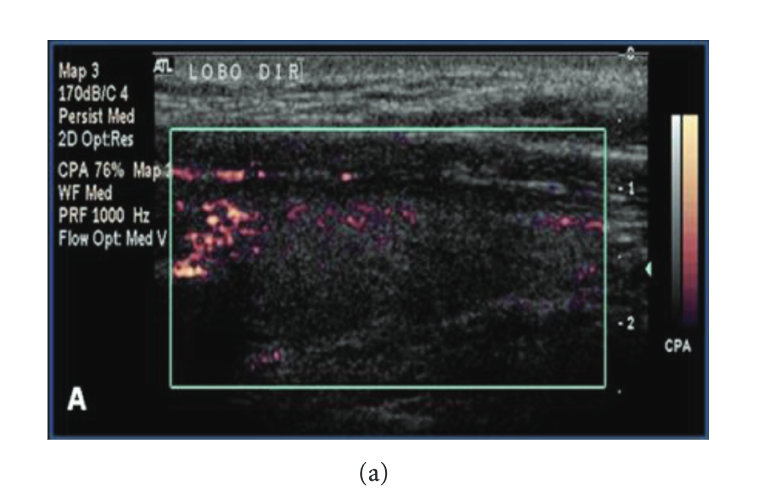
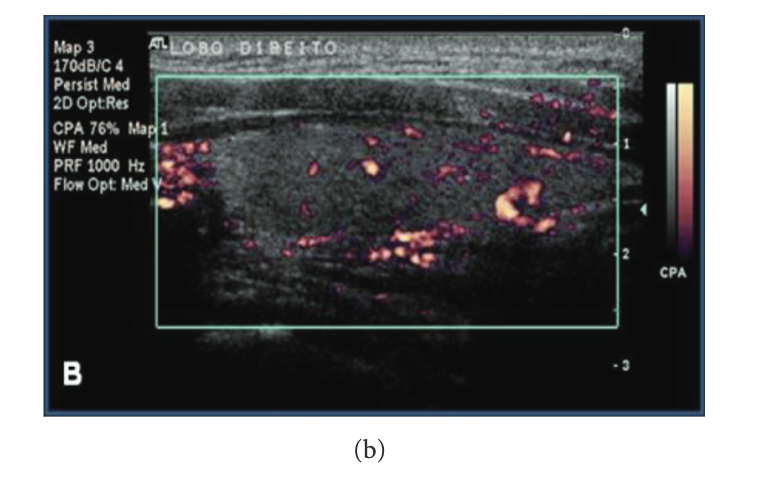
Below are Doppler ultrasound images from the study. The colored areas represent detected blood-flow signals.
The researchers classified thyroid blood-flow patterns into four categories, ranging from reduced activity to markedly increased activity. Their normal category sat between those extremes.
That distinction matters.
You’ve probably read that red light therapy/photobiomodulation improves blood circulation - 100% true. But a thyroid with unusually high blood-flow activity does not necessarily need more circulation. So we can see that the light ‘modulates’ the blood flow. Just like in a recent blood pressure experiment on pregnant women with hypertension. The women with normal blood pressure saw their bp stay normal even with the laser. However women with high blood pressure received significant benefits in a reduction in their blood pressure. In this study, a shift toward a normal pattern could mean less visible activity for one person and more for another.
These ultrasounds were taken 30 days after the study ended.
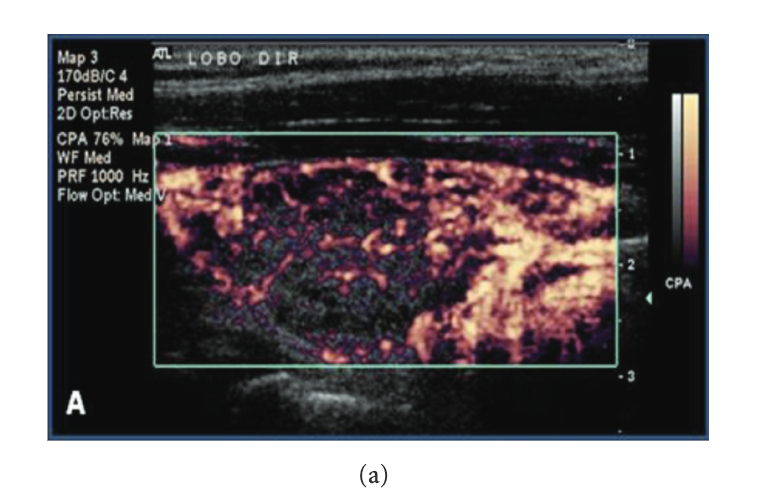
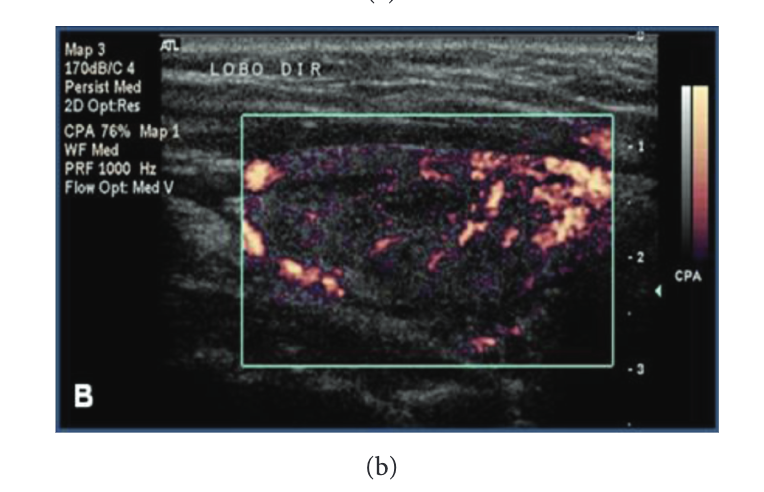
Figure 4: The participant’s above thyroid changed from an increased blood-flow pattern before treatment to a normal pattern afterward.
Doppler ultrasound from one laser-treated participant. Panel (a) shows increased thyroid blood-flow activity before treatment; panel (b) shows a normal pattern 30 days after the treatment course. Source: Höfling et al., 2012,
Figure 5: Below you’ll see the before and after ultrasounds of another participant who began with reduced blood-flow in the thryoid and showed a normal pattern after treatment. In this participant, reduced thyroid blood-flow activity before treatment changed to a normal pattern afterward. The finding illustrates the point of why “more blood flow” and “less blood flow” cannot automatically be labeled good or bad.
The Million Dollar Question - did participants need less thyroid medication?
The ultrasound images tell us about blood-flow patterns. But there’s another question that matters to people living with Hashimoto’s: did participants need less thyroid medication afterward?
During the short-term ultrasound study, everyone stayed on the same levothyroxine dose. That helps separate the blood-flow findings from changes caused by adjusting medication.
In a later clinical trial, researchers assessed how much medication participants needed through a supervised withdrawal and reassessment process. The laser-treated group initially required substantially less levothyroxine. However, the six-year follow-up showed that this early reduction did not fully last.
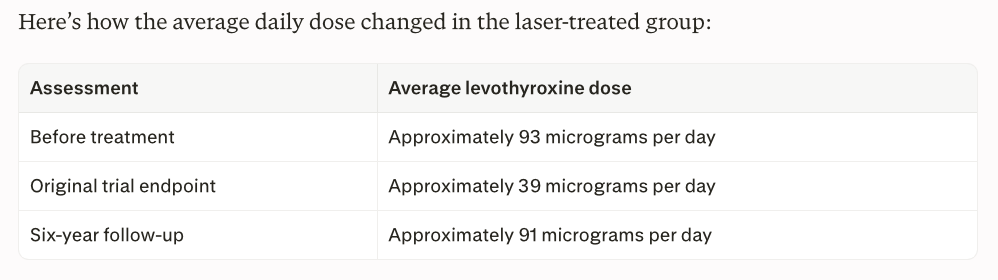
Average levothyroxine dose in the laser group (compared to 149 micrograms for the non laser participants).
(These figures describe group averages in the paired analysis - not an expected result for every patient).
By six years, the laser-treated group’s average dose had returned close to where it started. Still, the comparison group’s average dose had risen from approximately 89 to 142 micrograms per day. That means the laser-treated group continued to need less medication than the comparison group, even though its own early improvement had largely faded (I would suggest a maintenance laser treatment at home once a week).
The non-laser folks continued to need more and more thyroid medication suggesting a longer-term of the laser benefit compared with the other group.
For someone living with Hashimoto’s, these findings offer a reason to stay open to photobiomodulation as an adjunctive tool to support your health especially if you’re TTC.
Tracy
Resources:
https://onlinelibrary.wiley.com/doi/epdf/10.5402/2012/126720