Updated July 2026
Have you ever felt like a stranger in your own body? You take your thyroid medication every morning like clockwork, your doctor insists your "labs are normal," yet you wake up feeling like you’ve run a marathon in your sleep. For millions of women (and some men), Hashimoto’s isn’t just a diagnosis; it’s a thief. It steals your energy, clouds your mind with brain fog, and leaves you frustrated as you watch the scale climb despite your best efforts. And that’s WITH appropriate medication…so you might be asking yourself if this is how life is going to look for the forseeable future. No - it doesn’t have to. Light therapy is making a difference in women’s lives but few women have heard about it.
To understand why light on the neck might change how you feel (and even your waistline), it helps to remember what’s going wrong in Hashimoto’s. This is an autoimmune process: your immune system gradually damages thyroid tissue, antibodies like anti‑TPO and anti‑TG rise, and over time your gland struggles to produce enough T4 and T3. Standard care focuses on replacing hormone with levothyroxine, which is essential - but it doesn’t directly repair tissue, calm immune mis‑firing, or address the fatigue, weight resistance, and brain fog so many women still report even with “normal” TSH.
Thyroid problems are common in women, and roughly a third of women with autoimmune thyroid disease in recent U.S. data hadn’t been diagnosed yet - millions of women walking around with thyroid autoimmunity they don’t know about. If you’re trying to conceive or getting ready to try - get your thyroid labs checked.
How do you know your thyroid is ‘off?’: Some of the most common flags would be - fatigue and sluggish energy, hair loss or thinning, weight gain or resistance to weight loss, dry skin, constipation, feeling cold, brain fog, mood changes, heavy or irregular periods.
If you feel like you’re doing everything right but still feel "stuck," a new 2026 study published in Lasers in Medical Science has identified a missing piece of the puzzle. It’s not a new pill or a restrictive diet - it’s light. And aside from improvements in quality of life, women with Hashimoto’s are starting to see something most of them have never been offered: measurable changes in their waistlines from targeted light on the neck, not more time at the gym. This is one of several similar low level laser studies showing red light therapy can impact thryoid health significantly.
The Science of the "Stuck" Metabolism
Hashimoto’s Thyroiditis is an autoimmune disorder where your immune system mistakenly attacks your thyroid gland. It affects women at nearly ten times the rate of men, most frequently surfacing between the ages of 30 and 50. This often coincides with major hormonal shifts - like postpartum or perimenopause - where fluctuations in estrogen can trigger immune sensitivity.
The problem with standard treatment (Levothyroxine) is that while it replaces missing hormones, it doesn’t always address the chronic cellular inflammation or the mitochondrial "slump" that keeps you feeling exhausted. This is why "side effects" of the disease - like hair loss, brittle nails, and skin swelling, often persist even with meds. And if there’s one thing red light therapy can do really really well is to modulate the immune response and get it back to a healthy baseline.
The Discovery: 6 Minutes to a Better Baseline
In this recent clinical trial, researchers applied Photobiomodulation (PBM) - the medical term for specific red and near-infrared light therapy - directly to the thyroid glands of women who were still feeling awful despite taking their meds.
The protocol was shockingly simple:
Total Time: 3 minutes per session.
Frequency: Twice a week for only 3 weeks.
Total Investment: 6 sessions (less than 20 minutes of total therapy).
An Unexpected Finding - Weight Loss without More Effort
While researchers expected to see energy improvements, the physical data at the 3-month follow-up was a revelation for women struggling with their BMI. The most surprising finding? The active light therapy group saw these results without adding grueling workouts or 6 months of dieting:
Significant BMI & Weight Reduction: The group receiving active light therapy saw a measurable drop in weight and BMI. In a startling contrast, the control group (who didn't receive the real light) actually gained weight during the same three-month period.
The "Inch" Loss: There were significant decreases in waist, hip, and neck circumference.
Mental Health & Sleep: Anxiety and depression scores plummeted, and sleep quality improved dramatically.
Why it works: The light energy hits the mitochondria in your thyroid cells, boosting ATP (cellular energy) and lowering the pro-inflammatory cytokines that cause "puffy" weight gain and muscle aches.
In several clinical trials where thyroid photobiomodulation (PBM) was added to standard care, the PBM groups didn’t just report less fatigue and brain fog, they actually lost weight, lowered their BMI, and trimmed waist and hip measurements, while comparison groups on the same levothyroxine and supplements typically saw little change and for some - weight GAIN. What’s even more surprising is the time investment: protocols ranged from just 6 short sessions over 3 weeks to a few weeks of brief thyroid-focused treatments followed by routine follow‑up, yet over 3 - 6 months these women showed better thyroid labs, lower antibody levels, and leaner, less inflamed bodies, all without adding punishing workouts to an already exhausted system.
Hashimoto’s and Fertility
If you are navigating fertility treatments (IVF or IUI), Hashimoto’s is a common hidden hurdle. High thyroid antibodies are often linked to implantation failure. By reducing the autoimmune "fire" in the gland, red light therapy helps create a "calmer" environment, which is often a crucial step in a successful fertility plan. Make sure your provider does a FULL thyroid panel. A full thyroid workup often includes TSH, free T4, free T3, and antibodies. Hashimoto’s is an autoimmune issue first and a hormone problem second. Photobiomodulation is aimed at a tissue + immune level, not just trying to fix hormones.
Research on Light Therapy and Thyroid Functioning
RCTs showing reduced LT4 needs and antibody changes (2010 pilot + 2018 follow‑up)
RCTs showing improved oxidative stress and quality of life with 3‑week PBM.
RCT + abstract showing BMI, waist, hip and LT4 dose improvements in 6‑month PBM + supplements vs supplements alone.
3‑week LT4+PBM trial on fatigue, sleep, mood, pain, and small but significant drops in weight/BMI and waist/hip vs sham.
Taken together, these are small but consistent human trials pointing in the same direction: when red light therapy is dosed correctly and layered on top of good care, people move toward better thyroid function, lower medication needs, and a less inflamed, less ‘puffy’ body.
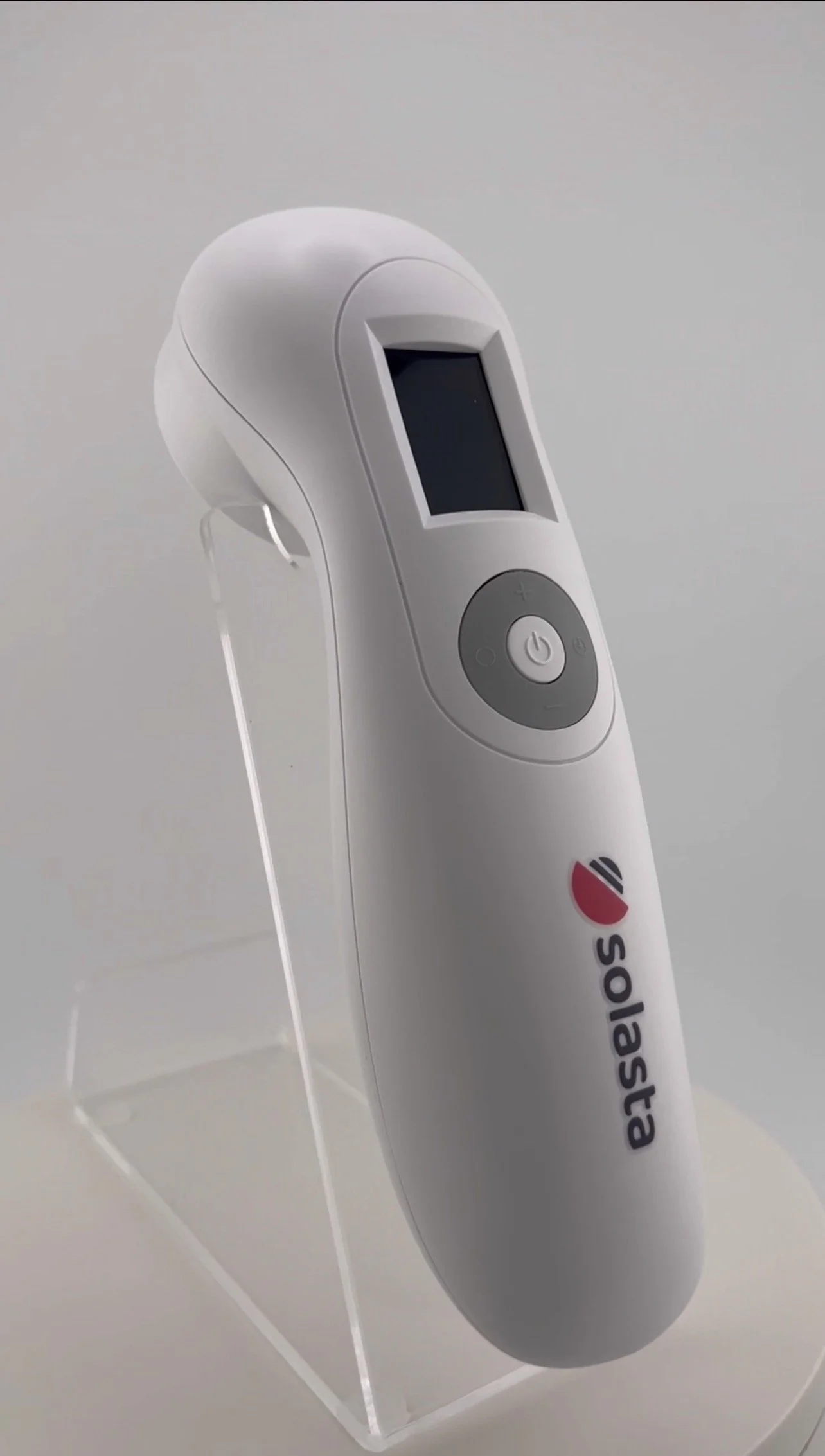
Supporting Your Journey with Solasta Home Laser
To replicate these clinical results at home, you need a device that delivers the right "therapeutic window." This is where the Solasta Laser fits into your wellness toolkit:
The Precision Wavelength: While the study used 850nm, the Solasta’s 808nm Near-Infrared (NIR) laser operates within the same essential "optical window" required to penetrate deep into the thyroid tissue. All of the studies used laser - not LEDs.
Contact Delivery: Most panels lose energy through distance. The Solasta is a handheld, contact-delivery home laser device. This ensures the photons actually reach the gland rather than reflecting off the skin.
The Protocol: Provided with purchase based on your health history.
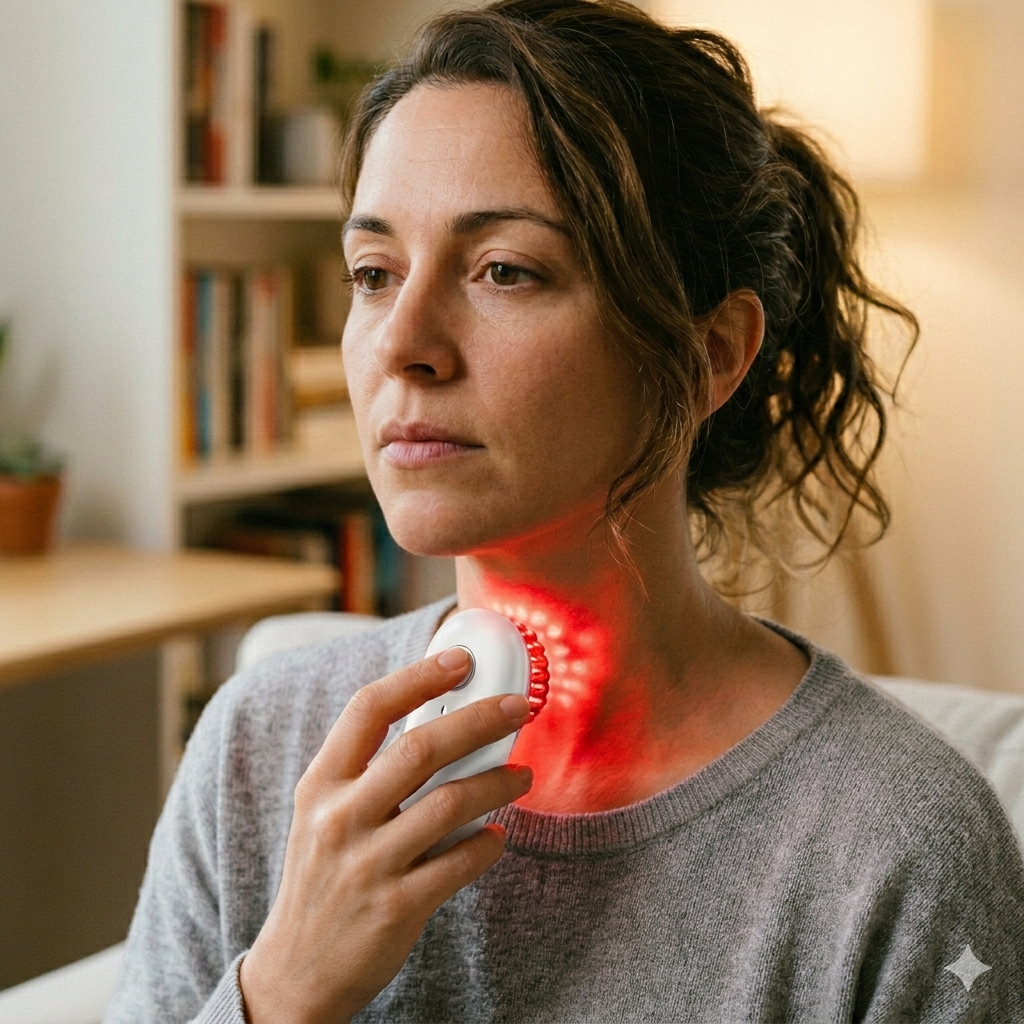
Near Infrared light on specific points on the neck improves thyroid health.
What PBM can’t replace:
Sufficient protein and nutrient‑dense food (iron, selenium, zinc, iodine in appropriate amounts, vitamin D).
Stress regulation.
Sleep and circadian rhythm (daylight signalling).
The healthiest approach for optimal thyroid health is red light therapy layered layered on top of these, not in place of them.
Hashimoto’s & Red Light Therapy FAQ
Q: Should I change my medication dose during treatment?
A: No. Always stay on your prescribed dose. However, because red light improves thyroid efficiency, the most responsible, evidence-based approach is to get blood work (TSH, Free T4, and Free T3) 4 to 6 weeks after your 3-week protocol. Share these results with your doctor; they may eventually need to reduce your dosage as your thyroid function improves.
Q: Were the women in the Hashimoto’s light therapy study doing anything else, like special diets or stacks of supplements, or was it really just the light?
A: Both groups were given the same simple supplement plan: 100 µg of selenium daily, plus individualized vitamin D3 if their blood levels were below 40 ng/mL; the only extra intervention in the successful group was thyroid‑focused photobiomodulation on top of that.
Q: Are there any side effects to the light treatment?
A: The study reported no adverse effects. Red light therapy is non-invasive and non-thermal. However, if you have a history of neck malignancy or active thyroid nodules, you must get an ultrasound and doctor's clearance before applying light directly to the thyroid.
Q: Why did the study measure neck circumference?
A: Goiters (swelling of the thyroid) are a common side effect of Hashimoto’s. The reduction in neck circumference is a physical sign that the internal inflammation of the gland itself is decreasing.
Resources:
Efficacy of Combined Photobiomodulation Therapy with Supplements versus Supplements Alone in Restoring Thyroid Gland Homeostasis in Hashimoto Thyroiditis” (J Pers Med 2023;13(8):1274)
https://pubmed.ncbi.nlm.nih.gov/37623524/
The effect of low-level laser therapy on the oxidative stress level and quality of life in patients with Hashimoto's thyroiditis
https://pubmed.ncbi.nlm.nih.gov/38628043/
Low-level laser therapy in chronic autoimmune thyroiditis: a pilot study
https://pubmed.ncbi.nlm.nih.gov/20662037/