A Simple Guide to Two Restorative Paths to Fertility Care
If you have been trying to understand your cycle, get pregnant, prevent another miscarriage, or find answers for painful, irregular, or confusing periods, you may have heard two names come up (or maybe this is the first time you’ve come across NeoFertility).
NaProTechnology and NeoFertility.
And then the questions start.
Are they the same thing?
Is one “better”?
Do I need to choose one over the other?
And where on earth do you find a clinician who actually understands this kind of care?
Let’s clear it up - without the confusing acronyms, the medical jargon. The short version: NaPro and NeoFertility share a restorative, cycle-informed philosophy. Both aim to understand what might be disrupting reproductive health and address contributing factors rather than simply bypassing the cycle. But they are not identical systems, and the day-to-day care experience can look different depending on the charting method, clinician training, and practice model.
Why this distinction matters
When someone is dealing with infertility, recurrent miscarriage, long cycles, absent ovulation, severe PMS, painful periods, abnormal bleeding, low progesterone concerns, or unexplained fertility struggles, they do not just need more information.
They need a plan.
And ideally, they need a plan that asks better questions:
What is this cycle pattern telling us?
Is ovulation occurring - and when?
Is this a ‘quality’ ovualtion or suboptimal?
Are hormones being checked at the right time for this woman’s cycle?
Could pelvic anatomy, endometriosis, thyroid function, semen parameters, tubal factors, metabolic health, inflammation, medication effects, or another issue be relevant?
What needs to be investigated now, what needs referral, and what can be supported while we seek answers?
That is the basic approach behind both NaProTechnology and NeoFertility: the menstrual cycle is not “just a period.” It provides clinically meaningful information that deserves attention.
What NaProTechnology is
NaProTechnology® - often shortened to NaPro - is an approach to women’s and reproductive health that works with the Creighton Model FertilityCare System.
The Creighton Model is a standardized fertility-awareness-based method that teaches a person to observe and chart specific cycle biomarkers, especially patterns of cervical mucus and bleeding. NaPro-trained clinicians can use those standardized observations, along with medical history, examination, laboratory testing, imaging, and referrals, to investigate reproductive-health concerns.
Think of it this way:
Creighton Model charting provides the data. NaProTechnology applies medical care to the patterns in that data.
For someone using the Creighton Model, this can create a shared language between the person charting, their FertilityCare Practitioner, and their medical clinician.
NaPro is not “just natural family planning.” It is a medical approach that uses standardized cycle observations as one part of a broader clinical evaluation.
What NeoFertility is
NeoFertility is a restorative reproductive-medicine approach developed by Irish physician Dr. Phil Boyle. It emerged from decades of clinical work in fertility care and was established as NeoFertility in 2016.
Like NaPro, NeoFertility aims to understand why pregnancy isn’t happening and treat identifiable contributors to infertility, miscarriage, and reproductive-health concerns rather than simply suppressing or bypassing the menstrual cycle.
Where NeoFertility differs most visibly is its use of Chart Neo, a digital fertility-charting diagnostic platform co-founded by Dr. Boyle. Chart Neo is designed to facilitate communication between the patient, fertility advisor, and clinician and can support more than one fertility-awareness method.
In simple terms, the NeoFertility workflow often looks like this:
Learn to observe and chart your cycle with guidance from a trained fertility advisor.
Use the chart to identify patterns and accurately time evaluation.
Combine chart data with a thorough history, targeted labs, imaging, semen evaluation, and other clinically appropriate testing.
Address potentially modifiable contributors and monitor whether the cycle is responding.
Coordinate specialty referrals when needed.
NeoFertility describes this as a whole-person, clinically precise approach supported by charting, clinician education, and a collaborative care model.
NaPro vs. NeoFertility: a simple comparison
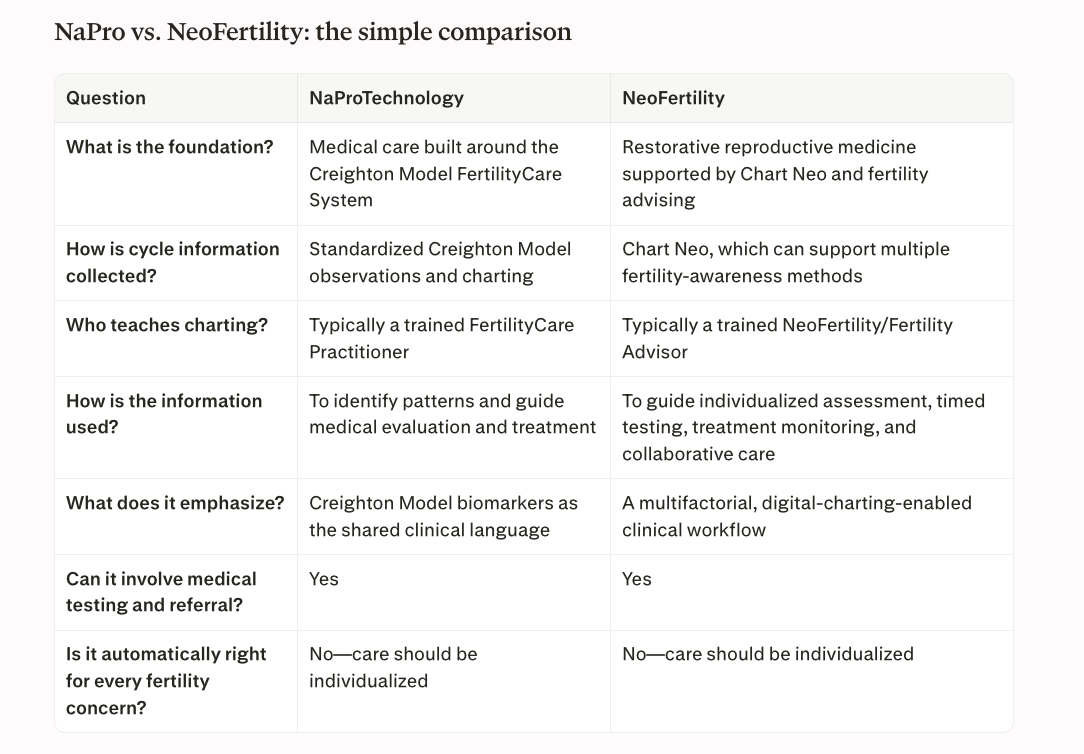
NeoFertility and NaPro
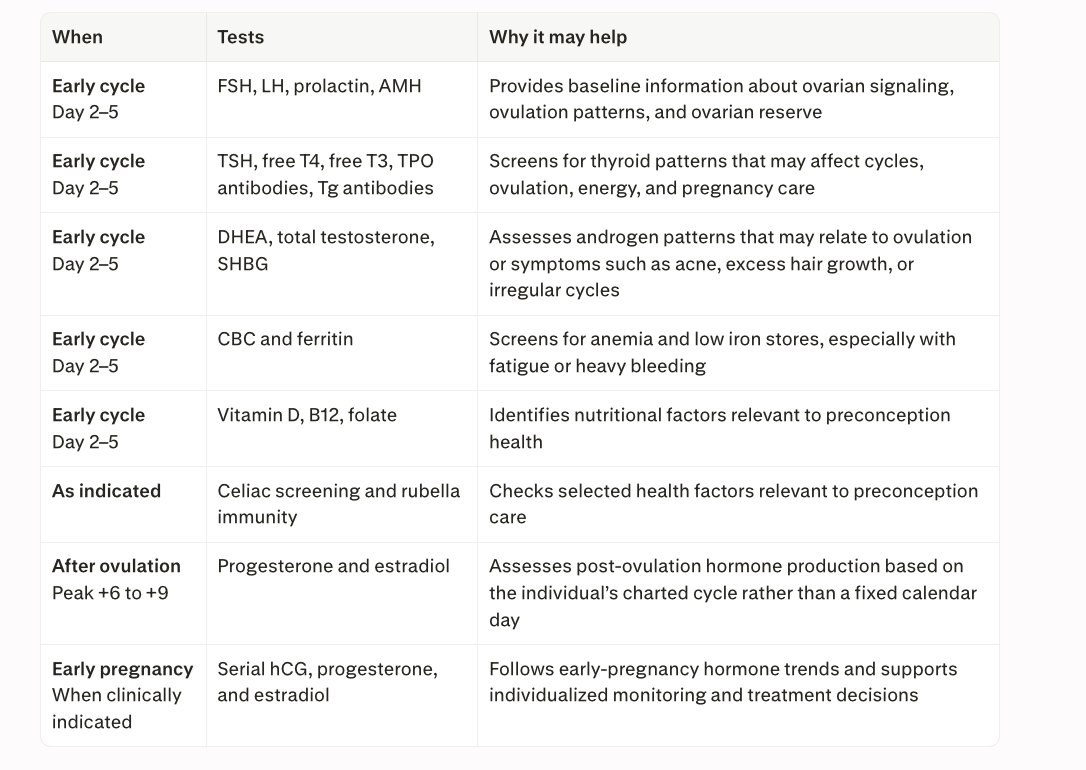
NeoFertility often takes a more clearly mapped-out approach to testing. That may include early-cycle baseline labs, selected nutrition and hormone markers, and post-ovulation hormone testing timed to your unique cycle - not just a standard calendar day. The goal is to look at the whole picture and explore the different factors that may be affecting fertility, rather than relying on one test result to tell the entire story.
Fertility is about more than a hormone number or a perfectly timed test. NeoFertility will also ask how you are feeling and record additional factors including your energy, stress load, sleep, pain, PMS, and mood - because those patterns can offer helpful clues. If concerns show up, the next step should be a thoughtful medical evaluation, not a one-size-fits-all supplement plan. For some couples, a qualified prescriber may consider options such as DHEA or LDN as part of broader care.
Below are the standard labs as part of your initial NeoFertility assessment.
One practical difference is the NeoFertility emphasis on a more standardized, cycle-timed laboratory assessment. Rather than relying only on a general fertility panel - or testing hormones on a fixed calendar day regardless of ovulation timing - NeoFertility teaching materials outline two key testing windows:
An early-cycle panel, typically around cycle Day 3, to look at baseline reproductive hormones, thyroid markers, nutritional factors, and selected metabolic or immune-related considerations.
A post-ovulation hormone assessment, typically about seven days after your Peak Mucus Day or ovulation marker, to assess progesterone and estradiol in relation to your cycle timing.
This approach helps clinicians connect the information your body is giving us (from your cycle chart) with lab results and decide whether further evaluation, treatment, scans, male-factor assessment, or referral may be appropriate.
The most important takeaway is this: both approaches use cycle information to support clinical thinking, but neither should replace appropriate medical evaluation or timely referral. A chart can be a powerful source of information. It is not a substitute for investigating urgent symptoms, blocked tubes, severe male-factor infertility, significant pelvic disease, pregnancy complications, or other issues that require specialty care.
The biggest difference is often the care experience
Here is something that is easy to miss when couples compare methods online:
Two patients can technically be receiving “NaPro care” or “NeoFertility care” and have very different experiences.
Why?
Because the quality of care depends heavily on the individual clinician and practice.
For example, one clinician may have deep expertise in recurrent miscarriage and collaborative referral relationships with reproductive endocrinology, maternal-fetal medicine, pelvic surgery, urology, and mental-health professionals. Another may focus primarily on cycle education and basic hormone support.
One practice may have an integrated fertility educator or advisor, digital chart access, clear follow-up systems, and a structured diagnostic pathway. Another may have a long waitlist and limited testing access.
One clinician may welcome collaboration with your OB-GYN, primary care clinician, endocrinologist, or reproductive endocrinologist. Another may not have the same network or scope.
That is why the real question is not simply:
“Should I choose NaPro or NeoFertility?”
A more helpful question is:
“Which qualified clinician can help me investigate my specific concerns thoroughly, safely, and in a way that fits my values and goals?”
What to look for in a clinician
Whether you are considering a NaPro-trained clinician, a NeoFertility clinician, or another restorative reproductive-medicine provider, use this checklist before you book.
Ask about training
You can ask:
What specific training have you completed in NaProTechnology, NeoFertility, restorative reproductive medicine, fertility awareness-based methods, or reproductive endocrinology?
Do you work with a trained charting instructor or fertility advisor?
Which charting method do you use in your practice?
How do you use chart data in clinical decision-making?
Ask about diagnostic evaluation
You deserve to know how your clinician thinks.
Consider asking:
What testing do you commonly consider for my situation?
How do you time hormone testing if my cycles are irregular?
When do you use pelvic ultrasound, semen analysis, tubal evaluation, or referral?
How do you screen for medical conditions that can affect reproductive health?
What symptoms would lead you to refer me to a surgeon, reproductive endocrinologist, urologist, maternal-fetal medicine specialist, or another clinician?
A thoughtful answer is a good sign. So is a clinician who says, “That is outside my scope, and here is who I would involve.”
Ask about access and follow-up
Fertility care can involve time-sensitive communication. Ask:
Do you offer virtual appointments?
Are you licensed to provide telehealth where I live?
How often will we follow up?
How do I contact the practice with cycle updates or medication questions?
Do you work directly with my current OB-GYN, primary care clinician, or other specialists?
What are the expected costs for charting education, appointments, labs, imaging, and referrals?
These questions are practical - and they matter.
How to find a NeoFertility clinician
NeoFertility has a patient-facing network and provider search process in the United States. Start with the NeoFertility US “For Patients” page, which includes an interactive tool to search for a provider. The Chart Neo platform also maintains a provider map for fertility-awareness-based and restorative reproductive-medicine professionals.
When you find someone promising, check four things before you schedule:
Training: Confirm that the clinician has completed NeoFertility-specific training or participates in the NeoFertility clinical training pathway.
Scope: Ask whether they see patients with your specific concern - such as infertility, recurrent loss, severe cycle symptoms, male factor, or fertility preparation.
Location and licensure: A clinician may offer telehealth, but they generally need to be licensed where you are located at the time of your appointment.
Care team: Find out whether you will also work with a trained fertility advisor for charting instruction and support.
How to find NaPro care
For NaProTechnology, a good starting point is the FertilityCare Centers of America network, which connects people with Creighton Model FertilityCare services and NaProTechnology-informed care.
You can also look for:
A Creighton Model FertilityCare Practitioner who can teach standardized charting
A NaPro-trained Medical Consultant or clinician
A practice that explicitly lists experience with infertility, recurrent miscarriage, pelvic pain, cycle disorders, or other concerns relevant to you
Clinicians who collaborate with local specialists when additional evaluation or treatment is needed
Remember: finding a charting instructor and finding a medical clinician are sometimes two separate steps. That is normal. In fact, a well-coordinated educator–clinician team can be a real asset.
One important reminder before you choose
Restorative reproductive care can be meaningful and helpful for many people - especially those who want detailed cycle education, individualized evaluation, and a care plan that respects their values.
But no approach can promise pregnancy, prevent every miscarriage, or identify every cause of infertility.
Fertility challenges can have many overlapping contributors. Some are treatable. Some require surgery, assisted reproduction, donor options, genetic counseling, medical management, or specialty referral. And sometimes, even after a thorough workup, there is no single clear answer.
The bottom line
NaProTechnology and NeoFertility are cousins in the world of restorative reproductive medicine.
Both value cycle literacy.
Both seek to identify patterns.
Both aim to address reproductive health in a way that works with, rather than ignores, the menstrual cycle.
The main distinctions are in the charting ecosystem, training pathways, digital tools, and the way individual practices organize care.
Choose the clinician - not just the label.
Look for someone who takes your symptoms seriously, uses a clear diagnostic process, communicates openly, respects your goals, practices within their scope, and knows when to bring in other experts. That is the kind of fertility care every person deserves.
Tracy
Resources:
https://pmc.ncbi.nlm.nih.gov/articles/PMC10902037/ (Successful pregnancy using oral DHEA treatment for hypoandrogenemia in a 30-year-old female with 5 recurrent miscarriages, including fetal demise at 24 weeks: a case report)
https://www.frontiersin.org/journals/reproductive-health/articles/10.3389/frph.2023.1321284/full (Restoration of serum estradiol and reduced incidence of miscarriage in patients with low serum estradiol during pregnancy: a retrospective cohort study using a multifactorial protocol including DHEA)
https://blog.tracydonegan.org/blog/why-women-are-angry-about-unexplained-infertility
https://blog.tracydonegan.org/blog/what-ivf-clinics-in-austin-wont-tell-you