A New Study on Red Light Therapy and Immature Eggs
If you're going through IVF, you already know how much every single egg can matter.
You wait for the retrieval call. You hear the number. Then you hear how many of those eggs were actually mature. If that second number is lower than you hoped, it can be devasting.
That's why a new 2026 study caught my attention. It looked at whether near-infrared light could help immature human eggs get closer to maturity in the lab.
I'm going to walk you through it in plain English: what the researchers did and what they found. This is very exciting research!
First, What Happens to Immature Eggs in IVF?
Not every egg collected during an IVF retrieval is ready to be fertilized. According to some data about 20% of retrieved eggs are still immature.
To keep things simple, I'll describe three stages:
Least mature eggs are at the very beginning of development. Under the microscope, you can still see the egg's nucleus, its "control center."
Nearly mature eggs have started dividing their chromosomes but haven't finished.
Fully mature eggs have completed this step and are ready to be fertilized. You can tell because the egg has pushed out a tiny packet of extra chromosomes called the polar body.
Immature eggs are usually considered unsuitable and are often discarded. Some labs give them extra time in a dish to see whether they'll finish maturing. This is called rescue IVM (in vitro maturation, meaning maturation outside the body).
So the researchers asked a big question: could light therapy help more of those eggs get there?
What the Researchers Did
A team in Genoa, Italy, studied 260 immature eggs from 114 women having IVF. The women were 34.7 years old on average, and their ages ranged from 23 to 39.
The eggs were randomly split into two groups. One group was treated with light and the other wasn't. The treated eggs received a single, carefully controlled dose of near-infrared laser light:
810 nm wavelength
1 watt of power
60 seconds of treatment
60 J/cm² of energy
Delivered directly to the egg in a lab dish
What They Found
More eggs moved towards maturation, and sooner
Within one-hour, the light-treated eggs were further along than the untreated eggs:
Least mature eggs: About twice as many had moved on to the next stage, a 112.5% increase.
Nearly mature eggs: Almost twice as many had moved on to the next stage, a 92.3% increase.
The light-treated eggs stayed ahead for up to 4 hours in the least mature group and up to 6 hours in the nearly mature group.
When the researchers accounted for age and for the fact that some women contributed more than one egg, the result for the least mature eggs was statistically significant. The nearly mature eggs showed the same trend (but that result wasn't strong enough to count as statistically significant).
What the microscope photos show
The researchers photographed example eggs at 1, 2, 4, 6 and 24 hours. Here's what a few of them showed:
One untreated least mature egg took 4 hours to reach the next stage. A light-treated egg got there in 1 hour.
One untreated nearly mature egg took 24 hours to fully mature. A light-treated egg finished in 6 hours.
Some eggs in both groups never matured at all (not unusual in IVF).
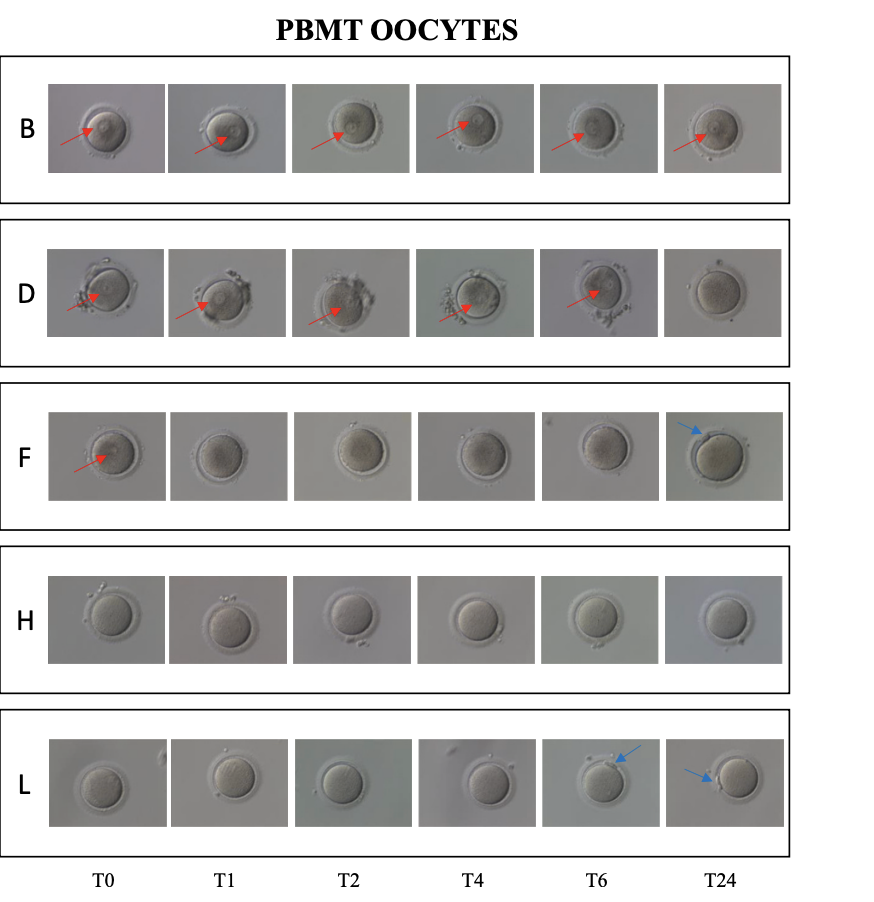
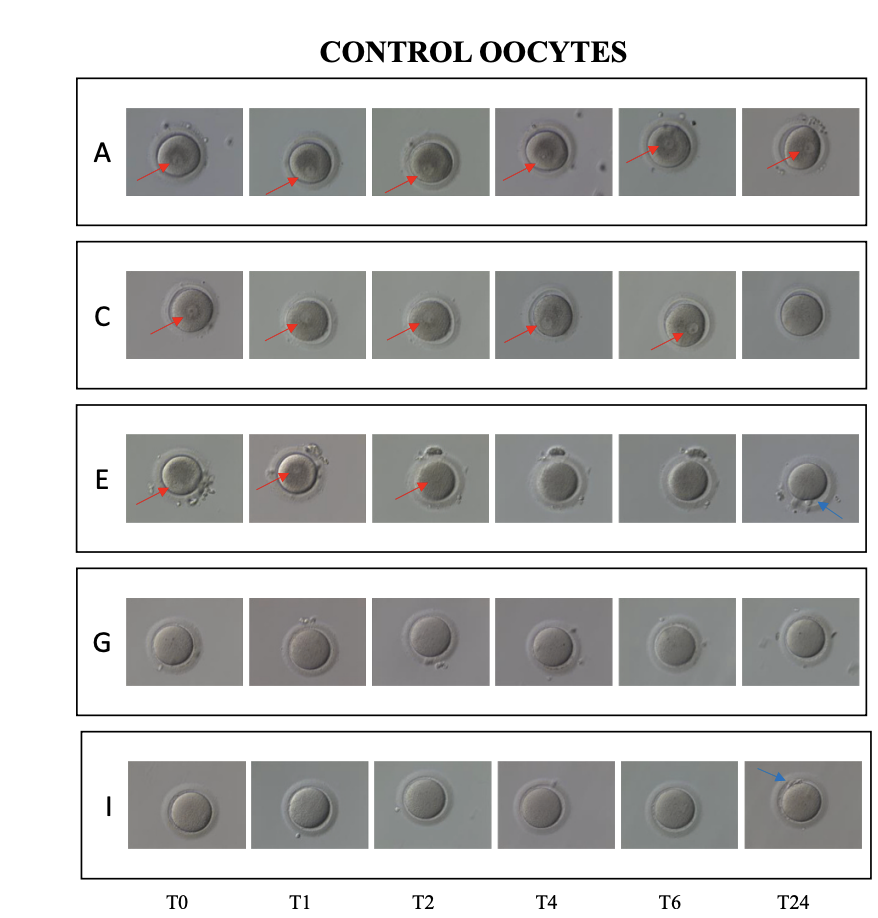
What the Photos Show
Panels A and B (least mature eggs): These eggs didn't progress at all, whether or not they were treated.
Panels C and D (least mature eggs): These eggs moved up one stage to nearly mature, but only after a full 24 hours.
Panels E and F (least mature eggs): These eggs eventually became fully mature by 24 hours. The untreated egg (E) took 4 hours to reach the nearly mature stage. The light-treated egg (F) got there in just 1 hour.
Panels G and H (nearly mature eggs): These eggs never finished maturing. The space around the egg stayed narrow and no polar body appeared.
Panels I and L (nearly mature eggs): Both of these eggs became fully mature. The untreated egg (I) took 24 hours. The light-treated egg (L) finished in 6 hours.
The eggs had more energy
This is the fascinating part!
Eggs need a huge amount of energy (ATP) to mature. They have to organize their chromosomes, build the machinery that divides them, and get ready for fertilization. That energy is called ATP, and it's made by your mitochondria, the tiny "power stations" inside the egg.
After the light treatment:
ATP levels were significantly higher in the treated eggs.
Mitochondrial energy activity rose by up to 240% in the least mature eggs and 194% in the nearly mature eggs, peaking about 10 minutes after treatment.
The boost lasted at least an hour, and the mitochondria kept working efficiently. They were producing usable energy, not just burning extra fuel. (And remember they were only under the light for 1 minute).
And the data keeps getting more interesting as you’ll see below.
“The researchers also noticed another fascinating pattern: nearly mature eggs that finished maturing within 2 hours of treatment had energy levels equal to or higher than eggs that matured naturally inside the body. Eggs that took 4 to 6 hours had less energy. This points to a possible two-hour “window” where light gives eggs a meaningful energy boost.”
No early signs of harm
The researchers checked for two warning signs.
Visible damage: Under the microscope, the treated eggs looked just as healthy as the untreated ones. The researchers saw no breakdown, no grainy texture inside the egg, and no damage to its protective outer shell.
Oxidative stress: They measured a marker of cell "wear and tear" and found no increase in the treated eggs.
That's reassuring, but it's not the whole safety picture, which brings me to the most important section.
What This Study Didn't Prove
I'd love to tell you this study proves light therapy creates more mature eggs, better embryos and more babies but the research isn’t there yet in this approach.
Italian law didn't allow the researchers to fertilize these eggs, so they couldn't measure fertilization, embryo development, implantation, pregnancy or live birth.
They also didn't test:
Chromosome normality (aneuploidy)
DNA damage
Changes in how the egg's genes are switched on or off (epigenetics)
Whether the important RNA and proteins inside the egg stayed intact
There are other limits too. Light alone didn't get the least mature eggs all the way to full maturity within the timeframe that matters clinically. After 24 hours, about 56% of treated eggs had fully matured vs. 46% of untreated eggs, and that difference wasn't statistically significant. The study excluded women with endometriosis, ovulation disorders like PMOS, or DOR.
What This Means for Light Therapy at Home
This study doesn't mean you can accelerate your egg growth at home. The laser in this study shone straight onto an egg in a dish. Inside your body, your ovaries sit deep in the pelvis, so light from outside your body would have to travel through skin, fat, muscle and other tissue to reach them (which is why I recommend using the pelvic wand and Solasta laser combo). In my protocols, light therapy supports the bigger picture: circulation, inflammation, mitochondrial signaling, stress, sleep and metabolic health. That's how I use it, and this study is one more reason I'm committed to careful dosing, honest education and personalized protocols.
So why is this an important study?
Because it shows something we've long believed: near-infrared light has a real, measurable effect on the energy systems of human reproductive cells. It adds more credible science to the body of PBM research (it’s far from being ‘woo’).
Why I'm Very Hopeful
For years, immature eggs retrieved during IVF have been seen as lost chances. This study suggests that a single, short dose of near-infrared light may help some of those eggs get closer to maturity, with no early signs of harm.
That's not a finished treatment. It's a very promising beginning. And for every woman who's been told every egg counts, that possibility deserves careful, ethical research.
I'll be watching for the next studies, especially ones that test chromosome safety, embryo development and outcomes for women with diminished ovarian reserve, advanced maternal age, endometriosis and PMOS. When they come out, you'll hear about them here first, in plain English.
Tracy
Study: Stigliani S, et al. "The impact of near-infrared photobiomodulation therapy on human oocyte rescue in vitro maturation." Journal of Photochemistry & Photobiology B: Biology, 2026;279:113452.
Note:
This post is for education only. Light therapy is a complementary approach and isn't a proven treatment for infertility. Don't change your IVF medications, treatment plan or clinic instructions without talking with your fertility specialist.