What IVF Clinics in Austin Won’t Tell You
What Your IVF Clinic Isn't Telling You (And What to Ask Instead)
And - what the clinic tells you vs. what actually happens to 100 women who walk through the door.
You sat across from a fertility doctor. They showed you a number - maybe 54%, maybe 58%. You felt a flicker of hope. You thought: that's not bad. That's actually pretty good.
So you signed the paperwork. You started the injections. You showed up at 7am for monitoring appointments and you did everything right.
And then it didn't work.
Here's the thing: that number on the brochure? It wasn't the full story. Not even close.
I'm a midwife, and a concierge fertility and red light therapy consultant in Round Rock TX, I've watched too many smart, health-conscious women walk into the IVF process armed with misleading statistics and walk out emotionally depleted and financially devastated wondering what they did wrong.
You didn't do anything wrong. You just weren't given the right information and that’s NOT on you. Let’s fix that right now.
The Number Nobody Shows You
When a clinic tells you their success rate, they're almost always quoting their live birth rate per embryo transfer. That sounds reasonable until you realize that number only counts the women who actually made it to the transfer stage.
Nationally, in 2023, the average live birth rate per transfer was approximately 54%. That's the number clinics lead with. That's the number that ends up in their marketing materials.
But per started cycle, meaning, everyone who walked in and began the process, the national average drops to around 39%.
That is a significant gap.
And I want you to really hear this: in Austin-area clinics, that same pattern holds. Advertised rates average 34 - 58% per transfer, but honest per-started-cycle rates fall to 21 - 55%. In one clinic - 39% of patients are quietly excluded from the headline number. These patients are quietly excluded from the headline number before it ever reaches a brochure.
Why? Because somewhere between starting a cycle and reaching a transfer, roughly one in four women hits a wall - no eggs retrieved, no viable embryos, a cancelled cycle. Those women don't disappear. They just don't count in the number you were shown..

National averages, SART 2023. Austin clinics show the same pattern.
Let Me Make That Statistic Easier to Understand
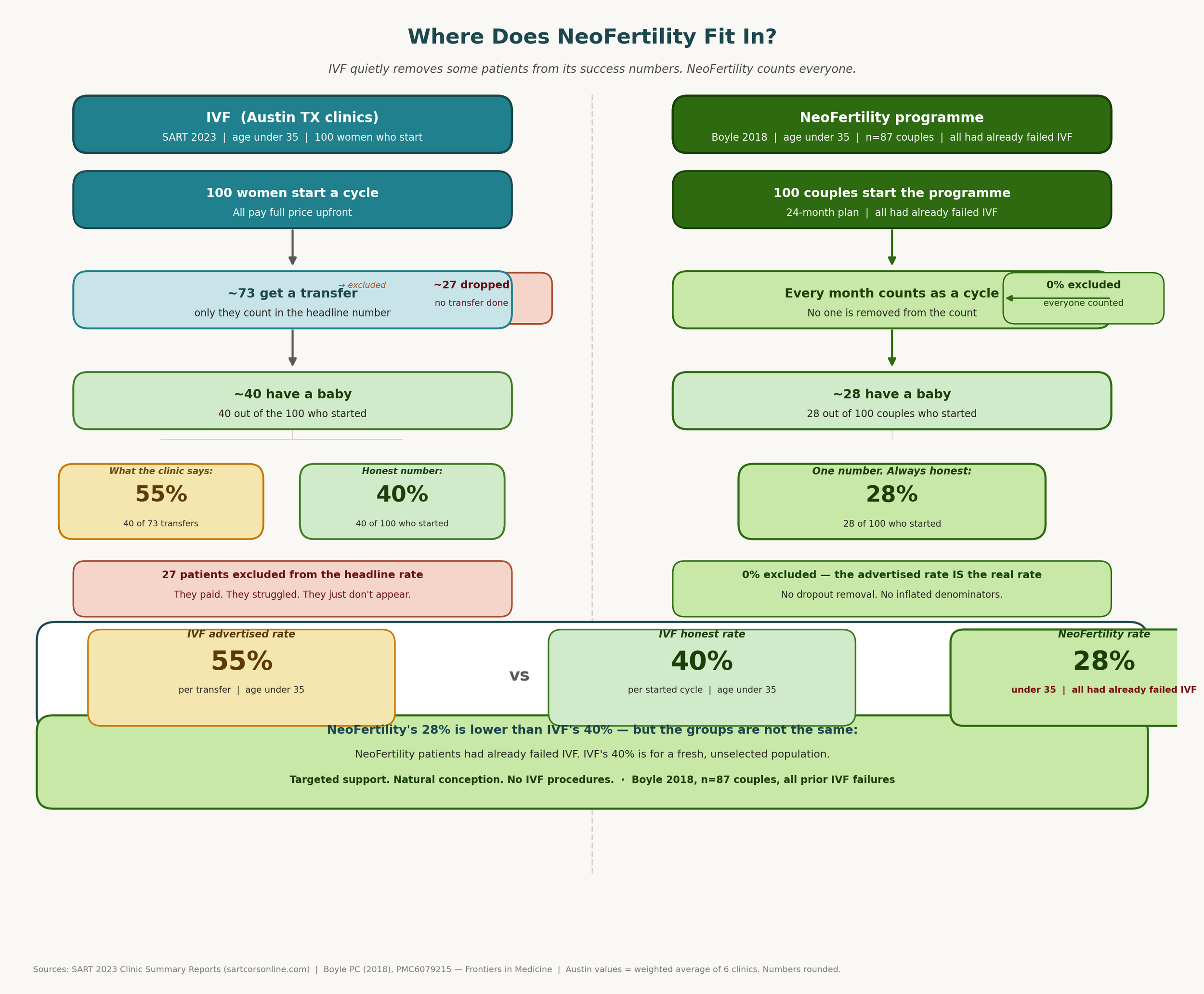
Imagine 100 women starting IVF at the same clinic in the same month. By the time transfers happen, 27 of those women are no longer in the room (SART 2023). Their cycles were cancelled. Their embryos didn't survive. They were told to "try again next time."
The remaining 73 move forward to transfer. And of those 73, maybe 55% bring home a baby. That's a beautiful outcome - for those 73. But the original 100? Their collective live birth rate is closer to 40%.
Those 27 women paid $15,000 to $20,000 for a cycle that ended before it could begin. Many went back for a second round. Or a third. Two full IVF cycles in Austin can cost $30,000 to $40,000 or more. (You have insurance? I’ll write on this soon).
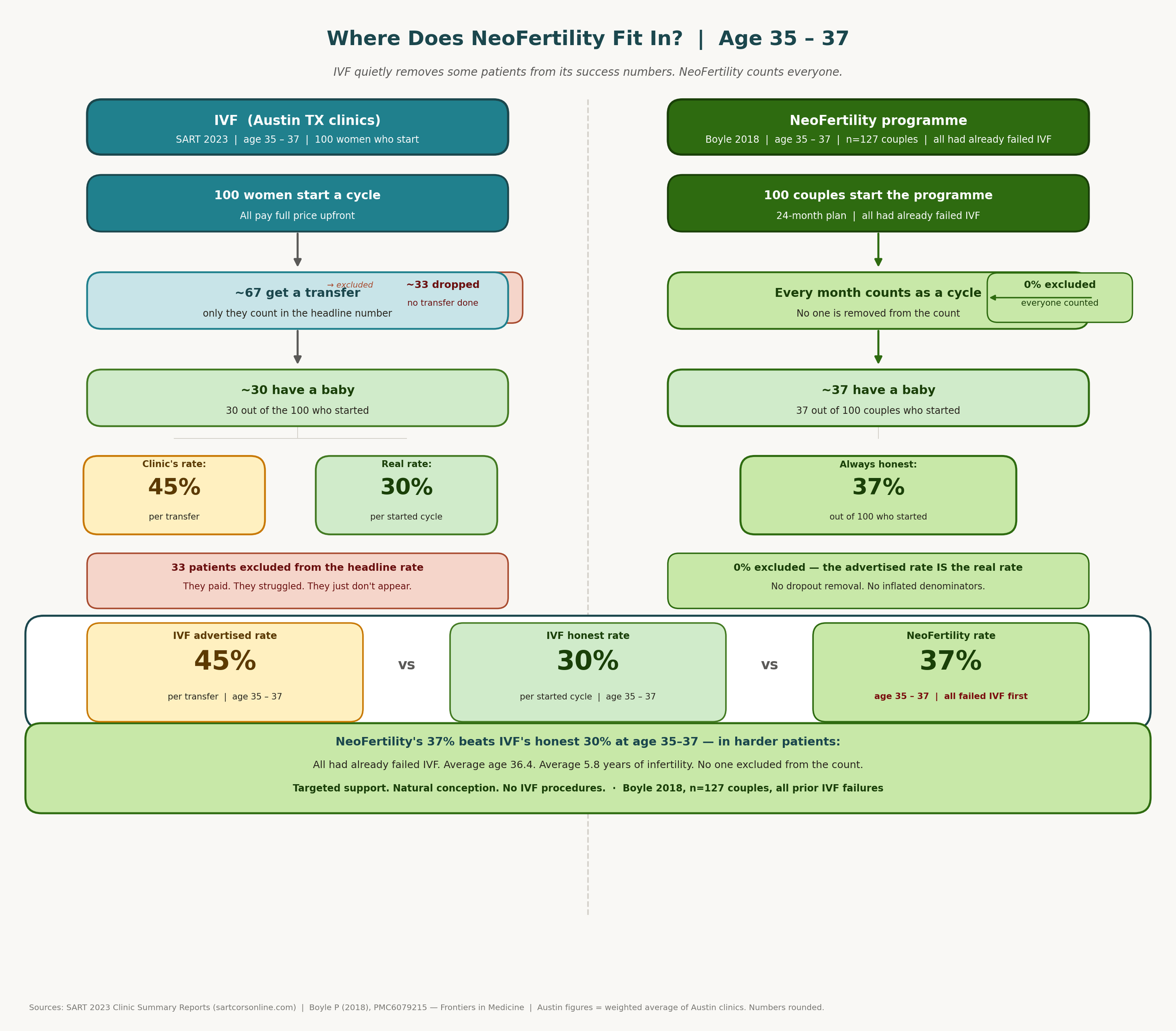
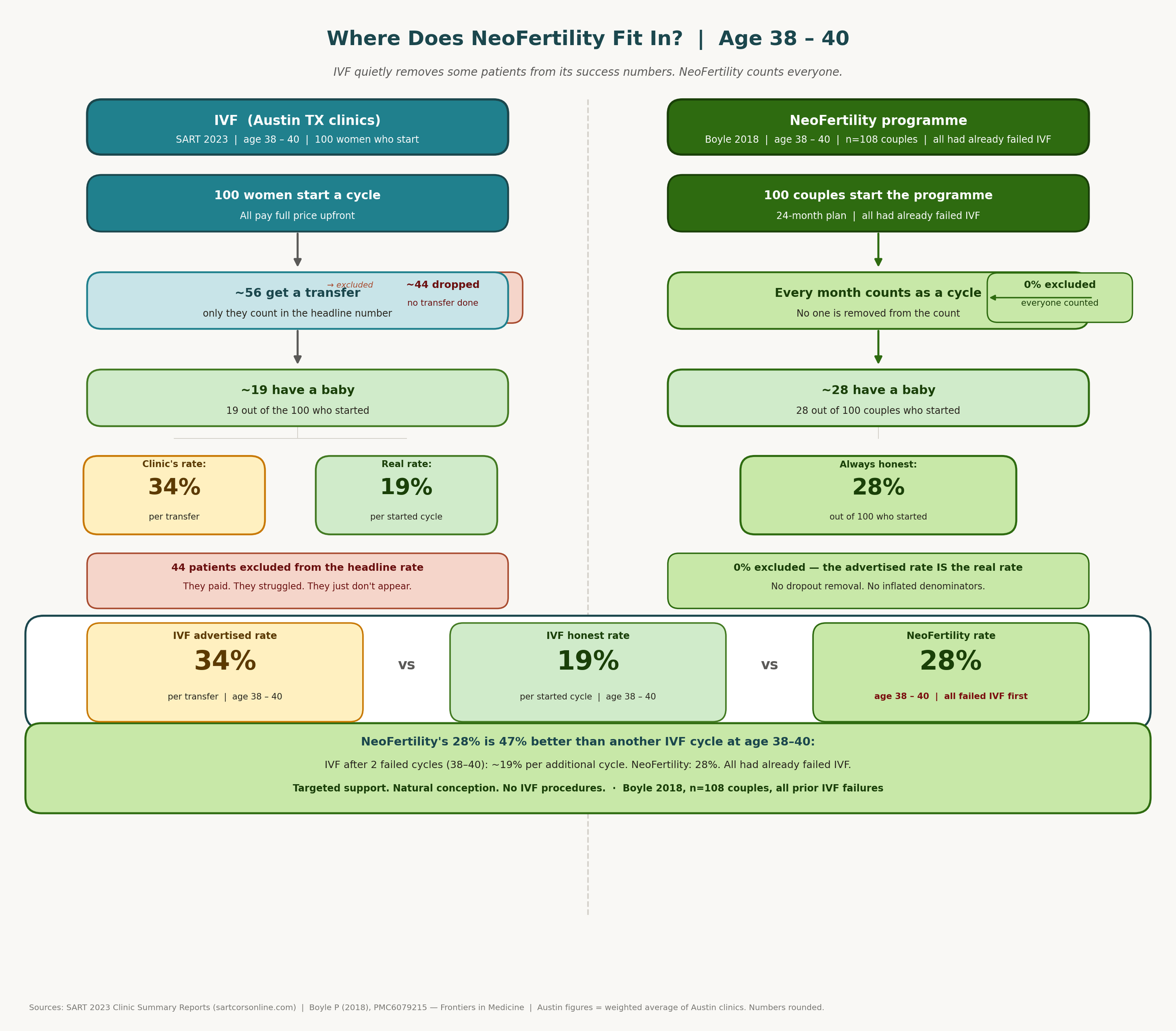
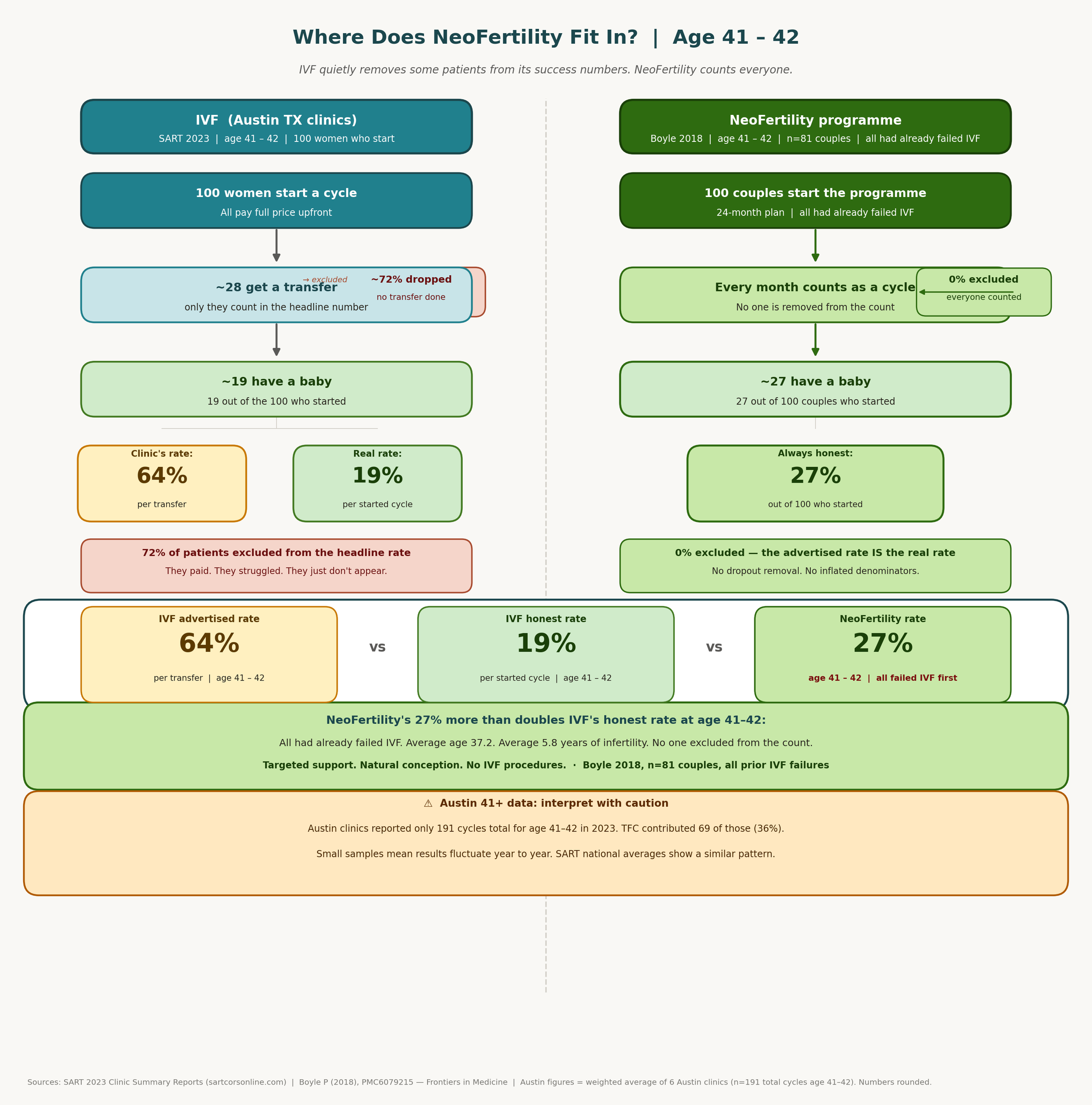
Now let’s look at honest, transparent numbers below - not brochures. Note that many of these couples ALREADY had failed IVFs.
What a Real Workup Actually Looks Like
Here's where I want to get specific, because this is where most fertility journeys go wrong from the very beginning.
The standard IVF diagnostic pathway is relatively narrow. Bloodwork, an ultrasound, a semen analysis, maybe an HSG to check if your tubes are open. If nothing obvious is flagged, you get a label: "unexplained infertility." Their job is to get you through IVF, not fix the health issue that’s preventing you from conceiving.
That label is assigned to roughly 1 in 4 fertility women, and it sounds like a diagnosis, but it isn't. It means: we haven't found anything with the tests WE ran.
Let’s get real here - "unexplained" is not the same as "unfixable." It often means "uninvestigated."
NeoFertility (part of Restorative Reproductive Medicine, or RRM) runs a substantially deeper investigation. Hormonal mapping across the full cycle. Detailed mucus assessment. Immune and inflammatory markers. Thyroid function across multiple points, not just TSH. When researchers applied this full workup to patients presenting with "unexplained infertility," that diagnosis dropped from 24% to just 1%.
Read that again. Twenty-four percent down to one.
Those weren't unexplainable cases - they were cases nobody had looked at closely enough yet.
The Outcomes Data (The Part Worth Knowing)
Now I want to walk you through the outcomes comparison by age group, because the data here is interesting.
Under 35: IVF per-cycle live birth rate in Austin averages around 40% (SART 2023).
Ages 35–37: IVF per-cycle rate drops to approximately 30% in Austin. NeoFertility achieved 37% - in a group where every single patient had already failed IVF at least twice (Boyle 2018, PMC6079215). Better outcomes. Harder patients.
Ages 38–40: IVF per-cycle rate falls to around 19% in Austin. After two failed IVF cycles, your odds on a third attempt drop further - to roughly 17.5%. NeoFertility outcomes for the same post-IVF, 38–40 group? 28% - without the heavy meds, no egg retrieval, no embryo lab (Boyle 2018).
Your Baby’s Health
But so does what happens after the positive test.
The national IVF twin rate sits at around 6%. The national preterm birth rate for IVF is 14.4% (SART 2023). In Austin, it ranges from 7.1% at AFRM/Westlake IVF up to 17.4% at Fora Fertility.
These babies aren't just born. They're born well.
Preterm birth carries real consequences, NICU time, developmental risk, family stress and financial hardship for many. When you're choosing a path to parenthood, your baby's health deserves to be part of the conversation (more coming on this soon).
Preterm birth carries real consequences — NICU time, developmental risk, family stress. When you're choosing a path to parenthood, your baby's long term health deserves to be part of the conversation.
Who NeoFertility Is - And Isn't - For
NeoFertility is a very different approach to fertility. It requires sustained commitment - cycle charting for an initial 2 months using the Chart Neo app (this is a key diagnostic tool - not just a cycle tracking app), hormonal support, lifestyle optimization, and regular check-ins. It is not a quick fix. It is not appropriate for everyone. We look for the root cause of WHY you’re not getting pregnant or sustaining a pregnancy once you are pregnant.
If you have significant structural factors like bilateral tubal blockage, or if time is critically short due to severe diminished ovarian reserve, IVF may still be the right primary path. These are nuanced decisions that deserve individualized guidance. Even if surgery is recommended or you’re short on time being in the best health possible for IVF makes sense.
But if you:
• Have been told you have "unexplained infertility"
• Have tried IVF one or more times without success
• Are 35 or older and want to understand all your options before committing to another cycle
• Are health-conscious and want to understand why conception isn't happening before throwing more intervention at it
…then NeoFertility is worth a serious look. The programme works by finding and addressing what's actually preventing conception - not bypassing it.
The Right Question to Ask
If you've read this far, you're not just looking for a quick answer. You're looking for the right answer.
Here's what I'd suggest as a first step: before your next fertility appointment, whether that's with a reproductive endocrinologist, a new clinic, or a consultant like me, write down this question and bring it with you:
Can you show me your live birth rate per started cycle, broken down by my age group?
If they can answer that question clearly and without deflection, that's a clinic worth trusting. If the answer is vague or they redirect you to a per-transfer number, you now know why.
And I want you to really hear this: the fertility journey is hard enough without navigating it on incomplete information. You deserve the full picture, the real numbers, the root-cause workup, the conversation about what's actually going on in your body.
That's what I'm here for.
If you're in Austin and considering IVF, before you sign that paperwork - let’s talk. You deserve complete information before making one of the biggest decisions of your life. Print this blog and take it with you - your questions are valid, and an ethical provider will answer them honestly.
You are not a statistic. And you don't have to keep making decisions based on incomplete information.
Email me at Tracy@TracyDonegan.org and let’s chat about your options.
Tracy
Sources
https://art.cdc.gov/artclinics?State=TX for all recent CDC info.
1. SART 2023 Clinic Summary Reports. sartcorsonline.com
2. IVF Cost Data. fertilityiq.com/ivf/the-cost-of-ivf
3. Boyle P (2025). New Insights into Fertility Treatment with RRM. naturalfamilyplanningireland.ie
4. Boyle PC (2018). "Healthy Singleton Pregnancies From Restorative Reproductive Medicine (RRM) After Failed IVF." Front Med (Lausanne). 5:210. PMC6079215
5. CDC National ART Summary 2022. cdc.gov/art
Tracy Donegan is a registered midwife, doula, and lactation educator based in Austin, TX. She is a NeoFertility consultant and runs a private concierge fertility and photobiomodulation consultancy. This article is for educational purposes and does not constitute medical advice.
tracydonegan.org | NeoFertility Concierge Fertility Consulting | Austin, TX