The ‘Medical Grade’ LED Myth: Does Red Light Therapy Work for Fertility
The "Medical Grade" LED Myth That's Costing You Hundreds (And Maybe Your Best Chance at Getting Pregnant and Staying Pregnant)
Let me guess.
You're scrolling Instagram at 2 AM (again), researching everything you can do to improve your egg quality. Whether you're preparing for IVF, trying naturally after months of disappointment, or somewhere in between, you're spending waaay too much on supplements, you’ve cleaned up your diet, and now you're staring at a $1000 red light therapy device that says "medical grade" device.
The sales page is covered in testimonials and phrases like "clinically proven" and "doctor recommended."
But here's what nobody's telling you: "Medical grade" doesn't actually mean anything standardized in the LED industry.
And if you don't know what to look for, you could drop thousands of dollars on an expensive mood light that won't move the needle on your AMH, your egg quality, uterine lining or your chances of bringing home a baby.
While LED devices are excellent for skin health, they often lack the penetration depth needed to impact ovarian tissue. For deep tissue fertility support, coherent laser light is often more effective than non-coherent LED. The available research is quite clear.
The "Medical Grade" Trap
I see this constantly with my fertility clients. They come to me excited about a device they just bought, and when I ask for the specs, they send me a sales page full of buzzwords but zero actual data. Or even more infuriating is the page of fertility citations of research that used laser - not LED.
"Medical grade" gets slapped on everything from FDA-cleared devices to Amazon knockoffs. Sometimes it refers to FDA 510(k) clearance status. Sometimes it means irradiance output. Sometimes it just means "we use triplechip LEDs".
There is no standardized definition.
So a $1500 "medical grade" panel might have the exact same power output as a $400 consumer device. Or worse - it might be weaker (especially without skin contact).
The label tells you nothing about whether it will actually impact your objective biomarkers.
Here's What Actually Matters for Fertility
Forget the marketing language. If you want a device that can improve your chances of conception, you need to ask ONE question:
"Will this device impact measurable fertility biomarkers?"
Because at the end of the day, we're not hoping for vibes and good energy. We're looking for objective changes in labs, mucus quality, length of luteal phase etc:
A fancy label won't improve your Day 3 FSH or lengthen your luteal phase. Only adequate light energy delivered to your ovarian tissue will.
The Red Flag You Can't Ignore
Here's something that should make you pause before hitting "add to cart":
If an LED device is citing laser studies in their marketing, run.
Seriously.
Lasers and LEDs are fundamentally different light delivery systems:
· Lasers deliver coherent, highly focused light with minimal divergence (about 7° spread), penetrating deep into tissues.
· LEDs emit non-coherent light that spreads at wide angles (up to 120° divergence), dispersing power over larger areas with shallower penetration - great for wound healing not fertility.
For surface treatments (like facial skin), LEDs can work similarly to lasers because laser coherence is lost in the first tissue layers anyway.
But for deep tissue penetration—like getting closer to your ovaries, supporting mitochondrial function in developing follicles 3-4 cm deep in your pelvis, or improving circulation to your uterine lining - the difference is massive.
A 2026 systematic review found that while both LEDs and lasers can activate cellular mechanisms, results vary dramatically by power, wavelength, and target depth. NASA research showed high-intensity LEDs can produce clinical outcomes (40% improvement in musculoskeletal injuries) - but these were high-powered professional devices, not typical consumer products. Yet almost every device manufacturer mentions NASA (now you know you’ll see it everywhere).
When a company cites laser research to sell you an LED device, they're not giving you relevant evidence for what their product can actually do.
It's like citing a study about IV vitamin C to sell oral supplements. Completely different delivery mechanism. Completely different results.
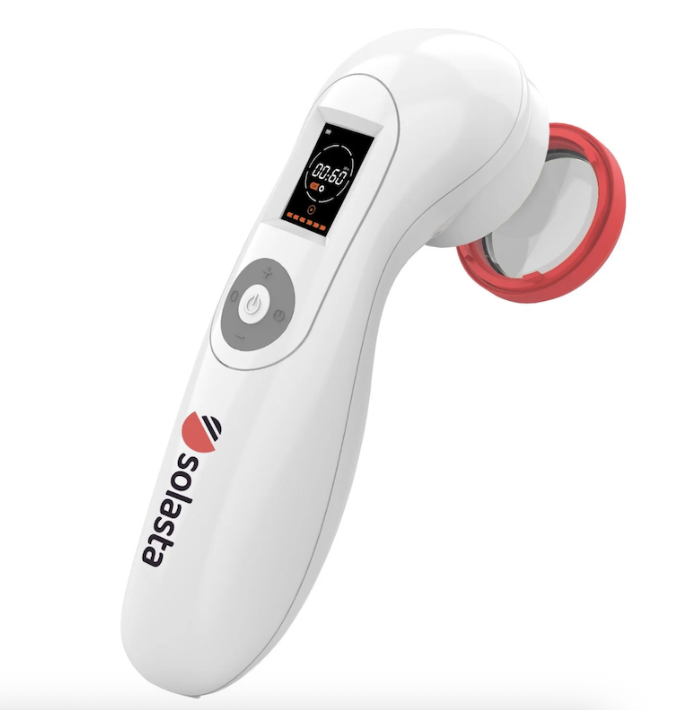
Now, true home lasers DO exist - like my Solasta device, But if you're looking at an LED panel or mask, laser studies simply don't apply.
The 5 Questions That Will Save Your Sanity
Before you invest in ANY photobiomodulation device for fertility, ask for these specifics:
1. What is the actual power output at the distance I'll be using it?
Don't accept vague answers. You need the irradiance measured in mW/cm² in skin contact - not just at the device surface.
2. What are the wavelengths?
NIR and red light is essential.
3. What specific medical indication received FDA clearance?
FDA 510(k) clearance means the device was cleared for specific medical claims based on clinical evidence. It does NOT mean the FDA verified every marketing claim or approved it for fertility use (there are no devices currently approved in the US for fertility). Get the actual clearance letter.
4. What published research supports this device type for fertility outcomes?
Not laser studies. Not "red light therapy" in general. Demand studies using the same technology (LED vs laser) with similar specifications for reproductive health.
5. What is your recommended protocol for my specific goal?
How long? How often? What distance? What body position? Dosing matters as much as the device itself.
But Here's the Thing About Photobiomodulation and Fertility...
Light therapy is just ONE piece of the fertility optimization puzzle.
In my work, my intake form is longer than any IVF clinic intake form.
Why? Because the information I gather about your complete health history gives me a fuller picture of your overall health and fertility - and how we can optimize it.
I'm not just looking at how to best use light therapy. I'm assessing:
· Your sleep quality and circadian rhythm patterns.
· Your natural sunlight exposure throughout the day.
· Your stress response and nervous system regulation.
· Your nutrition, movement, and environmental exposures.
· Your menstrual cycle patterns and biomarkers.
Fertility optimization isn't just about buying the right device. It's about understanding YOUR body, YOUR patterns, YOUR unique obstacles - and creating a comprehensive protocol that addresses all of them.
Sometimes that includes photobiomodulation with the right device at the right dose. Sometimes it starts with fixing your sleep and light exposure. Sometimes it's addressing luteal phase deficiency through multiple pathways.
But you can't know what you need until you have the complete picture and your IVF clinic isn’t interested in fixing any of it.
The Bottom Line
Some at-home LED devices may impact clinical outcomes and fertility biomarkers when used correctly (specifically combining my Solasta laser for external use and pelvic light therapy for intravaginal use).
Some "medical grade" devices are just overpriced consumer products with weak output that won't change your AMH, won't improve the environment your eggs are developing in, and won't increase your chances of conception.
The label won't tell you which is which.
The specs will.
Your fertility journey deserves devices backed by data, not just marketing departments. You deserve to know whether your investment will actually support better egg quality - or just make your Instagram feed look more wellness-optimized.
And more than that, you deserve a complete fertility optimization strategy using restorative reproductive medicine - not just a device recommendation.
Ask the hard questions. Demand the specific answers. And don't settle for buzzwords - there’s too much on the line.
Ready to optimize your fertility with evidence-based protocols tailored to YOUR body? I work with women trying to conceive - whether naturally or through IVF - to develop comprehensive fertility optimization strategies based on your complete health picture and specific biomarkers.
Let’s get to work!
Tracy