As a midwife and birth doula, I have spent years watching women do the extraordinary work of labor.
As a mother who has given birth vaginally twice - once with medication and once without - I have also lived a small part of that story from the inside.
Those births were different. The support I needed was different. And the lesson I carry from both is this:
Birth asks much of a woman - body, mind, and spirit. Suffering, when it comes, is not meaningless. No woman should have to labor unsupported, frightened, or ashamed for accepting the comfort measures or medical care that help her meet birth with peace and strength.
A woman deserves options.
She deserves excellent clinical care. She deserves someone protecting the normal physiology of labor while also recognizing when intervention is appropriate. She deserves movement, water, warmth, touch, quiet, nourishment when appropriate, a trusted person beside her, and access to medication or an epidural if that is what she wants or needs.
And I believe she should also have access to thoughtful, nonpharmacologic tools such as photobiomodulation - PBM, or red and near-infrared light therapy - as part of her labor comfort plan.
Not as a promise of a painless labor.
Not as a replacement for an epidural, skilled care, fetal assessment, or medical decision-making.
And not as a device to shine over the baby bump in hopes of “powering up” the uterus.
But as an optional, practical, and emerging evidence-informed tool for helping women manage labor pain - especially lower-back discomfort - while they do some of the most physically demanding work of their lives.
The research that stopped me in my tracks
A new report from Mount Sinai Hospital in Toronto described a possible answer to one of the great unanswered questions among birth professionals:
What actually helps switch labor on?
The research team, led by Stephen Lye, found evidence that near term, immune cells may move into uterine muscle and transfer their mitochondria directly into myometrial cells - the smooth-muscle cells of the uterus.
Let that sink in for a moment.
Your immune system may literally help deliver extra cellular energy to your uterus before labor begins.
The proposed sequence is remarkable:
· Near the end of pregnancy, the uterus releases cytokines and chemokines - signaling molecules that call immune cells toward the uterine muscle.
· Circulating monocytes enter the uterus and become macrophages.
· These macrophages form tiny tube-like bridges with uterine muscle cells.
· Through those bridges, the macrophages appear to donate mitochondria to the myometrial cells.
· ATP, the immediately available energy currency of the cell, rises.
· At the same time, the uterine cells increase local progesterone metabolism, possibly helping explain how human labor begins even though progesterone does not dramatically fall in maternal blood before birth.
In simple language: labor may begin partly because the uterus receives an energy handoff.
I think of it like a relay race.
The uterus has carried your baby for months. It has grown, stretched, softened, held, protected, and adapted. Then, when it is time to do the intensely physical work of labor, immune cells may hand it the biological baton: additional mitochondrial capacity, more ATP, and a local molecular shift toward contraction.
That is not a small detail.
It changes how we think about labor.
Labor is not merely mechanical. It is not simply “the uterus starts tightening.”
It is an exquisitely timed coordination of hormones, immune activity, nervous-system signaling, blood flow, oxygen availability, cellular energy, maternal emotions, fetal readiness, and the environment surrounding the woman (all of this - routine induction of labor tries to bypass)…
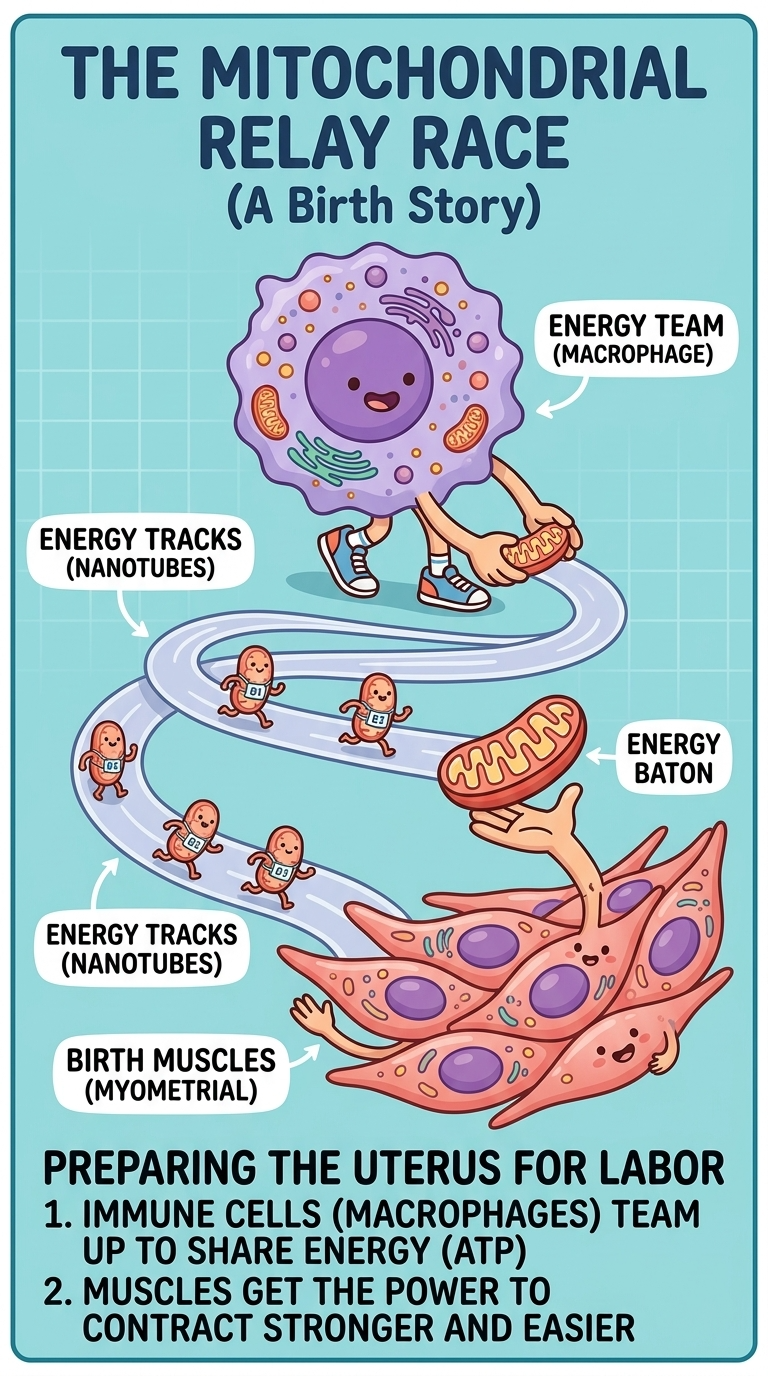
Immune cells donating mitochondria to the uterus
The tiny tubes with a big job
The “little tubes” described in the Mount Sinai work resemble what cell biologists call tunneling nanotubes.
Think of them as microscopic cellular bridges - or tiny biological extension cords.
They can allow one cell to pass materials to another cell, including entire mitochondria. Mitochondrial transfer has been studied in other areas of biology, including tissue injury, immune regulation, brain-cell stress, and cancer research. What is new here is the possibility that maternal macrophages use this process to support uterine muscle as normal labor approaches.
The body is not just telling the uterus to work.
It may be equipping it to work.
And that brings us to labor pain, muscular demand, oxygen, and why I think PBM deserves a real place in the labor-support conversation.
Labor is hard physical work
Women are sometimes told labor is “natural,” as if that should make it easy.
Natural does not mean effortless.
Natural does not mean painless.
And natural does not mean a woman should be expected to go through it without meaningful support.
Labor is powerful muscular work.
During a contraction, the uterus tightens and blood vessels traveling through the uterine muscle and placenta are compressed. Uteroplacental perfusion temporarily decreases - one review estimates a reduction of around 60% - before recovering again in the rest period between contractions.
That temporary drop in perfusion is part of normal labor physiology. In a healthy term pregnancy with adequate recovery between contractions, the baby and placenta are designed to tolerate those brief intervals.
But the uterine muscle is still working hard.
Contract.
Compression.
A temporary decrease in oxygen availability.
More metabolic demand.
A moment of rest.
Reperfusion.
Recovery.
Then another wave.
That cycle contributes to why contractions can feel so consuming.
Labor pain is not one simple sensation with one cause. It can include uterine muscle work, temporary hypoxia or ischemia during contractions, cervical dilation, tissue stretch, pressure from the baby’s position, back pain, fatigue, fear, uncertainty, and the way the brain interprets all of those signals.
Pain is real.
And women deserve help with it.
Lactate is not the enemy
You may hear people talk about lactate as though it is toxic waste that needs to be removed.
It is not.
Lactate is a normal part of human energy metabolism. During high-demand work, muscles may produce more lactate. The body can also use lactate as fuel and shuttle it between tissues. It is not simply something that needs to be “cleared.”
During labor, maternal lactate often rises because labor is metabolically demanding. That does not automatically mean something is wrong. In one recent cohort, maternal lactate increased through labor, with median values of 2.84 mmol/L at active pushing and 3.80 mmol/L at birth, without issues with with postpartum hemorrhage, or adverse cord-pH outcomes in that study.
So I am not suggesting that light therapy “flushes toxic lactate out of the uterus.”
That would be oversimplified and inaccurate.
What I am saying is this:
When a woman is doing repeated, intense muscular work, the conditions around that work matter.
Stress chemistry matters.
The ability to relax between contractions matters.
Sleep deprivation and fatigue matter.
Local muscular comfort matters.
The nervous system matters.
And a woman’s ability to remain within her coping capacity matters.
This is where photobiomodulation may be helpful.
What PBM can offer in labor
Photobiomodulation uses red and near-infrared light at specific parameters to influence biologic processes in the tissue being treated. In other contexts, PBM has been studied for pain modulation, inflammation, recovery, cellular signaling, and mitochondrial-related processes.
This does not mean that PBM recreates the macrophage-to-uterus mitochondrial transfer described in the new research.
It does not mean PBM increases uterine ATP during labor (but it’s very likely) as red light therapy immediately releases nitric oxide (improving blood flow around the body). It happens within minutes.
The new mitochondrial research does make the larger conversation more interesting.
If labor requires substantial cellular energy - and if our bodies appear to prepare the uterus through mitochondrial support - then it makes sense to study whether light-based approaches that influence pain and cellular signaling in other tissues can help support the woman during labor.
Not by treating her uterus directly.
By supporting her comfort.
By addressing pain in the lower back and sacrum.
By helping her stay regulated.
By giving her another non-drug option in a broader toolbox.
We do not shine light on the bump
I want to be very clear about the approach I am describing.
I am not recommending that women shine red or near-infrared light directly over the abdomen during labor.
I do not use PBM as a uterine-stimulation device.
I do not recommend trying to “supercharge” contractions, alter the immune system’s role in labor, increase uterine ATP, or change the baby’s oxygenation with a light device.
The Mount Sinai mitochondrial-transfer finding is fascinating, but it was observed in lab-based tissue research - not in women using a PBM device during labor.
The research we do have for labor pain focuses on maternal non-abdominal areas, especially the lower back.
That is important, because labor pain frequently shows up in the lower thoracic spine, lumbar area, sacrum, hips, and pelvis. Anyone who has experienced back labor - or supported a woman through it - knows that the lower back can become the loudest part of the room.
The lower-back PBM study
A small controlled randomized clinical trial in Brazil studied LED photobiomodulation for pain relief during childbirth.
Twenty-nine women were divided into two groups:
· One group received red and near-infrared PBM.
· The comparison group used a controlled-temperature hot shower.
The study found a statistically significant reduction in pain in the red light group after treatment.
That is a small study.
It does not tell us that PBM is the answer to labor pain.
But it does tell us something meaningful: lower-back red and near-infrared LED PBM reduced reported labor pain in a real clinical trial, without a detected difference in the fetal and newborn measures assessed in that small sample.
That deserves more attention.
The Iranian infrared-belt studies
Another research team in Mashhad, Iran, studied a different kind of light-based intervention: an 850 nm infrared tourmaline-ceramic heating belt placed around the maternal waist during first-stage labor.
This was not laser acupuncture. It was not a direct-abdominal PBM protocol. It was a thermal infrared-belt intervention used over the waist/lumbar region.
In the published pain study, the infrared-belt group had significantly lower first-stage pain scores than both the hot-water-bag and routine-care groups after treatment. The intervention group’s pain score was lower after the first and second sessions and remained lower at the end of first stage.
Pain was assessed with the short-form McGill Pain Questionnaire. The paper reports significant between-group differences favoring the infrared belt, with p < 0.001.
The researchers also reported greater satisfaction in the infrared-belt group: 86% described their satisfaction as “very good,” and 76% said they would recommend the intervention to others.
There were no reported abnormal fetal-heart-rate effects, no reported differences in 1- or 5-minute Apgar scores, no adverse events for mom/baby.
The belt delivered both infrared exposure and therapeutic warmth, so we cannot separate the effects of heat, infrared light, comfort, relaxation, local circulation, pain-gate mechanisms, or other factors. But that is precisely why I find the study useful in real maternity care: women do not experience labor in isolated mechanisms.
They experience it as whole human beings.
The first-stage duration findings
The same Iranian research group also published a separate three-arm randomized clinical trial on first-stage duration in 150 first time moms.
The researchers used two 20-minute cycles of infrared-belt or hot-water-bag at 4–5 cm and 6–7 cm dilation, with a routine-care control group. First-stage duration was measured from 4–5 cm dilation onward.
The abstract does not make the group-by-group duration values available in the English record I reviewed, so I will not pretend to know the exact mean number of minutes in each arm. But the authors’ conclusion is clear: the infrared-belt intervention was associated with a shorter first stage of labor and did not show adverse effects on fetal heart rate, Apgar scores, or postpartum hemorrhage in that trial.
Does this prove infrared therapy makes the uterus contract better?
No.
Does it prove every labor will be shorter with PBM?
No.
Could the effect have reflected a combination of warmth, comfort, reduced pain, less fear, greater relaxation, different local circulation, less muscular bracing, and a woman’s improved ability to cope?
Absolutely.
And honestly, that is not a weakness.
That is labor.
Labor is not one pathway. It is a living, interconnected system.
What I have seen as a midwife and birth doula
I want to be transparent about where published research ends and my own clinical experience begins.
I have personally seen women in their first labor at 5 to 7 cm - often a point when intensity rises and many women begin to question whether they can continue - remain surprisingly comfortable when PBM has been part of their labor-support plan.
I do not mean they felt nothing.
I do not mean every contraction was easy.
I do not mean a light device alone created their experience.
A woman’s labor is influenced by so many things: her baby’s position, her pelvis, her sleep, her hydration, her nourishment, her environment, who is in the room, whether she feels safe, whether she is afraid, how she has prepared her mind, whether she has support between contractions, and what other comfort tools she is using.
But I have watched women using red light therapy remain more present.
I have watched them soften between contractions instead of staying braced.
I have watched them come back to their breath.
I have watched them move, rest, drink, laugh, pray, cry, and then meet the next wave without the same degree of fear.
That matters.
In labor, the goal is not necessarily to make every sensation disappear.
The goal is to help a woman stay in her coping capacity.
To keep her from spending all of her energy fighting what her body is doing.
To help her feel supported enough that she can rest in the spaces between contractions and gather herself for the next one.
The mind is part of pain management
This is where I want to speak as both a midwife and a mother.
A prepared mind matters.
Not because pain is “all in your head.”
It is not.
The physical work of labor is real. The pressure is real. The stretch is real. The temporary reduction in oxygen availability during contractions is real. Back labor is real. Exhaustion is real.
But the mind interprets pain.
And an untrained, frightened, wandering mind can add a tremendous amount of suffering to an already intense physical experience.
One contraction can become:
“What if I cannot do this?”
“What if it gets worse?”
“What if I am not progressing?”
“What if something is wrong?”
“What if I lose control?”
That story can begin before the next contraction arrives. It can peak with the contraction. And it can linger long after the contraction ends.
The contraction has a beginning, a peak, and an end.
But the mind can keep replaying it.
This is why I believe childbirth preparation should include genuine brain and nervous-system training (all part of my previous life as Founder of the GentleBirth App):
· Practicing breath and relaxation before labor begins.
· Learning to return attention to the present moment.
· Preparing phrases, prayers, visualizations, or affirmations that feel true—not forced.
· Understanding the physiology of contractions so intensity does not automatically feel like danger.
· Learning how to vocalize, move, ask for touch, ask for space, and communicate needs.
· Choosing support people who can help reduce noise rather than add it.
· Remembering that accepting pain relief is not a failure—and choosing unmedicated labor is not a requirement for strength.
PBM can support pain management.
TENS can support pain management.
Hydrotherapy can support pain management.
Counterpressure can support pain management.
An epidural can support pain management.
And so can a mind that has been trained to work with the body rather than fear every sensation it produces.
PBM and TENS can work together
Doulas often ask if moms can use a TENS and red light therapy. I do not see PBM and TENS as competing tools.
I see them as different instruments in the same orchestra.
TENS uses electrical stimulation to modulate pain signaling. It can be especially useful in early labor and back labor, where steady sensory input can help turn down the nervous system’s perception of pain.
PBM uses targeted red and near-infrared light and may support local pain modulation, tissue comfort, and biologic signaling.
One woman may find that TENS helps her most in early labor while she is moving around the house.
Another may love hydrotherapy.
Another may need strong sacral counterpressure during every contraction.
Another may choose nitrous oxide.
Another may decide that an epidural is the best way for her to conserve energy and participate in her birth.
And a woman can use more than one tool.
That is the point.
Women deserve a full toolbox - not a contest to see who can labor with the fewest supports.
Let’s talk about light in the room
There is another kind of light that affects labor, and it has nothing to do with a PBM device.
The light in the room.
Labor is a hormonal and circadian event. Many women naturally begin or intensify labor at night, when darkness supports melatonin production and the environment tends to be quieter and more private. Melatonin interacts with oxytocin biology and may be part of the physiologic rhythm of labor.
This is why I care about protecting the labor environment.
Dim the overhead lights when possible.
Use warm, low lighting.
Reduce unnecessary screens and harsh blue-white glare.
Keep the room calm.
Protect privacy.
Make it feel less like a place where a woman is being observed and more like a place where she is being supported.
PBM is therapeutic, targeted light.
Room lighting is circadian and sensory information.
They are different.
But both remind us that light is not neutral.
Light tells the body something.
Why I believe PBM belongs in labor support
I believe lower-back PBM should be available as an optional nonpharmacologic comfort tool for women in labor.
Not because it is the only answer.
Not because every woman needs it.
Not because it replaces medical care.
Not because it guarantees a shorter labor.
And not because I want women to feel pressure to avoid medication.
I believe it belongs in the conversation because women deserve choices.
They deserve pain-management options that are more nuanced than “just breathe” or “take an epidural.”
They deserve care that honors the body’s physiology while also using thoughtful technology.
They deserve tools that can be layered: PBM, TENS, warmth, water, movement, counterpressure, touch, breath, GentleBirth preparation, nitrous oxide, medication, epidural analgesia, and skilled clinical care.
And they deserve providers who can say:
“You do not have to prove anything here. Let’s find what helps you.”
The early research is not perfect, but it is meaningful.
And the new Mount Sinai research gives us a breathtaking reminder that labor itself may depend on precisely coordinated mitochondrial support inside uterine muscle.
These studies do not prove that PBM changes the mitochondrial handoff in the uterus.
But they do make one thing very clear to me:
We should be studying this.
And while we do, women deserve to know that light-based, lower-back comfort support is a reasonable option to discuss with qualified maternity providers.
The bottom line
I have experienced vaginal birth with medication.
I have experienced vaginal birth without it.
Both taught me something about surrender, strength, dependence, and the astonishing work of bringing a child into the world.
As a midwife, I have supported women who found profound peace in an epidural, women who drew strength from the birth pool, women who prayed through every contraction, women who needed every comfort measure available, and women who discovered reserves they did not know they possessed.
Birth is not a contest. It is not a test a woman must pass by using - or refusing - a particular kind of pain relief. It is sacred work, and every woman deserves care that recognizes the fullness of what she is doing: physically, emotionally, and spiritually.
Whether she chooses prayer, movement, water, counterpressure, PBM, TENS, nitrous oxide, medication, an epidural, or a combination of supports, she deserves to be met with reverence and respect.
For some women, lower-back PBM may become one more gentle, noninvasive tool - one that supports comfort and helps her remain present for the holy work of bringing her baby into the world.
In my own practice, I also use the Solasta laser immediately postpartum to support perineal comfort and healing after birth. The postpartum period is a time of enormous transition: a mother is recovering from labor, healing from stretching or tissue trauma, learning to feed her baby, functioning on interrupted sleep, and adjusting to a completely new rhythm of life.
Used with appropriate screening, informed consent, eye-safety precautions, device-specific parameters, and postpartum assessment, PBM can be a gentle addition to standard perineal care. I see it as supportive - not a replacement for evaluating any postpartum concern that needs prompt clinical attention.
Many of my clients are also taught how to use their own laser at home as part of an ongoing recovery plan. This may include support for breastfeeding-related nipple soreness, perineal comfort, musculoskeletal aches from feeding and carrying a baby, and the normal healing demands of the postpartum season.
The goal is not perfection or pressure to “bounce back.” It is to give mothers another practical, nonpharmacologic tool for comfort and recovery - so they can spend less time overwhelmed by pain and more time resting, healing, feeding their baby, and settling into motherhood with support around them.
If you would like a personalized Solasta protocol for your upcoming labor/birth (vaginal or cesarean) let’s talk.
Tracy
Additional Resources:
Red Light Therapy for Pain in Pregnancy
https://www.youtube.com/watch?v=SFKU6IP-FAw
Red Light Therapy for Postpartum Nipple Soreness
https://www.youtube.com/watch?v=mB0gewZQMt4
Safety of Red Light Therapy in Pregnancy
https://blog.tracydonegan.org/blog/is-red-light-therapy-safe-in-pregnancy
Madi, O. (2015). Analysis of the immediate hemodynamic response to low-level laser application in hypertensive and normotensive pregnant women. Master's dissertation, UNINOVE, São Paulo.
Alsharnoubi, J. et al. (2015). Laser acupuncture effect on fetal well-being during induction of labor. Lasers Med Sci. https://pubmed.ncbi.nlm.nih.gov/25371029/
Photobiomodulation for analgesia during childbirth: RCT (2021). https://pubmed.ncbi.nlm.nih.gov/33760671/
Important note
This article reflects emerging research and my professional and personal perspective as a midwife and mother. PBM should be considered an adjunctive comfort option, not a substitute for clinical evaluation, fetal monitoring when indicated, assessment of labor progress, treatment of complications, or medically recommended induction. The research discussed does not establish that PBM induces labor, increases uterine ATP, causes mitochondrial transfer, improves contraction effectiveness, lowers uterine lactate, or prevents preterm birth. Women should discuss any PBM use in pregnancy or labor with their midwife or obstetric clinician, particularly if they have a high-risk pregnancy, vaginal bleeding, fever, hypertension, reduced fetal movement, suspected preterm labor, or any recommendation for additional monitoring or intervention.