Is Red Light Therapy Safe in Pregnancy?
Yes, red light therapy is generally considered safe during pregnancy because red and near-infrared light (600 - 1000nm) are non-ionizing radiation that cannot alter DNA. However, experts recommend avoiding direct exposure to the belly/bump as a precaution.
Here's What the Research Actually Says
Let's have an honest conversation about red light therapy in pregnancy. I work with a lot of women who use photobiomodualtion to support their fertility so this is a question I get asked often. If you've been using red light therapy (photobiomodulation, or PBM) and you just found out you're pregnant, or you're pregnant and wondering whether you have to give up your panel for nine months, you probably have one big question spinning around your head at 2am: Is this safe for my baby?
Here's the deal: it's the right question to ask. And you deserve a real answer, not a shrug and a “better safe than sorry.” So let me walk you through what the actual research shows - including a handful of studies where researchers literally monitored the baby's heartbeat during light therapy - plus the common-sense caveats every smart expectant mom should follow.
This is the honest, evidence-based talk you've been looking for.
Understanding the Physics: Non-Ionizing Light vs. Radiation
This is the single most important concept, so let's start here.
When people hear light therapy/laser therapy and “pregnancy” in the same sentence, their brain jumps to X-rays, CT scans, and “avoid all radiation.” Totally understandable - but red and near-infrared light are in a completely different category.
Red and near-infrared light (roughly 600 - 1000nm) is non-ionizing. That means it physically cannot break chemical bonds in DNA, cause mutations, or trigger birth defects the way ionizing radiation (X-rays, gamma rays, UV-C) can. It sits in the same family as visible light and the warm infrared you feel from the morning sun, not the scary stuff.
Bottom line: The mechanism that makes X-rays dangerous in pregnancy simply does not exist with red light therapy. That's just physics.
What Does Clinical Research Say About Fetal Safety?
Here's what I love as a research nerd: we don't have to guess. There are real clinical studies where practitioners used light therapy on pregnant women and monitored the baby's heart with EFM (electronic fetal monitoring / cardiotocography) the entire time. If light therapy were stressing babies, this is exactly where we'd see it. We don't.
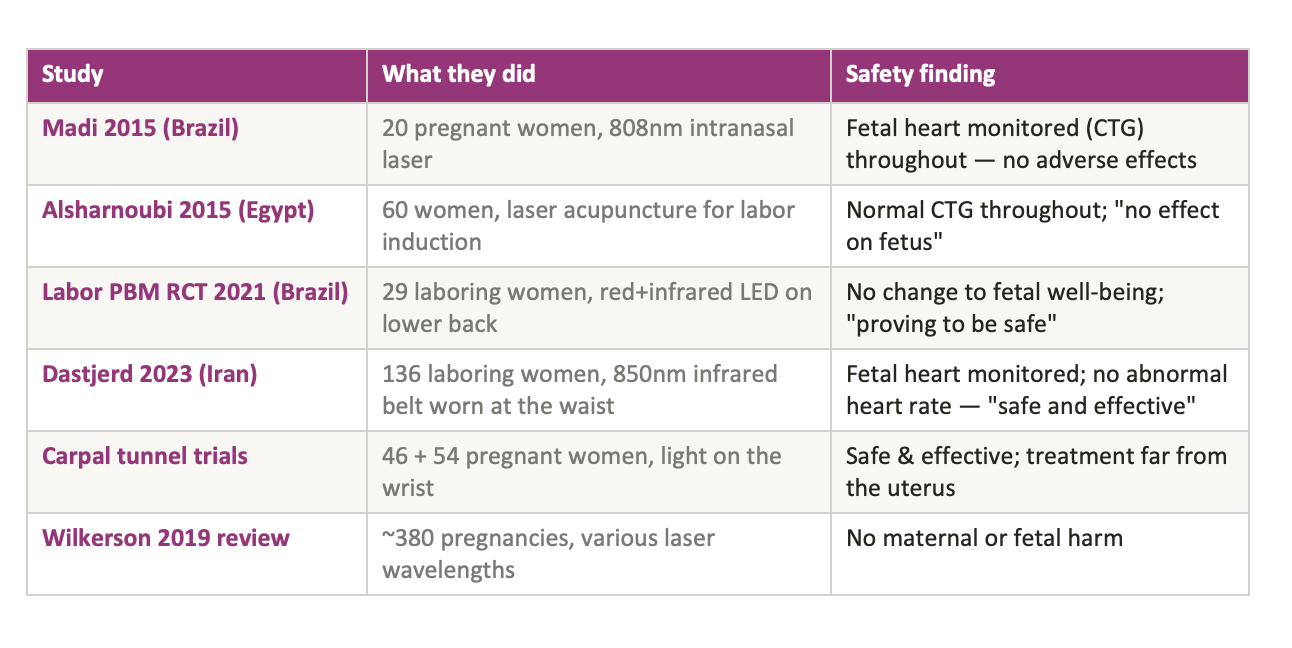
Review of current evidence of red light therapy use during pregnancy/labor.
1. The Madi hypertension study (Brazil, 2015) — fetal heart monitored the entire time.
This one is close to my heart because the researchers were so careful. Otávio Madi's master's dissertation at Universidade Nove de Julho (UNINOVE) in São Paulo studied 20 pregnant women - both hypertensive (high blood pressure) and normotensive (no blood pressure issues) - receiving low-level laser therapy.
Here's the beautiful part: the laser was delivered intranasally shining the light up the nose (808nm, 100mW, just 120 seconds) - nowhere near the belly - and cardiotocography monitored the babies throughout the entire procedure. The result, in the researchers' own words: “Considering cardiotocography, no adverse effects of maternal and fetal repercussions were detected... the Laser did not produce harm to the fetus, moreover signalized a favorable and feasible fetal repercussion.”
Translation: They watched the babies' heartbeats in real time during laser therapy, and the babies were completely fine. It did reduce mom’s blood pressure if she already had high BP and had no impact on the mom’s who had normal bp (this is very reassuring).
2. Laser acupuncture for labor induction (Cairo, 2015) - normal CTG throughout
In this randomized trial, researchers used laser acupuncture (not needles — light on acupuncture points) on 60 first-time mothers who were 40+ weeks pregnant, to see if it could nudge labor along.
The safety data is the gold here. Fetal well-being was tracked with cardiotocography throughout, and the authors concluded plainly: “Laser acupuncture has no effect on fetus” - with normal CTG tracings and no side effects reported. This study even made it into a Cochrane systematic review on acupuncture for labor induction.
3. LED photobiomodulation for labor pain (São Paulo, 2021) — "proving to be safe"
This is one of my favorites because it used PBM during active labor. In this randomized controlled trial, 29 laboring women received red LED (660nm) plus infrared (850nm) light applied to the lower back for 10 minutes.
They measured fetal well-being by cardiotocography and checked Apgar scores at 1 and 5 minutes. The findings: pain went down, and there was no change to fetal well-being or labor duration - the intervention was, in their words, “proving to be safe.”
4. The Iranian infrared belt study (Mashhad, 2023) — a near-infrared belt worn during labor
This one is especially interesting because it's the closest thing we have to a wearable light belt studied in labor. In this randomized controlled trial in Iran, 136 first-time mothers were split into three groups - an infrared belt, a hot water bag, and routine care, during the first stage of labor.
The belt was a tourmaline-ceramic near-infrared belt (850nm) applied in 20-minute cycles. Here's the honest nuance, because I always give it to you straight: this device is framed as an infrared heat belt, so its effect is partly thermal — it's not a pure low-level laser. But it operates in the same near-infrared range we've been talking about, and it was worn on the body during active labor.
The safety data is what matters for us: the fetal heartbeat was monitored during the intervention, and there were no abnormal fetal heart rates, no hyperthermia, no skin reactions, and no postpartum hemorrhage. The authors concluded the infrared belt “could be used and recommended as a safe and effective pain relief in childbirth and maternity care.” Pain scores dropped significantly, too.
5. Light therapy for carpal tunnel in pregnancy - safe on the wrist, far from the bump
Pregnancy carpal tunnel is miserable and common, and this is where light therapy has been studied specifically in pregnant women. A prospective clinical trial treated 46 pregnant women (all in their third trimester) with laser directly on the wrist — and concluded it was a “reliable, safe, and effective treatment option in pregnant patients.” A separate randomized trial of high-intensity laser on the wrist in 54 pregnant women also showed clinical improvement.
One note: these wrist studies didn't use continuous EFM during treatment — but that makes sense, because the wrist is about as far from the uterus as you can get. The takeaway isn't “EFM confirmed safety on the belly.” It's “light therapy on a distant body part, in pregnant women, showed no harm.”
6. The big-picture safety review — 380 pregnancies, no harm
Zooming out: a systematic review looked at 22 publications covering 380 pregnant women treated with various laser wavelengths across all trimesters. Other than one case of premature rupture of membranes only questionably related to treatment, there were no cases of maternal or fetal harm, premature labor, or fetal stress. The authors added a line I want you to hold onto: “laser physics and optics dictate there should theoretically be no risk of fetal laser exposure from commonly used cutaneous lasers.”
So when we add it up: multiple studies — including ones where the baby's heart was monitored in real time — and hundreds of documented pregnancies, with no sign of harm.
But wait - how much light actually reaches my baby?
Okay, this is the question I get asked most, and it's such a good one. Because “no harm in studies” is reassuring, but you want to understand why. So let's talk about what actually happens to light when it hits your body.
Here's the honest, slightly surprising truth: your body is an incredible light filter, and only a tiny sliver of light ever reaches the womb - but it's not zero.
The womb is dim, not pitch-black
Scientists have actually measured this. Using tissue transmission models, researchers estimate that in a light-skinned, unclothed woman, only about 0.1% to 1% of ambient light makes it into the uterus. Older animal measurements found roughly 2% of light transmitted into the uterus at biologically relevant wavelengths, rising to about 12% at 650nm through full maternal tissue. To put a picture on it: in bright sunlight, the inside of the womb is thought to be about as bright as a heavily curtained room or a clear night under a full moon — dim, diffuse, and reddish (sounds cozy!).
Your belly fat is the real gatekeeper (and this changes by stage of pregnancy)
Here's the fascinating part for anyone who loves the science. A 2025 Monte Carlo simulation study (12+ billion simulated photons) found that adipose tissue — body fat — is the single biggest factor determining how much light reaches the uterus. Their third-trimester modeling of light hitting the maternal abdomen found, at the uterine wall:
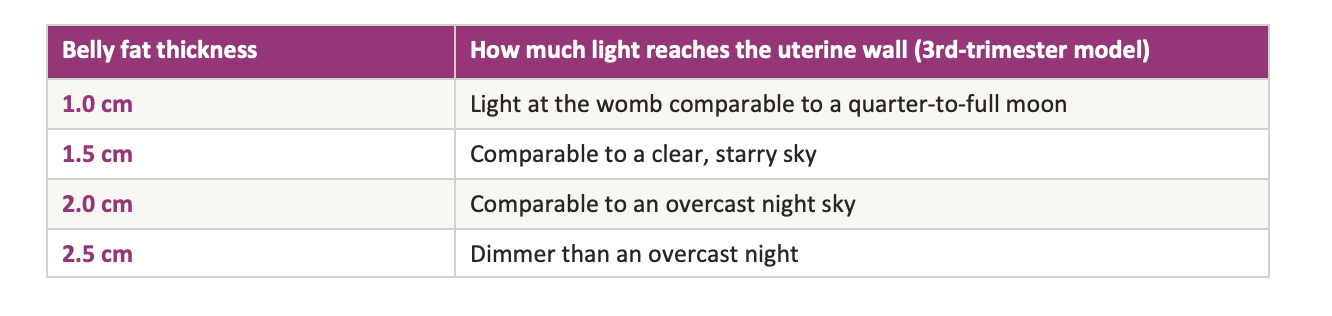
The kicker: reducing fat thickness by just 0.5cm increases the light reaching deep inside by about 15 times. And red-orange wavelengths (600 - 700nm) penetrate best, while blue and UV are almost entirely absorbed by the surface.
This matters for stage of pregnancy in two ways. First, as your abdomen thickens through pregnancy, the tissue barrier between a panel and the womb generally increases. Second, researchers have found that amniotic fluid becomes more optically dense as pregnancy progresses — so less light passes through in late gestation than early on, with peak transmission around 850nm (near-infrared).
Where Can You Use Red Light Therapy During Pregnancy?
Facial LED Masks (Melasma & Pregnancy Acne)
Musculoskeletal Joint & Back Pain (Targeted spot treatment)
Sunlight vs. your panel: the honest comparison
Here's a comparison I want you to really sit with, because it reframes the whole worry.
When you step outside for 20 minutes of morning sun on your skin, you're being bathed in full-spectrum light at very high intensity — sunrise solar irradiance is on the order of 100 mW/cm² across visible, infrared, and UVA. A home red light panel typically delivers a fraction of that intensity in a narrow band of wavelengths. In both cases, the overwhelming majority of that light - often 99%+ - is absorbed and scattered by your skin, fat, and muscle long before it could reach your baby. Direct laparoscopy measurements show 3–5 orders of magnitude of light being lost through the abdominal wall alone.
So if you're comfortable getting a little morning sun on your bump - which delivers far more total light energy to your body - then a red light device used sensibly is a much gentler exposure, not a scarier one. And whichever way you get it, only a whisper of that light ever reaches your little one.
The bigger picture: Red light therapyy for pain, and why sunshine still matters most
Here's a thought I want to leave you with, because it reframes why this research is so exciting.
Pregnancy and labor come with real pain - and our usual pharmaceutical options all carry trade-offs. Many pain medications cross the placenta, come with side effects, or simply aren't recommended in pregnancy. That's exactly why a drug-free, non-ionizing tool like PBM is so appealing: in the studies we just walked through, it eased pain during labor while the babies' hearts stayed calm and reassuring. A gentle tool with a clean safety signal is a beautiful thing to have in the toolbox.
And here's where the newest science gets really cool. Professor Glen Jeffery's lab at UCL — the same group behind the red-light-and-blood-sugar work, published a 2025 study showing that longer wavelengths of sunlight actually pass all the way through the human body. They measured near-infrared light (around 830 - 860nm) after it traveled through the human torso, and found it improved mitochondrial function and cellular energy (ATP) - with effects showing up a full day later. Their words: sunlight's longer wavelengths “can reach key organs even through clothing and likely promote mitochondrial function.” Clothing dimmed the light but didn't block it.
Why does that matter for you? Because it tells us the sun is a legitimate, deep-reaching source of the very same near-infrared light we use in panels - and it's free.
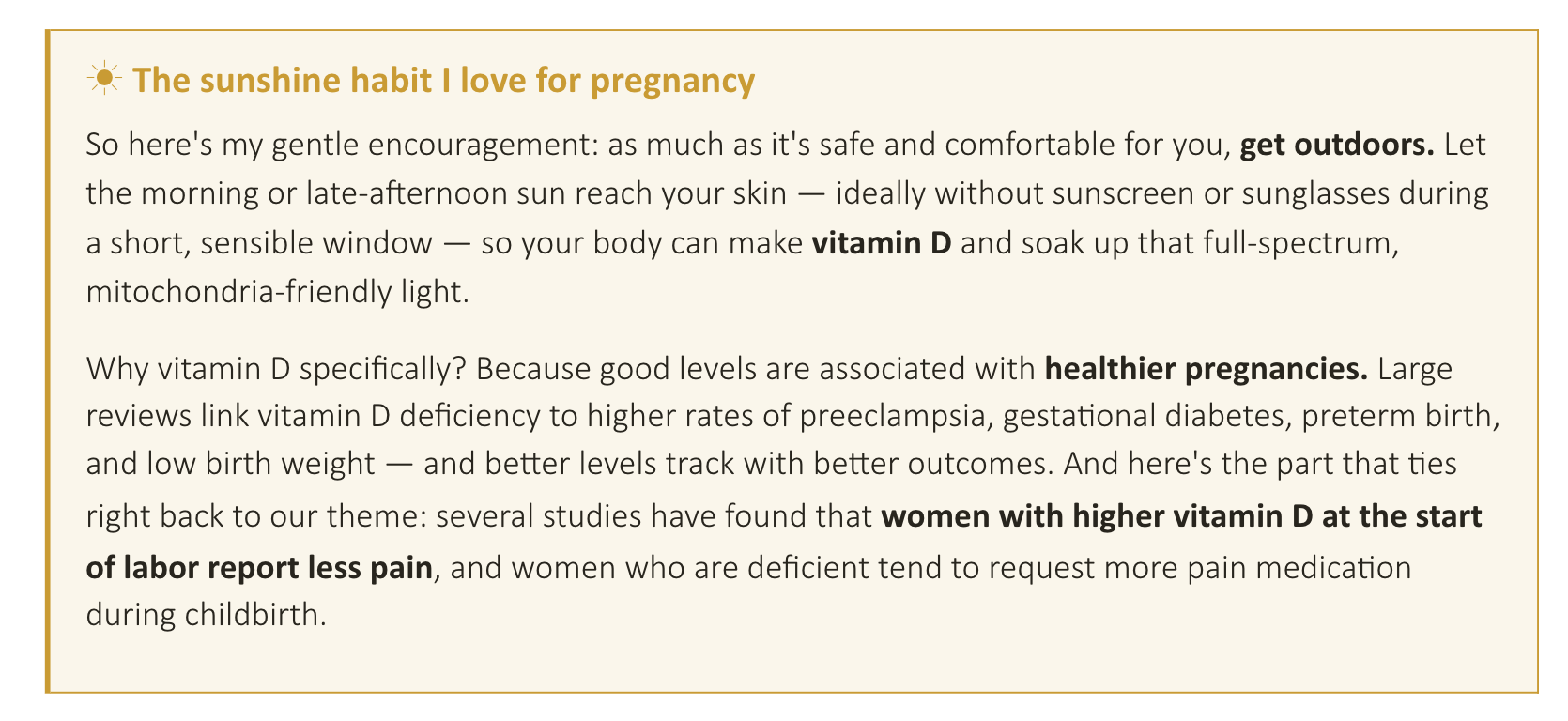
Download the FREE D-Minder app for safe sun exposure timing.
What the international guidance actually says (and it’s more nuanced than "don’t")
Now, let's be real about the caveats around red light therapy during pregnancy.
The consistent message from clinicians worldwide - including Michael Hamblin, one of the most cited PBM researchers - is not “never.” It's “don't light up the bump.” Brazilian clinical guidance frames it perfectly: this is a local precaution, not an absolute contraindication for the whole body.
The advice is to avoid direct application over the abdomen, pelvis, and lower back, be extra cautious in the first trimester when organs are forming, and treat other areas (face, hands, feet, upper body) with sensible parameters. The North American Association for Laser Therapy (NAALT) similarly recommends not using laser directly over the developing fetus.
German and Swiss obstetric literature echoes the same theme for light-based labor preparation - that low-level “soft laser” stimulation of acupuncture points is used precisely because it's low-risk and needle-free.
So - what’s the honest verdict?
Here's where I land after digging through all of it as a mom, midwife and someone who uses PBM regularly with my clients in labor.
Red and near-infrared light is non-ionizing - it can't damage DNA the way X-rays can. Multiple studies, including ones that monitored the baby's heartbeat in real time, showed no harm. Hundreds of documented pregnancies across the literature show no signal of danger. And the physics tells us that only a tiny, dim, filtered fraction of light ever reaches your baby - less, in fact, than what reaches them when you enjoy morning sun on your skin.
The evidence we have is genuinely reassuring. It's also true that we don't yet have large, pregnancy-specific randomized trials with light aimed directly at the belly — which is exactly why the universal, sensible caveat is: don't light up the bump, treat distant areas, and loop in your provider.
You don't have to choose between being smart and being at peace. You can be both.
Additional Resources:
For a deep dive on how light therapy supports pregnancy energy, back pain, and metabolic health, read my companion guide here
https://blog.tracydonegan.org/blog/safety-of-red-light-therapy-in-pregnancy
Oral Inflammation and Preterm Birth
https://blog.tracydonegan.org/blog/red-light-therapy-to-protect-your-pregnancy
Pelvic Girdle Pain
https://blog.tracydonegan.org/blog/pelvic-girdle-pain-red-light-therapy
This article is for educational purposes and is not medical advice. Photobiomodulation has not been evaluated by the FDA to treat, cure, or prevent any pregnancy-related condition. Always consult your OB, midwife, or qualified healthcare provider before starting or continuing any light therapy during pregnancy, labor, or postpartum - especially if you have a higher-risk pregnancy.
Frequently Asked Questions
General Safety & Fundamentals
Is red light therapy safe to use while pregnant?
Yes, red light therapy (photobiomodulation) is widely considered safe and low-risk during pregnancy when used correctly. Because red and near-infrared light (600 - 1000 nm are non-ionizing, they do not produce harmful radiation, break chemical bonds, or cause cellular mutations like X-rays or UV rays do. However, because pregnancy-specific clinical trials are naturally limited, most experts advise using targeted treatments and keeping the light off your bare abdomen as a general precaution.
Can red light therapy harm my unborn baby?
There is no evidence that red light therapy harms a developing fetus. Sunlight exposure on your bare skin delivers significantly more energy than an at-home red light panel, yet over 99.9% of that solar light is absorbed, scattered, or blocked by maternal tissue before reaching the uterus. Therapeutic red light penetrates only a few millimeters into skin and sub-dermal tissue.
Does red light emit dangerous radiation or heat?
No. Red light therapy uses visible red light and invisible near-infrared (NIR) light, which sit on the opposite end of the electromagnetic spectrum from ionizing radiation (like X-rays and gamma rays). Quality LED panels are non-thermal or emit only mild, soothing warmth - they will not raise your core body temperature or pose a hyperthermia risk.
Body Regions & Usage Precautions
Can I use an LED face mask for pregnancy acne or melasma?
Yes. Using an FDA-cleared LED face mask or targeted wand on your face, neck, chest, hands, or feet is widely considered safe during pregnancy. These areas are far removed from the uterus, making facial photobiomodulation an appealing, drug-free alternative to skincare ingredients that are off-limits during pregnancy (such as topical retinoids).
Is it safe to use red light panels on my back for pregnancy back pain?
Yes, spot-treating your upper back, lower back, hips, or knees for musculoskeletal pain is generally safe and very effective. Pregnancy causes postural shifts and joint laxity (thanks to the hormone relaxin), leading to severe lower back or pelvic girdle pain. Applying targeted red light to these joints reduces localized inflammation without taking pharmaceuticals.
Why do manufacturers advise against putting red light directly on the pregnancy bump?
Most manufacturers include a blanket "not recommended during pregnancy" warning purely for legal liability and defensive labeling, as pregnant women are excluded from clinical safety trials. Leading photobiomodulation researchers (such as Dr. Michael Hamblin) maintain that red light medicine is non-harmful, but avoiding direct abdominal application remains the standard precaution in the wellness community.
Trimesters, Timing & Specific Conditions
Can I use red light therapy during the first trimester?
While non-ionizing light carries no biological mechanism to cause birth defects or miscarriage, some practitioners recommend waiting until the second trimester simply out of an abundance of caution, as the first trimester is when organogenesis (fetal organ formation) occurs. If you do use it during the first trimester, stick to localized facial or limb applications.
Will red light therapy prevent or treat stretch marks?
Red and near-infrared light stimulate mitochondrial production of ATP (cellular energy) and encourage collagen and elastin synthesis. While it cannot entirely prevent stretch marks caused by rapid structural stretching, applying red light to targeted areas post-pregnancy can significantly speed up skin repair, improve elasticity, and fade discoloration.
Is red light therapy safe during postpartum and C-section recovery?
Very much so. Postpartum is one of the best times to utilize red light therapy. It accelerates wound healing (including perineal tears, episiotomies, and cesarean incisions), reduces localized inflammation, supports metabolic recovery from the demands of pregnancy, and helps regulate circadian rhythms to combat postpartum exhaustion and mood dips.
Red Light vs. Other Light Sources
How does red light therapy differ from tanning beds or SAD lamps?
Tanning Beds (UV Light): Use ionizing ultraviolet radiation, which damages cellular DNA, degrades essential folate in pregnant women, and increases melanoma risk. Avoid during pregnancy.
SAD Lamps (Bright White Light): Use high-lux white light aimed at the eyes in the morning to suppress melatonin and boost morning alertness.
Red Light Therapy (600 - 1000 nm: Uses non-ionizing red and near-infrared wavelengths directed at the skin/body to stimulate mitochondrial cellular energy (ATP) without UV risks or eye-strain bright white light.
What about artificial light at night (blue light)?
While therapeutic red light in the morning or early evening supports cellular health, artificial blue light at night (from screens, overhead LEDs, and tablets) suppresses melatonin, disrupts circadian balance, and is linked to elevated risks of gestational diabetes and poor sleep quality during pregnancy. Swapping bright screens for warm, amber/red lighting in the evening is a simple way to protect your health and your baby’s.
Sources
• Madi, O. (2015). Analysis of the immediate hemodynamic response to low-level laser application in hypertensive and normotensive pregnant women. Master's dissertation, UNINOVE, São Paulo.
• Alsharnoubi, J. et al. (2015). Laser acupuncture effect on fetal well-being during induction of labor. Lasers Med Sci. https://pubmed.ncbi.nlm.nih.gov/25371029/
• Photobiomodulation for analgesia during childbirth: RCT (2021). https://pubmed.ncbi.nlm.nih.gov/33760671/
• Study protocol — PBM for labor analgesia (NCT03496857). https://pmc.ncbi.nlm.nih.gov/articles/PMC6023678/
• Liebert Publishers — Effectiveness of photobiomodulation for analgesia during childbirth. https://home.liebertpub.com/news/effectiveness-of-photobiomodulation-for-analgesia-during-childbirth/3839
• Dastjerd, F. et al. (2023). Effect of infrared belt and hot water bag on labor pain intensity: an RCT. BMC Pregnancy and Childbirth (Mashhad, Iran; trial IRCT20190805044446N1). https://pmc.ncbi.nlm.nih.gov/articles/PMC10234070/
• Treatment of carpal tunnel syndrome in pregnancy with polarized polychromatic light (Bioptron). LASER THERAPY. https://www.jstage.jst.go.jp/article/islsm/26/4/26_17-OR-18/_pdf
• Ashour et al. (2022). High-intensity laser therapy in pregnant women with carpal tunnel syndrome: RCT. https://www.sciencedirect.com/science/article/pii/S0894113022000394
• Wilkerson et al. (2019). Utilization of laser therapy during pregnancy: a systematic review. Lasers Med Sci. https://pubmed.ncbi.nlm.nih.gov/30998530/
• Del Giudice, M. (2011). Modeling the conditions for visual experience in human fetuses. https://marcodg.net/wp-content/uploads/2014/04/delgiudice_2011_visual-experience_human-fetuses-dpb.pdf
• Jacques, S. et al. (1987). Penetration of light into the uterus of pregnant mammals. https://institutobeatrizyamada.com.br/wp/wp-content/uploads/2023/08/PENETRATION-OF-LIGHT-INTO-THE-UTERUS-OF-Pregnat-mammals.pdf
• Isaac, Z. et al. (2025). The effect of adipose tissue on transdermal monochromatic light presented to the human fetus (Monte Carlo). Scientific Reports. https://pmc.ncbi.nlm.nih.gov/articles/PMC11836304/
• Optical properties of human amniotic fluid. Fetal Diagn Ther (Karger). https://karger.com/fdt/article-abstract/27/2/87/135501/Optical-Properties-of-Human-Amniotic-Fluid
• Design of a light stimulator for fetal and neonatal studies (light penetration & safety). Physiol Meas. https://pmc.ncbi.nlm.nih.gov/articles/PMC2965530/
• Pregnancy-related carpal tunnel syndrome review (NAALT guidance cited). Cureus. https://pmc.ncbi.nlm.nih.gov/articles/PMC12617996/
• Is red light therapy safe during pregnancy? What research shows (non-ionizing, safety overview). Hale Health. https://halehealthrecovery.com/blog/red-light-therapy-pregnancy-safety
• Contraindicações do laser de baixa intensidade — local precaution vs. absolute contraindication (Portuguese). https://www.virginiaferreirasaude.com.br/post/indica%C3%A7%C3%B5es-contraindica%C3%A7%C3%B5es-e-precau%C3%A7%C3%B5es-do-laser-de-baixa-intensidade-o-que-realmente-importa-na
• Grávidas podem fazer laserterapia? Contraindications & parameters (Portuguese). LaserTheraPro. https://lasertherapro.com.br/gravidas-podem-fazer-laserterapia-veja-as-contraindicacoes-reais/