Pregnancy Hypertension and Red Light Therapy
Let's talk about something that's been lighting up my research feed lately (pun absolutely intended).
You've probably heard me get excited about photobiomodulation before - that's the fancy name for red and near-infrared light therapy. I use it. I study it. I genuinely believe it's one of the most exciting tools in women's health right now. But today I want to go somewhere a lot more important: high blood pressure in pregnancy and the use of red light therapy.
And here's the deal. There is a study on this. Not a hunch. Not a wellness-influencer claim. An actual clinical dissertation on pregnant women. So grab your coffee (or your third glass of water), and let me walk you through exactly what it found, what protocol they used, and this is the part I need you to hear - safety cautions.
Why this matters so much
Let me set the stage, because context is everything.
Hypertensive disorders of pregnancy - chronic hypertension, gestational hypertension, and preeclampsia - are one of the leading direct causes of maternal death worldwide. The World Health Organization estimated hundreds of thousands of maternal deaths globally, and high blood pressure accounts for a heartbreaking share of them, many of which are preventable.
Here's the frustrating part: for preeclampsia specifically, our medical toolbox is thin. Blood pressure meds can blunt the severe spikes, but they don't cure the underlying disease. Magnesium sulfate - used for over 70 years, prevents seizures but doesn't treat the preeclampsia itself. The only definitive “cure” is delivery. That's it. That's the whole list.
So when researchers start asking, “Could light therapy help?” I get excited. And I think you should too.
First, what standard care actually looks like
Before we go one inch further into the light-therapy conversation, I want you grounded in what the medical standard of care is right now - because everything else I share lives around this, never instead of it.
When you have high blood pressure or preeclampsia in pregnancy, your care team is typically working from a few tools (per ACOG, the American College of Obstetricians and Gynecologists):
• Blood pressure medications. For dangerously high pressures (160/110 or above), the first-line medicines are labetalol, hydralazine, and nifedipine - given fast, often within 30 - 60 minutes, to reduce the risk of stroke.
• Magnesium sulfate. This doesn't lower blood pressure - it's given to prevent or stop eclamptic seizures, and it's been a cornerstone for decades.
• Closer monitoring. More frequent visits, lab work (platelets, liver, kidney), and fetal surveillance, watching for the disease to progress.
• Timing of delivery — the only true cure. For preeclampsia, the definitive treatment is delivering the baby and placenta. With severe features, ACOG often recommends delivery around 34 weeks; without severe features, around 37 weeks. Earlier if mom or baby becomes unstable. Sometimes that means a medically-indicated early delivery, and that decision belongs to you and your obstetric team.
So yes - sometimes the answer really is earlier delivery and/or medication. That's not a failure; that's the system working to keep two people safe. Please, please loop in your provider. Everything I talk about next is a “watch this space” adjunct - not a substitute for any of the above.
The study you need to know about
The research I keep coming back to is a 2015 master's dissertation out of Universidade Nove de Julho (UNINOVE) in São Paulo, Brazil, by Otávio Madi, under Dr. Maria Cristina Chavantes — a serious name in the laser-medicine world.
The title translates to: “Analysis of the Immediate Hemodynamic Response to Low-Level Laser Application in Hypertensive and Normotensive Pregnant Women.”
Here's how they ran it, in plain English:
• 20 pregnant women, split into two groups: those with high blood pressure (including several with preeclampsia and gestational hypertension) and those with normal blood pressure.
• Each woman was her own control. First they got a placebo phase (laser switched OFF), then the real laser phase — so any change couldn't be chalked up to just lying down and resting.
• Everyone rested 15 minutes before measurements, semi-seated.
• Blood pressure and vascular resistance were measured.
• And - this is the part that made me exhale - the babies were monitored the entire time with continuous electronic fetal monitoring (the fetal heart-rate tracing), before, during, and after.
The results - and the numbers that made me sit up
Here's what happened in the women WITH high blood pressure, comparing the placebo phase to right after the real laser:
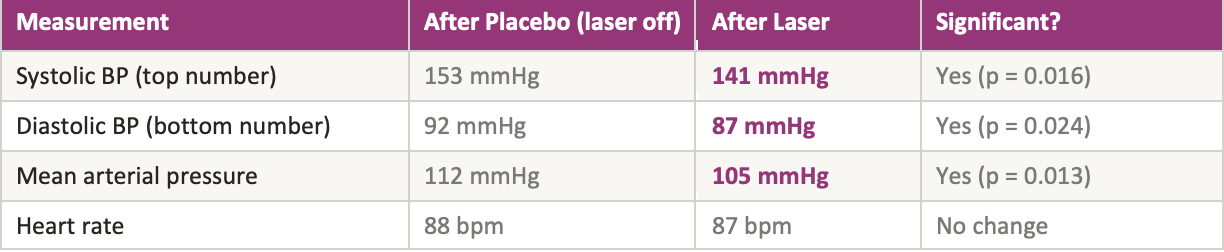
Blood pressure readings after low level laser in pregnancy.
That's a meaningful drop in blood pressure after a single light session - and the systemic vascular resistance (basically how “tight” the blood vessels are) came down significantly too. That vascular relaxation is almost certainly the engine behind the whole thing.
Now here's my favorite detail, because it's the one that speaks to safety: in the women with normal blood pressure, the laser did essentially nothing. Their numbers stayed put (systolic hovered around 111 - 114, diastolic around 62). The light didn't send anyone's blood pressure crashing. It appears to nudge things toward balance only when the body is out of balance - a “normalizing” effect, not a blunt “lower everyone” effect. That's the biomodulation principle in action, and it's exactly what you'd want in something you'd ever consider using in pregnancy.
And the babies? Every single fetal tracing was Category I - normal, reassuring, no signs of distress. In fact, in two cases where the tracing looked a little flat beforehand (compressed variability under 6 bpm), the tracing actually improved after the laser, hinting at possibly better fetal perfusion. No adverse maternal or fetal effects were observed.
Okay — but what about using a red light device on my thigh?
I know a lot of you are picturing a wearable red light belt wrapped around the thigh, and asking, “Could I just do that?” So let me be crystal clear and honest with you, because I’m a Midwife as well as PBM consultant.
The study did NOT use a thigh belt. It used an intranasal applicator - the light was delivered inside the nose, right next to a rich blood supply. Here's the exact protocol they used:
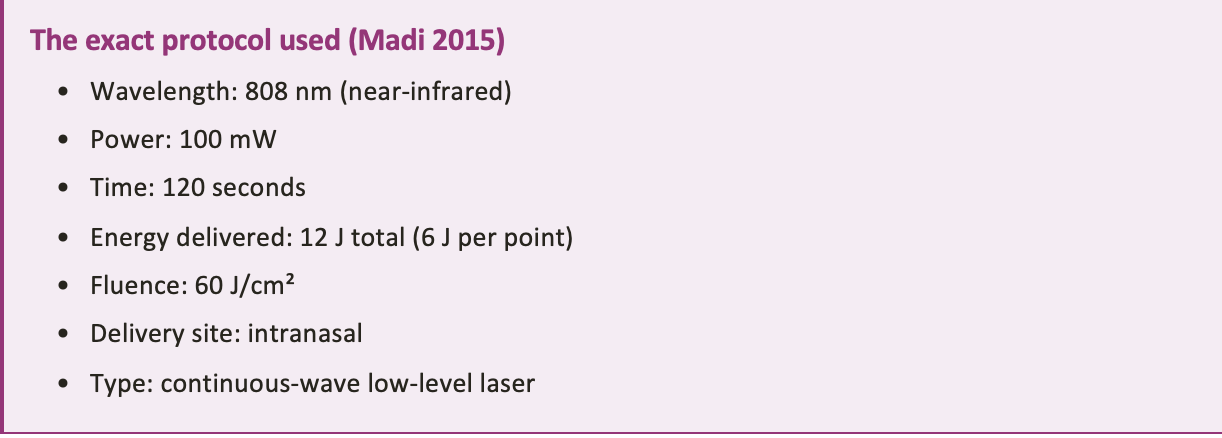
Madi Red Light Protocol for Hypertension in Pregnancy
The thigh idea comes from a related, very reasonable mechanism: red and near-infrared light (around 660 - 670 nm) can trigger the release of nitric oxide from storage pools in your blood and muscle, and nitric oxide is the body's natural vasodilator. The thigh is appealing because it's a big, blood-rich muscle bed that's far from the uterus - so you get a systemic effect without shining light anywhere near baby. It's the same logic behind studies showing a localized dose of 670 nm light to the back can lower blood glucose across the whole body.
But - and I need you to write this on a sticky note - the thigh-wrap approach in pregnant women with high blood pressure has NOT been tested. Transferring an intranasal laser dose to a thigh belt is an educated guess, not a validated protocol. That's a research gap, not a green light.
How red light may help the placenta itself (the 670 nm study)
Now let me take you somewhere really fascinating, because this is the study that first made me fall down this rabbit hole. Remember how preeclampsia is, at its heart, a placental problem - the blood vessels in the placenta don't develop properly, nitric oxide runs low, and less oxygen and nourishment reach your baby? Well, a team at the Medical College of Wisconsin asked a bold question: what if red light could help repair that damaged placental environment?
They took placental tissue samples from women who'd had late-onset preeclampsia and, in the lab, exposed the cells to 670 nm red light for just 40 seconds. Here's what they found (Griffin et al., 2022):
• A healthier placental environment. The light reduced harmful oxidative-stress markers in the placental extracellular matrix (the scaffolding that supports your baby's lifeline). A calmer, less-oxidized matrix means better support for the growing baby.
• Better-behaving trophoblasts. Trophoblasts are the cells that form the outer layer of the placenta and handle the nutrient-and-oxygen exchange between you and baby. On preeclamptic tissue their migration was sluggish - but after the 670 nm light, they moved and functioned much more like healthy cells again. Cell death (apoptosis) dropped, too.
• More nitric oxide. The light triggered greater nitric-oxide availability - that same vasodilator we keep coming back to. Interestingly, the authors think the benefit comes from releasing NO from other internal stores (like nitrosothiols and heme-bound NO) rather than 'fixing' the eNOS enzyme itself.
• Restored growth factors. The 670 nm light brought key pregnancy growth factors (TGFβ and placental growth factor, PLGF) back toward the levels seen in healthy placental tissue.
How amazing is that? In plain terms: in the lab, 670 nm light repaired several features of a damaged, preeclamptic placental environment. That raises a genuinely hopeful possibility — but I have to be honest with you about the limits, because they matter.
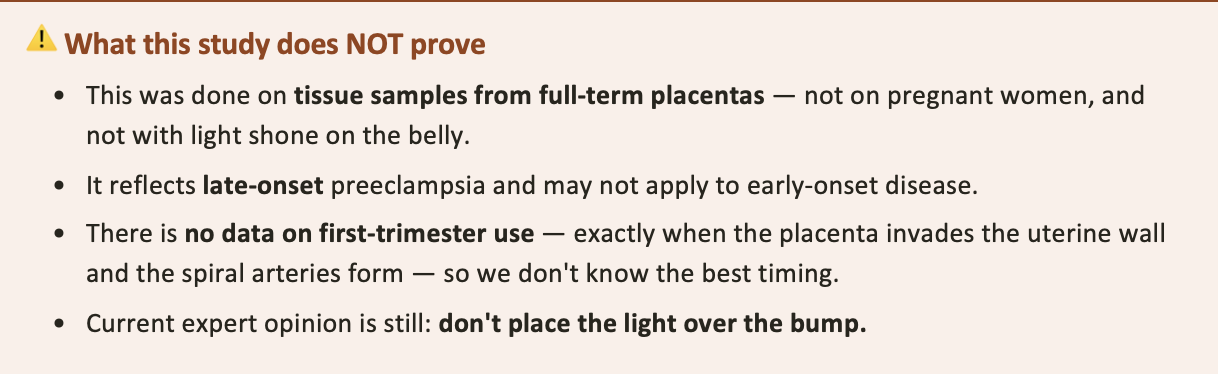
So why am I still excited? Because red light has a systemic (whole-body) effect - which means there may be other ways to nudge your body's own nitric-oxide production without going anywhere near baby. And that's where the leg comes in.
How a “spotlight” on your leg can support your whole body
You might be wondering: how does putting light on my leg help anything else? The answer lives in that tiny hero molecule again - nitric oxide (NO).
Research on circulation suggests that when 670 nm red light hits the big muscle bed of your leg or thigh, it triggers the release of nitric oxide from local storage pools. Think of NO as a natural relaxer for your blood vessels - it helps them open up so blood flows more smoothly, with less strain on the vessel walls. Here's the 'why' behind the thigh idea:
• Local support. The light improves blood flow right where it's applied - lovely for tired legs and for helping blood return from your lower body back toward your heart.
• Targeted, not overwhelming. Unlike a drug that hits your whole system at once, this seems to work locally - you get better circulation in that area without a sudden, dramatic drop in overall blood pressure.
• A cellular 'hug.' It helps the lining of your blood vessels (the endothelium) stay healthy and resilient.
And here's a coincidence I love: 670 nm is the very same wavelength shown in other studies to lower blood glucose (with a 15-minute dose) and even used safely on preterm babies in NICUs in Australia. Same gentle light, different target.
A quick, honest word on devices
Because you'll ask (you always do, and I love it): what would you even use? Here's my honest, current read.
As of late 2025, there are no skin-contact home devices at exactly 670 nm. But 660 nm sits right inside the same therapeutic window, and in the cardiovascular/nitric-oxide research the most-used wavelengths cluster around 630–670 nm (especially 660/670) and 800 - 850 nm (especially 808/810 and 850). The intravascular study I mentioned earlier actually used 660 nm.
For this specific situation, the device I'd reach for is my own Solasta Laser, used on a low power setting and applied to a limb — never the bump. Why low power? Because light therapy is biphasic — the 'more is not better' rule really matters here. A gentle, well-controlled dose to the thigh is exactly the kind of thoughtful, conservative approach that makes sense while the pregnancy research is still catching up. This is why I write personalized protocols only for my own device: I know its output precisely, so I can dial the dose in carefully for moms. Even if your bp behaves during your pregnancy you’ll find a million uses for your laser for postpartum healing (or for pregnancy pain).
Please hear the disclaimer in my Mom/Midwife voice: no red-light device has been clinically tested or cleared for preeclampsia or gestational hypertension. I do not recommend using photobiomodulation to manage these dangerous conditions on your own. This is an adjunct - a gentle helper alongside your provider's care - never a substitute for it.
If nothing else, get some safe sunshine
Here's something beautiful, free, and grounded in the very same mechanism we've been talking about. Remember how red and near-infrared light works partly by releasing nitric oxide - the body's natural vasodilator? Well, sunlight does this too. When UV hits your skin, it mobilizes nitric oxide from skin stores into your circulation, and research has linked sun exposure to modestly lower blood pressure through exactly this pathway.
So while we wait for the light-therapy research to catch up to pregnancy, one of the most sensible, low-cost things you can do is get regular, safe sun exposure. Bonus: sunlight supports vitamin D, mood, and circadian rhythm - all of which matter in pregnancy.
My favorite tool for doing this safely is the D-Minder app. It uses your location, date, time, and skin type to tell you exactly when the sun is strong enough to be beneficial and when to come inside before you burn. For the nitric-oxide and vitamin-D benefits, the goal is skin exposure - no sunscreen and no sunglasses during your short, tracked window - then cover up or head in once D-Minder says your time is up. Short, sensible sessions. Never burning. Always listening to your body.
A few honest caveats, because you know me: talk to your provider first, especially if you have a history of melasma, skin cancer risk, or photosensitivity. Sun is an adjunct for general wellbeing — it is not a treatment for preeclampsia or severe hypertension, and it should never delay medical care. But as a gentle, daily, nitric-oxide-friendly habit? I'm a fan.
Now let’s talk safety - the real talk
Because you know me: I will never hype something at the expense of your safety. Here's where I land after digging through the evidence.
The reassuring stuff
• Red and near-infrared light is non-ionizing. Unlike X-rays or UV, it physically cannot damage DNA or cause birth defects. This is well established.
• The consistent professional guidance across laser-medicine organizations is that the only real pregnancy caution is: don't treat directly over the developing baby (the abdomen/uterus). Treating distant areas - face, back, shoulders, arms, legs, thighs - has no evidence of harm.
• A published review of roughly 380 pregnancies treated with various lasers found no maternal or fetal harm.
• In the Madi study itself, continuous fetal monitoring showed no distress, and normal-BP women didn't drop dangerously (as have other studies shown no adverse events in pregnancy).
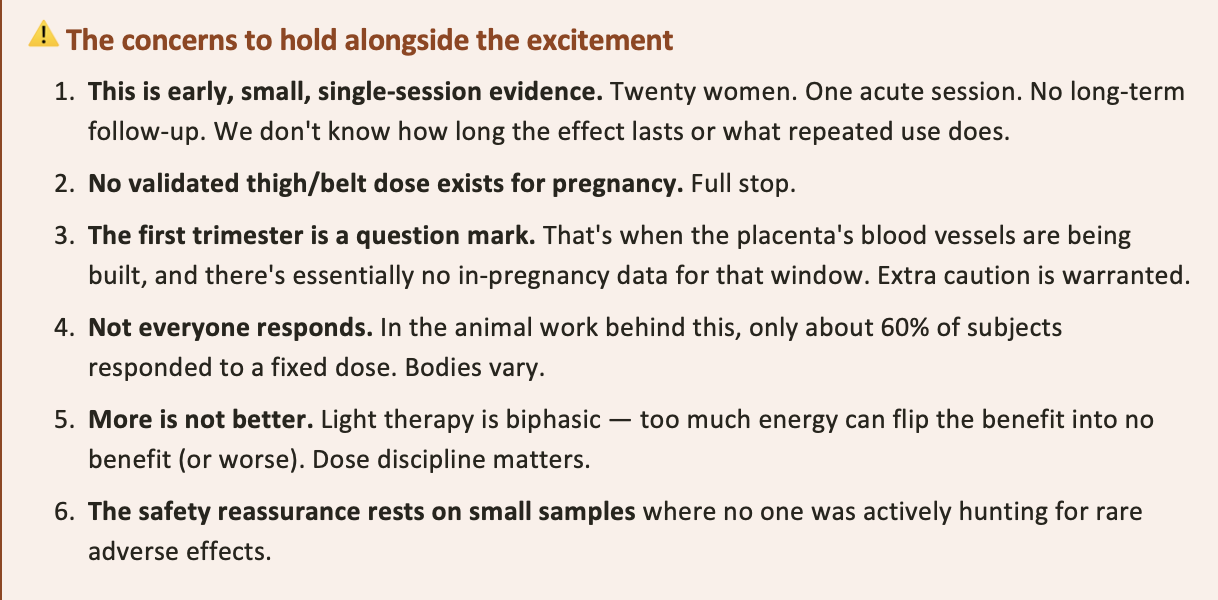
Notes on PBM for Pregnancy Hypertension
Where the science is headed (and why I’m hopeful)
Here's the exciting horizon. The same Brazilian research group recently registered a brand-new 2026 clinical trial studying photobiomodulation for blood pressure and vascular function in treated hypertensive patients - using direct vascular light over an artery, measuring actual blood-vessel function. That's a real step toward rigor.
Preeclampsia-specific lab work is promising too, as we just walked through: shining 670 nm light on preeclamptic placental tissue restored healthy cell migration, reduced cell death, and rebalanced key pregnancy proteins. And separate research shows red light meaningfully lowering blood glucose - which has my wheels turning about gestational diabetes down the line.
On the blood-pressure side, a 2025 systematic review of photobiomodulation for hypertension found that small clinical trials using red/NIR light (mostly 630–830 nm) produced average systolic drops of about 10–15 mmHg, plus modest diastolic and heart-rate reductions, though the authors rated the overall certainty of evidence as very low, because the studies were small and varied a lot. Honest data, honestly reported.
And in one randomized trial of intravascular 660 nm red light in women on endocrine therapy after mastectomy, weekly treatments significantly lowered both systolic and diastolic pressure and heart rate versus controls - a real hemodynamic effect even in a higher-risk cardiovascular group. Animal studies point the same direction, even in overfed, obese mice.
But, and this is the honest bottom line - there is no active clinical trial yet testing for any at-home red light for preeclampsia or gestational hypertension. Most of the newer trials specifically exclude pregnant women. The pregnancy translation is still catching up.
Wait — the danger doesn’t end at delivery
This next part is the one I beg you not to scroll past, because it's the piece so many mamas (and honestly, a lot of clinicians) miss: preeclampsia and dangerous high blood pressure can show up AFTER your baby arrives - sometimes for the first time.
Here's what the evidence says:
• Postpartum hypertension affects roughly 2% of pregnancies, and blood pressure often peaks around days 3 - 6 after birth - right when you're home, exhausted, and focused on the baby.
• About 1 in 5 eclamptic seizures happen postpartum, and around 25–40% of eclampsia cases develop in the postpartum window, anywhere from 2 days to 6 weeks after delivery.
• You can develop postpartum preeclampsia even if your pregnancy was totally normal. In fact, roughly 60% of women with new, delayed-onset postpartum preeclampsia had no prior hypertensive diagnosis. Most present within the first 7 - 10 days after birth.
• The most common warning sign is a severe or persistent headache — followed by vision changes, upper-right belly pain, swelling, and shortness of breath.
Treatment mirrors what's used during pregnancy: rapid-acting blood pressure medicines (labetalol, hydralazine, nifedipine) for severe readings, and magnesium sulfate for seizure prevention when there are neurologic symptoms. One extra flag — avoid NSAIDs like ibuprofen if your blood pressure is running high postpartum, and ask your provider what pain relief is safe for you.
So here's my ask: know your numbers after birth. If you had any hypertension in pregnancy, ask about a blood pressure check around days 3–7. And if you get a pounding headache that won't quit, vision changes, or that upper-belly pain in the days and weeks after delivery - do not wait, do not tough it out. Call your provider or go get seen. This is exactly the kind of thing that gets brushed off as “just new-mom exhaustion,” and it can be dangerous. You deserve to be taken seriously.
The bottom line, from me to you
Photobiomodulation for blood pressure in pregnancy is one of the most fascinating “watch this space” stories in women's health. The Madi study gives us a genuine, monitored, published signal that low-level laser can lower blood pressure in hypertensive pregnant women - gently, selectively, and without harming the babies in that study.
But here's my heart-to-heart close: this is not a DIY protocol, and it is never, ever a replacement for prenatal care. High blood pressure in pregnancy is dangerous. If you're pregnant and dealing with elevated pressures, your prenatal team is the plan. Any light therapy is an adjunct, delivered thoughtfully, and ideally under the guidance of a provider who knows this science.
So keep learning. Ask great questions. And let's keep watching this research together - because I have a feeling the next few years are going to be really, really interesting.
Note to to my biohacker followers:
(I know that many in the biohacking community will be reading this and may decide to track your BP and PBM exposure in pregnancy. Please think carefully before adding your baby to an uncontrolled experiment).
Tracy
This post is for education only and is not medical advice. Always talk to your obstetric provider before considering any therapy in pregnancy, especially with high blood pressure or preeclampsia.
Resources
• Madi, O. (2015). Analysis of the immediate hemodynamic response to low-level laser application in hypertensive and normotensive pregnant women. Master's dissertation, UNINOVE, São Paulo. Advisor: Dr. Maria Cristina Chavantes.
• Espósito et al. (2025). Photobiomodulation for hypertension: a systematic review and meta-analysis. J Clin Med. https://pmc.ncbi.nlm.nih.gov/articles/PMC12524357/
• Griffin et al. (2022). Red light mitigates the deteriorating placental extracellular matrix in late-onset preeclampsia and improves trophoblast behavior (670 nm, Medical College of Wisconsin). Journal of Pregnancy. https://pmc.ncbi.nlm.nih.gov/articles/PMC9045993/
• Powner & Jeffery (2024). Light stimulation of mitochondria reduces blood glucose. https://pubmed.ncbi.nlm.nih.gov/38378043/
• ClinicalTrials.gov NCT07525310 — Photobiomodulation Effects on Blood Pressure and Vascular Function. https://clinicaltrials.gov/study/NCT07525310
• Wilkerson (2019) review on laser safety in pregnancy, via Canadian Physiotherapy Association. https://physiotherapy.ca/app/uploads/2022/07/safety_of_laser_therapy.pdf
• ACOG Practice Bulletin No. 222 (2020). Gestational Hypertension and Preeclampsia. https://www.preeclampsia.org/frontend/assets/img/advocacy_resource/Gestational_Hypertension_and_Preeclampsia_ACOG_Practice_Bulletin,_Number_222_1605448006.pdf
• American Academy of Family Physicians (2024). Hypertensive Disorders of Pregnancy. https://www.aafp.org/afp/2024/0300/hypertensive-disorders-of-pregnancy
• Hauspurg & Jeyabalan (2021). Postpartum preeclampsia or eclampsia: defining its place and management. Am J Obstet Gynecol. https://pmc.ncbi.nlm.nih.gov/articles/PMC8857508/
• Best Practices for Managing Postpartum Hypertension (2022). Curr Obstet Gynecol Rep. https://pmc.ncbi.nlm.nih.gov/articles/PMC9207847/
• Cleveland Clinic. Postpartum Preeclampsia: Causes, Symptoms & Treatment. https://my.clevelandclinic.org/health/diseases/17733-postpartum-preeclampsia
• Liu et al. (2014). UVA, nitric oxide release, and blood pressure lowering. J Invest Dermatol. https://pubmed.ncbi.nlm.nih.gov/24445737/
• 2025 systematic review — photobiomodulation for hypertension (red/NIR ~630–830 nm; ~10–15 mmHg systolic reduction, very-low certainty). https://pubmed.ncbi.nlm.nih.gov/41095798/
• Intravascular 660 nm red light therapy and blood pressure/heart rate in women after mastectomy on endocrine therapy — randomized trial. https://pubmed.ncbi.nlm.nih.gov/36462596/
• Photobiomodulation and cardiovascular/nitric-oxide effects — additional supporting research. Photobiomodul Photomed Laser Surg. https://liebertpub.com/doi/abs/10.1089/photob.2022.0127
• Additional photobiomodulation cardiovascular/metabolic research (animal and mechanistic support). https://pubmed.ncbi.nlm.nih.gov/38165554/