Stretch Marks and Red Light Therapy
Tackling Stretch Marks: How Red Light Therapy Can Help
Today, we're diving into a topic that many women, teens (and men) can relate to: stretch marks. Often called "tiger stripes" to embrace their natural beauty, the truth is, many of us feel self-conscious about them - and calling them ‘tiger stripes’ isn’t helpful (IMO). While we often associate stretch marks with pregnancy, stretch marks can appear due to rapid weight gain, muscle growth in bodybuilders, certain hormonal disorders like Cushing syndrome, breast augmentation, or even from the use of topical corticosteroids. Stretch marks are most commonly seen on the thighs, abdomen, breasts, and upper arms. So whether you're dealing with them from pregnancy or any other cause, it's important to understand what they are and how we can address them effectively. Topical treatments have only mild effects and researchers question if creams and ointments with “specific ingredients” exert better improvements than moisturizers. Topical treatments don’t seem to be able to prevent the occurrence of stretch marks in pregnancy.
Stretch marks are one of the most common body changes of pregnancy - and one of the least honestly discussed. If you are seeing red, purple, silver, or white lines across your belly, breasts, hips, thighs, or buttocks, here is the truth: you did not do anything wrong, and you do not need to “fix” your body to deserve confidence in it.
But if you want support for the way your skin feels, heals, and changes through fertility, pregnancy, postpartum, and beyond, photobiomodulation (PBM)—also called low-level laser therapy—may be a thoughtful, non-invasive tool to consider. The key is realistic expectations, good dosimetry, and using a device designed to deliver purposeful light rather than vague promises.
That is exactly why I love the Solasta Laser.
First: what stretch marks really are
Stretch marks - clinically called striae distensae - are not simply “surface marks.” They develop when the dermis, the deeper structural layer of the skin, changes faster than collagen and elastin fibers can adapt.
They commonly appear during periods of rapid tissue expansion or hormonal change, including:
Pregnancy
Puberty
Rapid weight change
Muscle growth
Corticosteroid exposure
Perimenopause and other hormonal transitions
Genetic predisposition
Early stretch marks are often called striae rubrae. These tend to look pink, red, purple, or darker than the surrounding skin. Over time, they often become paler, flatter, and more silvery or white; these mature marks are called striae albae.
And here is the part that matters: newer and older stretch marks are not biologically identical. That means we should not expect one product, one dose, or one protocol to work exactly the same way for every person (men can get them too) - or every stage of skin change.
The American College of Obstetricians and Gynecologists notes that many products marketed to prevent stretch marks have not been proven to work. Moisturizers can help skin feel comfortable, but they should not be marketed as a guaranteed way to prevent or erase striae.
The honest answer about red light therapy and stretch marks
Stretch marks involve real structural changes within the dermis. No cream, laser, microneedling session, or light device can responsibly promise to “erase” them. What we can talk about is supporting the things that often make stretch marks less noticeable over time:
Skin texture
Color contrast
The look of atrophy or depression
The appearance of surrounding skin
Overall skin comfort and quality
Photobiomodulation uses non-ionizing red and near-infrared light to influence cellular signaling. In skin-focused research, PBM is being studied for its relationship to fibroblast activity, collagen and elastin remodeling, inflammation, circulation, and tissue repair. A 2024 review describes PBM as having potential relevance to wound healing, inflammation modulation, extracellular-matrix remodeling, and skin rejuvenation - but these mechanisms should never be confused with a guarantee of cosmetic outcomes.[mdpi]
Think of PBM less like a magic eraser and more like a supportive signal: a way to encourage the biological conditions involved in repair and remodeling.
How Light Therapy Works
Red light therapy involves exposing the skin to low levels of red or near-infrared light. This light penetrates the skin layers and promotes healing and rejuvenation. Here’s how it works:
Stimulates Collagen Production: Red light therapy boosts collagen production, which is essential for skin elasticity and repair. Increased collagen can help improve the texture and appearance of stretch marks.
Enhances Cell Regeneration: The therapy accelerates cell turnover, helping the skin heal faster and reducing the appearance of scars and stretch marks.
Reduces Inflammation: Red light therapy has anti-inflammatory properties, which can help reduce the redness and swelling often associated with new stretch marks.
Improves Blood Circulation: Better blood flow means more oxygen and nutrients are delivered to the skin cells, aiding in the healing process and improving skin health.
“Interestingly, 4 patients who were part of the study reported an unexpected pregnancy (two of the women had a history of infertility). So if you’re postpartum and not planning on extending your family just yet - be cautious over the lower abdomen. But when you’re ready to conceive again - let’s talk!”
The stretch-mark research that matters
We are finally moving beyond “there is no evidence at all.”
A 2024 randomized controlled study evaluated low-level laser therapy using an 808 nm diode laser for mature white stretch marks, or striae alba, in 30 participants with Fitzpatrick skin types III–IV. Participants received 8 - 12 treatments over approximately 4 - 6 weeks, with follow-up at one and three months. The low-level laser group had improvement outcomes that were statistically comparable with fractional carbon-dioxide laser treatment on several patient- and physician-rated measures - and the PBM group had no reported treatment downtime.[pmc.ncbi.nlm.nih]
The study was small, involved a specific device and protocol, focused on mature striae alba, and cannot tell us that every 808 nm device—or every red-light panel—will produce the same outcome. It also does not establish a universal home-use protocol.
The evidence-based takeaway is this:
Photobiomodulation has emerging clinical evidence as a non-ablative option that may improve the appearance of mature stretch marks for some people. It is not a guaranteed cure, and optimal protocols still need larger, standardized research studies.
That may not be the flashy promise you see online. But it is the kind of honest education I want women to have.
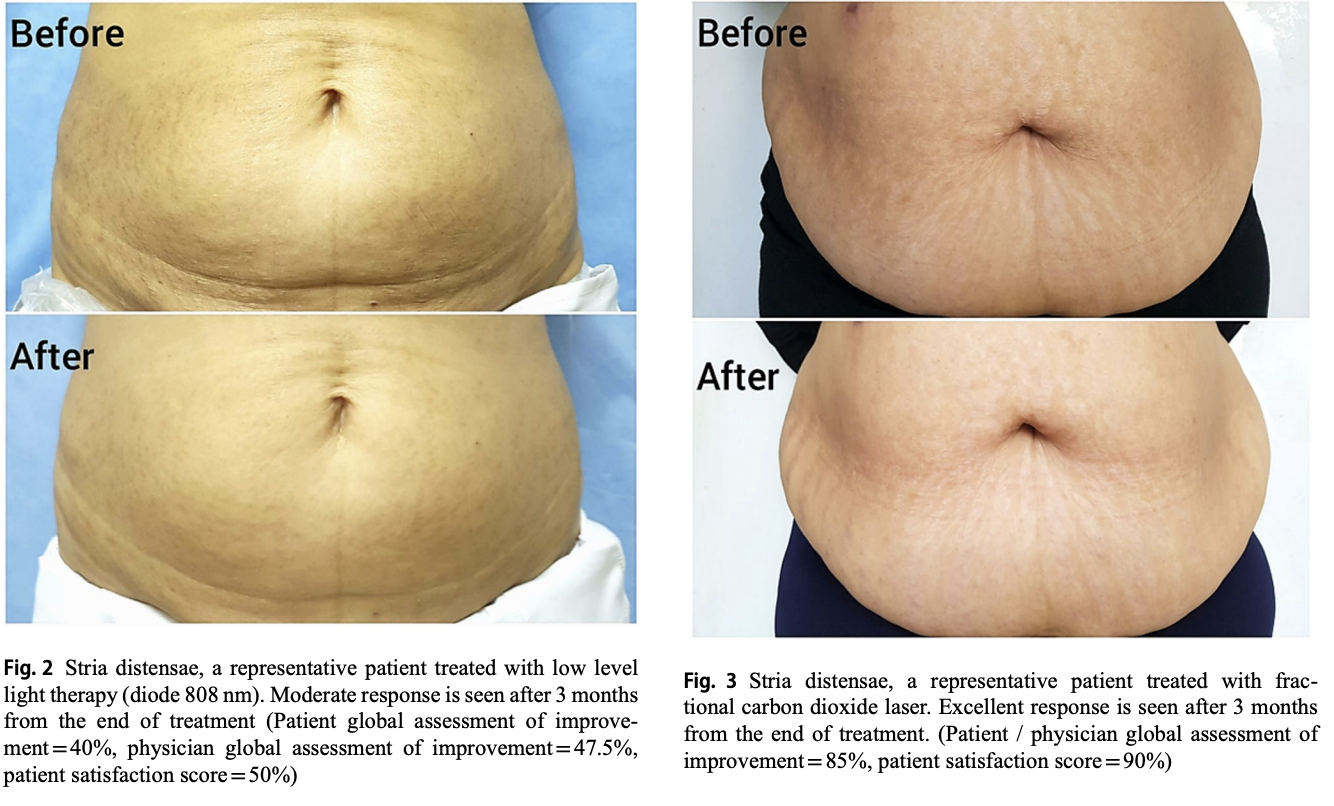
Before and after images from low level laser using 808 nm
Why the Solasta Laser is different
This is where the Solasta Laser shines - literally and practically.
The Solasta is not just a generic “red light” gadget with a few impressive-sounding wavelengths printed on a box. It is a portable, clinical-grade handheld low-level laser designed to offer targeted, skin-contact treatment with dual red and near-infrared wavelengths:
The Solasta device uses GaAlAs semiconductor diodes with 650 nm and 808 nm wavelengths.
That matters because PBM is dose-dependent. Wavelength is only one piece of the puzzle.
Results depend not just on what color the light is, but also on how much optical power reaches the tissue, for how long, over what area, how often, and for which clinical goal.
This is why I do not recommend random “20 minutes a day, everywhere” protocols. More light is not automatically better light.
From fertility to postpartum & menopause: one tool, many seasons
I created the Solasta Laser with women’s real lives in mind - not in the imaginary world where we have unlimited time, unlimited clinic visits, and unlimited bandwidth.
Skin changes and stretch marks
This is where the Solasta may offer a particularly thoughtful complement to postpartum skin care.
For someone treating postpartum stretch marks, the realistic aim is not “perfect skin.” It may be:
Supporting skin quality over time
Improving the look of texture or contrast
Creating a consistent self-care ritual
Tracking changes with standardized photos
Using a non-ablative option before - or alongside - considering procedures with more downtime
How to track results without fooling yourself
Before-and-after photos can be useful. They can also be wildly misleading.
If you want to monitor skin changes, use the same:
Lighting
Room
Camera distance
Camera settings
Body position
Time of day, when possible
No filters, smoothing, contrast manipulation, or AI enhancement
Take images every four to six weeks rather than checking obsessively every day. Look at more than one feature: color contrast, texture, width, depth, borders, and overall visibility.
And remember: pregnancy and postpartum bodies continue to change over months. Weight shifts, hydration, hormones, breastfeeding, sun exposure, skin tone, genetics, sleep, and time all influence how stretchmarks look.
A better standard for women’s wellness
I believe women deserve tools that are effective enough to matter, simple enough to use, and honest enough to trust.
That means no miracle language.
No “erase your stretch marks” claims.
No promise that a laser replaces fertility care, postpartum medical assessment, pelvic-floor therapy, lactation support, nutrition, sleep, movement, or time.
But it also means we do not have to dismiss supportive tools just because they are gentle.
The Solasta Laser is built for the full arc of women’s health: fertility preparation, pregnancy comfort in appropriate areas, postpartum recovery, lactation-related discomfort, pelvic and musculoskeletal support, skin health, and the transitions that continue long after baby arrives.
Your body is not a before-and-after project.
But if you want a well-designed, targeted, portable photobiomodulation tool to support it through the many seasons of womanhood, the Solasta Laser was made for exactly that.
Tracy
Resources:
Hafez, V., Mahgoub, D., Satour, E. M. A., Mikhail, M. M. S., & El-Kalioby, M. (2024). Photobiomodulation versus fractional carbon dioxide laser for stria alba in phototype III–IV: A randomized controlled study. Lasers in Medical Science, 39(1), 159. https://doi.org/10.1007/s10103-024-04107-x
Important safety note
This article is educational and does not replace individualized medical care. Photobiomodulation should not be used to diagnose, treat, cure, or prevent disease. Do not use laser therapy directly over a pregnant uterus without individualized guidance from an appropriately qualified clinician. Follow device instructions, use eye protection as directed, and seek prompt medical care for concerning pregnancy, postpartum, wound, breast, pelvic, or skin symptoms.
For fertility, pregnancy, postpartum, or scar-recovery protocols, dosing should be individualized according to the specific device, clinical goal, tissue location, medical history, and care plan.