New Lichen Sclerosus Treatment - Combining Red Light Therapy and Adderall
Imagine sitting down with a cup of coffee, scrolling, and stumbling on a story that sounds almost unbelievable: a doctor uses a low dose of an ADHD-type medication, and a woman’s long-standing lichen sclerosus calms down dramatically. That’s the spark behind Dr. Jerome Check’s 2026 case report, where a dopamine-boosting medicine similar to Adderall appeared to send a chronic LS case into a long remission. And when you place that story beside the growing interest in photobiomodulation, or PBM, as a way to soothe inflamed tissue, calm itching, and support healing, you start to see why this question feels so exciting: could these two approaches actually work better together than either one alone?
What makes this especially compelling is that Dr. Check’s LS report did not come out of nowhere. Over many years, he and colleagues have published case reports and series describing women with other stubborn inflammatory and pain conditions who improved on dextroamphetamine-based treatment, sometimes quite quickly. One published case described dramatic relief of chronic pelvic pain with dextroamphetamine sulfate. Another reported marked improvement in a woman with treatment-resistant fibromyalgia “within a short time” with a very low dose. There is also a published case of ulcerative colitis refractory to standard therapy responding well to dextroamphetamine sulfate. Even though these are not large randomized trials, they create a pattern that is hard to ignore: in certain women with chronic inflammatory or pain syndromes, dopamine-targeted treatment may sometimes shift the body out of a long-standing inflammatory loop faster than anyone would expect.
To understand why, it helps to zoom way out and think about your brain like a giant messaging system. Your neurons are constantly texting each other with little chemical messengers, and two of the most important messengers here are dopamine and norepinephrine. Usually, those messages are sent, read, and then quickly cleaned up so the signal does not get too loud. Medications like Adderall and dextroamphetamine change that rhythm by helping release more dopamine and norepinephrine and by slowing down the cleanup system that would normally vacuum them back up. The result is a stronger, longer-lasting signal between certain nerve cells. That is why people usually think of these medications in terms of focus and energy. But the bigger idea in Dr. Check’s work is that these signals may also influence how the nervous system talks to the immune system, how inflammation is turned up or down, and how tightly barrier tissues like skin and mucosa hold themselves together.
That last part is where this gets really interesting for lichen sclerosus. Dr. Check’s theory is that dopamine signaling may help reduce what he describes as increased cellular permeability, meaning tissues become less “leaky,” less reactive, and less likely to trigger an ongoing inflammatory response. Adderall-type medicine may be doing more than helping the brain pay attention. It may also be helping the body stop overreacting. It is a little like turning down a smoke alarm that has become so sensitive it goes off every time someone makes toast. The alarm is meant to protect you, but if it is always screaming, the system itself becomes part of the problem.
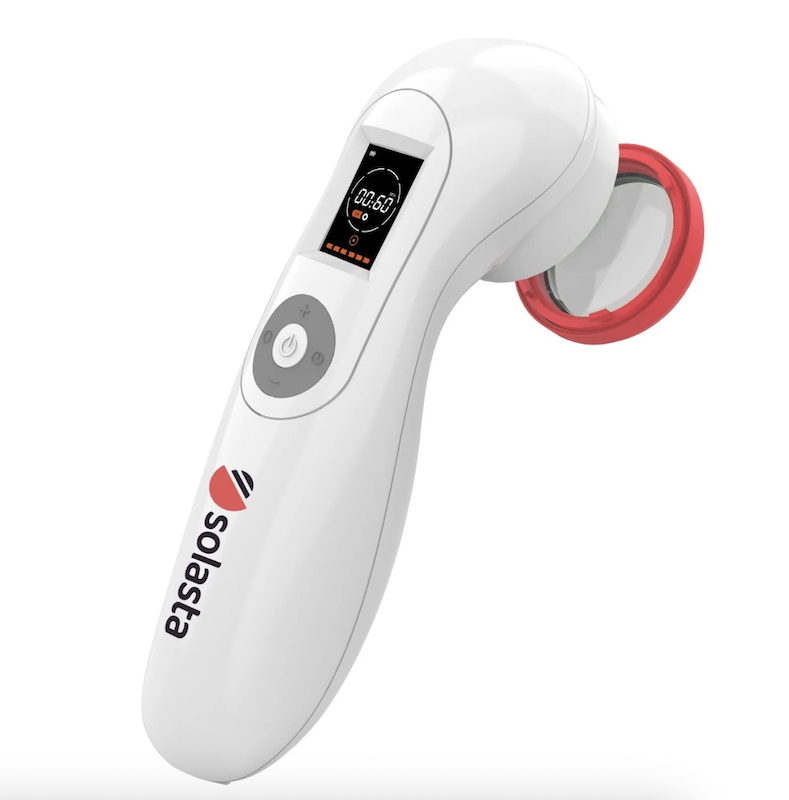
Now shift to red light therapy because this is where the story gets even more hopeful. If low-dose dextroamphetamine is working from the inside out, Photobiomodulation is working from the outside in. PBM uses red or near-infrared light, often in wavelengths like those used in vulvar laser and home LLLT devices, and shines that light directly on affected tissue. This is not a hot, cutting laser. It is a low-level light signal designed to interact with cells. Inside those cells are mitochondria, the tiny structures that make energy. When the right light hits them, they can make more ATP, which is basically the fuel your cells use to repair themselves, maintain healthy function, and recover from stress. PBM also changes oxidative stress signaling and local blood flow, which can help reduce inflammation and support healing. My Solasta home laser is already making a difference in so many women’s lives with this condition and I’m incredibly optimistic that by reducing cellular permeability, we have a winning combination.
And this isn’t just theoretical. In a 2024 study of vulvar lichen sclerosus, PBM produced rapid and sustained improvement in both symptoms and physical signs over a 16-week period, with no observed side effects in the small cohort. Other light-based vulvar LS studies, including reviews of photodynamic and laser approaches, have reported remission or meaningful relief of symptoms in many women, including reductions in itching, pain, and lesion burden. So when women say they felt relief quickly with light-based treatment for inflammatory vulvar disease, that claim is not coming out of thin air. The early literature really does suggest that some women experience noticeable changes on a short timeline, especially in symptom burden.
Put these two ideas together, and the synergy almost tells its own story. The dopamine-based approach is trying to calm the command center. It may reduce the brain-and-body signaling that keeps inflammation switched on, lower pain amplification, and help barrier tissues stop acting so irritated and fragile. PBM, meanwhile, is working right at the site of the damage. It is helping local cells make energy, improving circulation, reducing inflammatory signaling, and giving stressed tissue a better chance to rebuild. One is changing the instructions coming from the top. The other is helping the tissue at the bottom respond and recover.
That is why this feels more powerful than just saying, “Here are two treatments.” It is really two entry points into the same problem. One is neuroimmune. One is local and cellular. One is trying to stop the fire from being constantly restarted. The other is helping repair what the fire already damaged. If LS is a condition where the immune system, the nervous system, and the tissue barrier all keep feeding each other in a bad cycle, then it makes intuitive sense that a brain-based anti-inflammatory signal and a tissue-based healing signal might complement each other beautifully.
And honestly, that possibility matters because so many women with LS are exhausted by the narrowness of the current conversation. They want more than symptom management. They want to understand why the tissue stays inflamed, why it tears so easily, why it can feel like the body never fully settles down. Dr. Check’s pioneering work offers one possible answer: maybe for some women, the deeper issue is not just what is happening on the skin surface, but what is happening in the body’s signaling systems. PBM adds another layer of hope because it does not ask women to choose between systemic and local care. It invites the possibility that both matter.
Of course, it is important to stay grounded. Dr. Check’s LS paper is still a single case report, and his broader dopamine literature is largely based on case reports, series, and hypothesis-driven clinical observations rather than large randomized trials. PBM for vulvar LS is also promising but still early, with small cohorts and supportive studies rather than definitive proof. No published trial has yet tested low-dose dextroamphetamine plus PBM together in women with LS. So this is not a finished story. It is an emerging one and will minimal treatments available, more women are taking their health into their own hands.
But maybe that is exactly why it is so compelling. Because sometimes the first step in changing care is not waiting for the perfect study. Sometimes it starts when a physician notices something remarkable in a patient, publishes it, and opens a new line of thinking. Then another tool, like PBM, comes along and seems to fit that same story from a different angle. Suddenly, what looked like two separate ideas starts to feel like one integrated strategy: calm the system, strengthen the tissue, and give healing more than one chance to happen.
Resources:
https://blog.tracydonegan.org/blog/red-light-therapy-and-vulvar-lichen-sclerosus
1. https://pmc.ncbi.nlm.nih.gov/articles/PMC11875058/
2. https://skeenapublishers.com/journal/ijog/IJOG-06-00047.pdf
3. https://www.sciencedirect.com/science/article/pii/S1572100025000092
4. https://pubmed.ncbi.nlm.nih.gov/17447641/
5. https://pubmed.ncbi.nlm.nih.gov/24707694/
6. https://pubmed.ncbi.nlm.nih.gov/20602469/
8. https://pmc.ncbi.nlm.nih.gov/articles/PMC8658411/
9. https://ijcmcs.org/articles/1021.pdf
10. https://ccivf.com/files/2015/08/5.pdf
12. https://blog.tracydonegan.org/blog/red-light-therapy-and-vulvar-lichen-sclerosus