Start Here: The One Thing Worth Understanding
Every month, your body grows a tiny fluid-filled sac in your ovary called a follicle. Inside it is an egg. Around the egg are thousands of support cells called granulosa cells that feed the egg, manage hormones, and keep the whole environment healthy.
When the follicle ruptures and the egg is released (ovulation), something amazing happens: the leftover shell of the follicle transforms into a brand new structure called the corpus luteum - Latin for "yellow body." The corpus luteum then produces the progesterone and oestradiol needed to prepare the womb lining and support a pregnancy in those crucial first weeks.
A key insight from Dr. Phil Boyle at NeoFertility is that the corpus luteum is only as strong as the follicle it came from. If the follicle was under-nourished, poorly supplied with blood, or under oxidative stress during the weeks it was growing, the corpus luteum it produces will be weaker, and progesterone output will suffer. Red light therapy (also called photobiomodulation, or PBM) is one of the most promising tools available for improving the quality of the follicle before ovulation, and therefore the quality of the corpus luteum after it.
A Surprising Discovery: Your Ovaries Are an Ecosystem
Scientists at UCSF published a landmark study in October 2025 that changed the way we think about fertility. Using advanced imaging and gene-mapping technology, they examined over 100,000 cells from mouse and human ovaries. What they found was not a simple storage vault for eggs — it was a rich, complex ecosystem.
Inside healthy ovaries, each egg sits in its own little "pocket," surrounded by:
· Dedicated blood vessels that deliver nutrients and hormones
· Fibroblasts (structural support cells) that build the scaffolding around the follicle
· Nerve fibres that communicate between the brain and the ovary
· Glial-like support cells never before identified in human ovaries
When this ecosystem breaks down because of age, stress, inflammation, or poor blood flow the follicles suffer, eggs mature poorly, and the corpus luteum is compromised before it even begins. The UCSF team found that this breakdown begins in the ovaries earlier than in almost any other organ in the body.
Between the ages of 25 and 40, a woman's chance of conceiving per cycle drops from around 25% to under 5%. This research suggests that much of this decline is not just about fewer eggs — it is about the breakdown of the ecosystem supporting those eggs. The good news? Red light therapy addresses many of these ecosystem problems directly.
How Red Light Therapy Works Inside a Follicle
Red and near-infrared light (wavelengths of roughly 600–1000 nanometres) pass through skin and tissue and are absorbed by the mitochondria — the tiny energy generators inside your cells. In follicle cells, this triggers a cascade of healing responses. Here are the six most important ones.
1. It Charges Up the Cells That Feed Your Egg
Granulosa cells - the support cells surrounding your egg need enormous amounts of energy to do their job. They produce estradiol, manage the follicle's internal environment, and directly nourish the egg.
Red light stimulates an enzyme in the mitochondria called cytochrome c oxidase, dramatically increasing the production of ATP — the cell's energy. Think of it like charging a battery that has been running low. When granulosa cells are well-energised, they produce more estradiol, protect the egg more effectively, and are in much better shape to transition into corpus luteum cells after ovulation.
A 2024 study (He et al.) confirmed that red light therapy directly improved mitochondrial function in aged granulosa cells, reversing biological markers of ovarian ageing.
2. It Protects Cells from Damage
Every cell produces "exhaust" in the form of reactive oxygen species (ROS) molecules that, at high levels, damage DNA, hormones, and cell membranes. This oxidative stress is particularly harmful inside follicles, where the egg is developing.
Red light therapy reduces oxidative stress in two ways:
· It boosts the body's own antioxidant defences (including a molecule called glutathione) by around 25% in the He et al. study.
· It reduces a key marker of cellular damage (malondialdehyde) — by around 30%
The practical result: granulosa cells survive and function better throughout the entire follicular phase, and the egg inside is better protected.
3. It Restores Hormone Balance
One of the most striking findings from animal research is just how powerfully red light therapy can improve hormone levels. In the He et al. (2024) study of naturally aged mice:
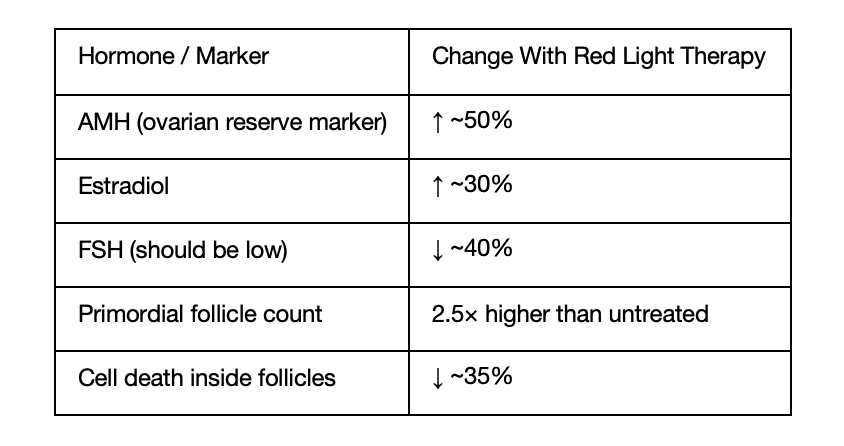
A 50% increase in AMH and a halving of FSH, in aged animals represents a meaningful reversal of ovarian aging. The clinical implication is that red light therapy may help the body recruit better-quality follicles, not just more of them.
4. It Improves Blood Flow to the Ovaries
Remember the UCSF finding that each follicle pocket needs its own dedicated blood supply? As women age, and in conditions like PCOS or endometriosis, the blood vessels supplying follicles can become sparse or dysfunctional. Less blood supply means organs are really struggling as we can’t get oxygen and nutrients to them.
Red light therapy improves ovarian blood flow in two ways:
· Nitric oxide release: Red light prompts the release of nitric oxide, a natural molecule that relaxes blood vessel walls and increases blood flow. More blood flow means more FSH, LH, and oxygen reaching the growing follicle.
· VEGF stimulation: Red light increases the production of a growth factor (VEGF) that stimulates the formation of new capillaries inside the follicle wall. This improved vascularisation does not just help the follicle, it directly enables the corpus luteum to receive the LH signals it needs to produce progesterone after ovulation.
5. It Repairs the Ovarian Scaffolding
The UCSF discovery placed fibroblasts - structural support cells in the ovary, at the centre of the fertility story. As we age, or in the presence of inflammation, fibroblasts become dysfunctional. The ovarian tissue stiffens, scars, and blood flow is reduced - cutting your follicles off from the resources they need.
Red light therapy has well-established effects on fibroblasts. It activates healing pathways that boost collagen production, promote blood vessel formation, and reduce inflammation. In the language of the UCSF ecosystem research: PBM repairs the roads and the scaffolding of the ovarian ‘neighborhood’.
6. It Calms Stress-Related Disruption
One of the most surprising findings from the UCSF team was that sympathetic nerve density increases with age in the ovaries, and that this over-activation of the stress nervous system directly accelerates the depletion of the egg reserve. This is one reason why chronic stress is so damaging to fertility: it physically remodels the ovarian nerve environment.
Red light therapy has a calming effect on the sympathetic nervous system. By improving mitochondrial function in nerve tissue and increasing nitric oxide, it shifts the body away from "fight-or-flight" mode and toward "rest and repair" helping create a more spa like environment for follicle maturation.
What the Research Actually Shows
In Animals
He et al. (2024) Aged mice treated with red light therapy for two months showed significant reversals of ovarian aging: more follicles, better hormones, improved blood vessel growth, reduced cell death, and healthier mitochondria in ovarian cells.
Alves et al. (2019) In rats with PCOS, red light therapy improved ovarian activity including corpus luteum formation, directly demonstrating that better follicles produce better corpora lutea.
Richey et al., Clemson University (2024) Red LED light applied to cattle eggs during maturation significantly increased ATP levels inside the egg itself and improved early embryo development rates. This confirms that the energy boost from red light reaches the egg directly, not just the surrounding cells.
Li et al. (2021) In mice with chemotherapy-damaged ovaries, red light therapy restored follicle counts, AMH, steroidogenesis, and ovarian blood vessels showing PBM can recover ovarian function even after significant damage (this research floored me!)
What About Human Research
Phypers et al. (2024) Three women aged 40 - 43 with unexplained age-related infertility. After multiwavelength red and near-infrared PBM treatment, all three achieved healthy live births. One produced six high-grade Day 5 blastocysts - more than twice her previous IVF attempts without PBM.
Phypers & Hanna (2025) - A woman with PCOS, endometriosis, and low ovarian reserve who had failed IVF conceived naturally and delivered a healthy baby after four months of follicular-phase PBM, five sessions per cycle, restricted to the first two weeks of each cycle only.
Grinsted et al. (2019/2022) - In a cohort of 400 severely infertile women aged 34 - 50, 65% conceived following high-powered near-infrared laser treatment. Most had already failed conventional fertility treatments.
Stigliani et al. (2025) — Near-infrared PBM at 810 nm improved the maturation of immature human eggs retrieved during IVF, allowing more eggs to reach the mature stage - the first study to demonstrate this effect in human eggs.
Most human PBM research has been done in IVF cycles - which actually obscures some of the most important effects for women conceiving naturally. IVF bypasses the cervix, the natural LH surge, and the corpus luteum entirely. What I am seeing in natural cycles with the Solasta laser is something the IVF studies cannot measure: an improvement in cervical mucus quality. This matters because mucus is a direct hormonal readout of follicular health. The cervix responds to estradiol produced by granulosa cells inside the growing follicle. When mucus improves quickly after starting PBM, it tells us the follicle is producing more estradiol which is exactly what the research predicts, and exactly what leads to a stronger corpus luteum and better progesterone after ovulation. I see this in my menopausal clients too who use pelvic transvaginal red light therapy. I have a couple of case studies I need to write up and hopefully add to the growing body of research on PBM and RRM.
Why Timing Matters: Treat the Follicle, Not Just the Egg
Across the clinical research, one theme appears consistently: treating during the follicular phase (the first half of the cycle, while follicles are growing) produces better results than treating at other times
This makes biological sense. The goal is to support the follicle while it is developing, improving the granulosa cells' energy and function, building the blood supply, and reducing oxidative stress so that when ovulation occurs, the resulting corpus luteum is ready to rock.
At NeoFertility Austin, where your cycles are carefully tracked with mucus charting, ultrasound follicle tracking, and serial blood tests, this creates a precise treatment window: from the start of the period until the Peak Day (confirmed ovulation). Red light therapy applied during this window directly targets the follicle at its most critical stage of development.
A Simple Way to Think About It
Imagine the follicle as a greenhouse growing a precious plant (the egg). The corpus luteum is what that greenhouse becomes after harvest, it repurposes itself to support the seedling (the embryo) that was planted.
If the greenhouse had cracked glass, poor drainage, inadequate heating, and no proper water supply during the growing season you won’t get much of a harvest, and the post-harvest structure will be fragile too.
Red light therapy, applied during the follicular phase, is like restoring the greenhouse: fixing the energy supply, improving the irrigation, clearing out the damage, and strengthening the structure so that both the egg and the corpus luteum have the best possible foundation.
This is what Dr. Boyle means when he says: if you improve follicular functioning, the corpus luteum will be stronger.
For more details on the UCSF study on women’s health and longevity.
This blog is for educational purposes. Red light therapy for fertility should be delivered by a trained practitioner using calibrated equipment, and treatment plans should be tailored to individual cycle tracking and hormone data.
Based on current published research
References
PBM & Follicular Function
The Ovarian Ecosystem
Gaylord et al. (2025) — UCSF
Comparative analysis of human and mouse ovaries across age
Published in Science, October 2025
https://www.science.org/doi/10.1126/science.adx0659
UCSF News Release (2025)
Why Does Female Fertility Decline So Fast? The Key Is the Ovary
https://www.ucsf.edu/news/2025/10/430841/why-does-female-fertility-decline-so-fast-key-ovary
biorXiv preprint — Single-cell exploration of ovarian aging across vertebrate models (2025)
https://www.biorxiv.org/content/10.1101/2025.10.15.682639v1[^3]
PBM and Ovarian Aging
He et al. (2024)
Photobiomodulation ameliorates ovarian aging by alleviating mitochondrial dysfunction and oxidative stress
Journal of Photochemistry and Photobiology B: Biology
https://www.sciencedirect.com/science/article/pii/S1011134424001842
PBM and PCOS / Corpus Luteum
Alves et al. (2019)
Photobiomodulation can improve ovarian activity in polycystic ovary syndrome-induced rats
Journal of Photochemistry and Photobiology B: Biology
https://www.sciencedirect.com/science/article/abs/pii/S1011134418308698
PBM and Ovarian Function / LLLT
Oubina et al. (2018/2019)
Low level laser therapy (LLLT) modulates ovarian function in mature female mice
Progress in Biophysics and Molecular Biology
https://www.sciencedirect.com/science/article/abs/pii/S0079610718301573
PBM and Red/Infrared Lasers on Folliculogenesis
Frare et al. (2017)
How do red and infrared low-level lasers affect folliculogenesis cycle in PCOS-induced rats?
PMC Full Text:
https://pmc.ncbi.nlm.nih.gov/articles/PMC5682863/
PBM and Premature Ovarian Failure
Li et al. (2021)
Local application of low level laser therapy in mice ameliorates cyclophosphamide-induced premature ovarian failure
https://www.sciencedirect.com/science/article/abs/pii/S0303720721001623
PBM and Human Oocyte Maturation
Stigliani et al. (2025)
The impact of near-infrared photobiomodulation therapy on human oocyte maturation
Photochemistry and Photobiology, April 2026
https://www.sciencedirect.com/science/article/pii/S1011134426000990
ESHRE 2025 Abstract (P-191):
https://academic.oup.com/humrep/article/40/Supplement_1/deaf097.500/8170223
PBM and Human Fertility Outcomes (Clinical)
Phypers et al. (2024)
The Efficacy of Multiwavelength Red and Near-Infrared Transdermal Photobiomodulation Light Therapy in Enhancing Female Fertility Outcomes and Improving Reproductive Health: A Prospective Case Series with 9-Month Follow-Up
Journal of Clinical Medicine (PMC Open Access)
https://pmc.ncbi.nlm.nih.gov/articles/PMC11642705/
PBM for Complex Female Infertility (Natural Conception Case)
Phypers & Hanna (2025)
Red Light Therapy for Complex Infertility — Case Report
https://blog.tracydonegan.org/blog/photobiomodulation-in-complex-female-infertility
PBM and 630nm LED — Advanced Reproductive Age
2026 Study
630 nm LED phototherapy enhances ovarian function and fertility in advanced reproductive age
Biotechnology & Medicine, February 2026
https://aiche.onlinelibrary.wiley.com/doi/10.1002/btm2.70117
PBM and Bovine Oocytes (ATP / Embryo Development)
Richey, Clemson University (2024)
Photobiomodulation of Bovine Oocytes During Maturation Increases ATP Content and Enhances Subsequent Embryonic Development
Master's Thesis, Clemson University
https://open.clemson.edu/all_theses/4294/
PMC conference abstract:
https://pmc.ncbi.nlm.nih.gov/articles/PMC10158067/
PBM Mechanism — Mitochondria, Cytochrome C Oxidase, Nitric Oxide
Hamblin (2020)
What Lies at the Heart of Photobiomodulation: Light, Cytochrome C Oxidase and Nitric Oxide
PMC Full Text:
https://pmc.ncbi.nlm.nih.gov/articles/PMC7495914/
Bhatt et al. (2022)
Photobiomodulation and nitric oxide signalling
PMC Full Text:
https://pmc.ncbi.nlm.nih.gov/articles/PMC9808891/
Karu et al. (2014)
Low-level laser (light) therapy increases mitochondrial membrane potential and ATP synthesis
PMC Full Text:
https://pmc.ncbi.nlm.nih.gov/articles/PMC4355185/
Granulosa Cells and Mitochondrial Function
Mitochondrial Function in Modulating Human Granulosa Cell Steroidogenesis (2020)
PMC Full Text:
https://pmc.ncbi.nlm.nih.gov/articles/PMC7279321/
NeoFertility — DHEA and Estradiol in Early Pregnancy
Boyle, Andralojc, Stanford et al. (2024)
Restoration of serum estradiol and reduced incidence of miscarriage in patients with low serum estradiol during pregnancy: a retrospective cohort study using a multifactorial protocol including DHEA
Frontiers in Reproductive Health
https://www.frontiersin.org/journals/reproductive-health/articles/10.3389/frph.2023.1321284/full
Corpus Luteum and Luteal Phase
Updates on Molecular and Environmental Determinants of Luteal Function (2020)
PMC Full Text:
https://pmc.ncbi.nlm.nih.gov/articles/PMC7484338/[^25]
Cervical Mucus and Estradiol — Mechanism
Solasta Health — The Secret Role of Cervical Crypts in Fertility and How Red Light Therapy Supports Them
https://www.solasta.health/blog/red-light-therapy-and-trying-to-conceive-naturally
Mouse vs Human Ovary Validity
Comparative analysis of human and mouse ovaries across age — PubMed (2025)
https://pubmed.ncbi.nlm.nih.gov/41066539/
Translation Potential and Challenges of In Vitro and Murine Models in Female Reproductive Research (2022)
PMC Full Text:
https://pmc.ncbi.nlm.nih.gov/articles/PMC9741314/
Blog - Ovarian Ecosystem and PBM
The Newly Discovered Ecosystem of Ovaries — and How Red Light Therapy May Help It Thrive
https://blog.tracydonegan.org/blog/the-newly-discovered-ecosystem-of-ovaries-and-how-red-light-therapy-may-help-it-thrive[^30]
How Photobiomodulation Improves Ovarian Granulosa Cells
https://blog.tracydonegan.org/blog/photobiomodulation-improves-ovarian-granulosa-cells[^31]
Red Light Therapy and Ovarian Aging
https://blog.tracydonegan.org/blog/red-light-therapy-and-ovarian-aging[^32]