Preparing for IVF? There’s Another Light Conversation We Need to Have
In my recent article, Red Light Therapy and Egg Quality: New IVF Study Explained, I shared some exciting research on near-infrared light and immature human eggs - this amazing study shows how carefully dosed light can support an egg’s energy after retrieval.
After a single, carefully controlled treatment delivered directly to eggs in a laboratory dish, researchers measured higher ATP - the energy cells use to do their work - and increased mitochondrial activity. Some treated eggs also moved through early maturation stages sooner. The researchers found no increase in the oxidative-stress marker they measured.
That is an encouraging example showing that the right light can have a measurable positive effect on the energy systems of human reproductive cells.
It also brings us to a question we haven’t explored yet:
What about the other light those eggs encounter in the laboratory?
Not therapeutic light delivered at a selected wavelength and dose, but the overhead lighting, workstation illumination, and microscope light used during everyday IVF procedures.
Because light can also influence cells in negative ways, we need to talk about both.
This is more than a theoretical concern. A Hungarian research group has published several studies examining light protection during IVF. Its 2020 and 2024 papers reported higher blastocyst development after introducing protective measures such as filtered lighting and shielding during handling. A 2026 analysis explored outcomes further, including patients with poor blastocyst development. Together, these findings give women a practical reason to ask their clinic how it manages laboratory light exposure.
The researchers also looked beyond embryo development. Their 2024 paper also reported a significantly lower miscarriage proportion in the conventional-IVF subgroup after laboratory light protection was introduced. A subsequent analysis found an association with improved pregnancy achievement in cycles with low blastocyst development. These findings make laboratory light management an important question to bring to your embryology team.
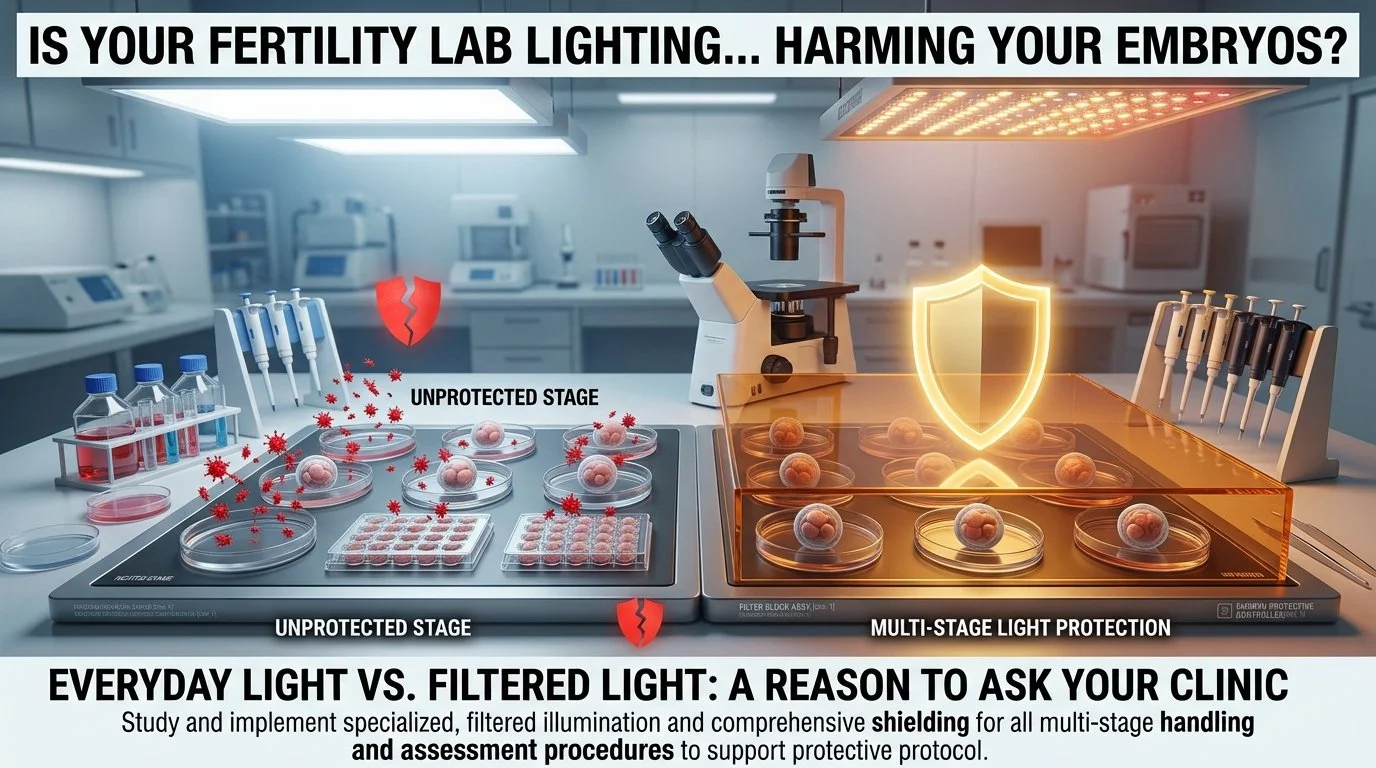
Same word. Different exposures.
The near-infrared treatment in that study was a planned intervention: a specific wavelength, dose, and exposure time.
Everyday laboratory illumination serves another purpose. Embryologists need it to find eggs, carry out procedures, and assess development.
Certain wavelengths can also trigger reactions in cells and their surrounding culture fluid that generate reactive oxygen species. When these molecules exceed the available antioxidant defenses, oxidative stress develops. Researchers have paid particular attention to shorter wavelengths, including blue and near-ultraviolet light. I discussed this challenge in a recent article - IVF Prep and How To Reduce Cellluar Stress with Red Light Therapy.
The important distinction is not simply “light is good” or “light is bad.”
It is which wavelengths reach the cells, at what intensity, and for how long
Why this deserves a place in your IVF preparation
You may be putting considerable time, energy, and money into preparing for retrieval.
Understanding how your eggs and embryos are cared for afterward belongs in that conversation, too.
A Hungarian fertility center studied embryo development before and after introducing a comprehensive light-protection protocol. The changes included filters on lighting and microscopes, shielding of collection equipment, and protection during handling. Researchers reported higher day 5 blastocyst development after the changes.
That finding gives us a practical reason to ask about the laboratory environment - not to place another responsibility on women, but to make an often-invisible part of IVF care easier to understand.
Do US IVF labs address lighting?
Yes. U.S. guidance from the American Society for Reproductive Medicine and the Society for Reproductive Biologists and Technologists recommends dimmable incandescent lighting and avoiding fluorescent or bright lights in embryology laboratories.
But it’s what happens in YOUR clinic that matters…
A recommendation tells us what professional guidance says. To understand your clinic’s actual approach, you need to ask its embryology team.
And “we keep the room dim” is only part of the answer. Microscope and workstation illumination deserve attention as well.
You don’t need to inspect the laboratory or become an expert in optics. Start with these seven questions.
Your clinic conversation checklist
You can send these questions ahead of your appointment or ask to speak with the embryology laboratory director.
1. What is your approach to protecting eggs and embryos from unnecessary light?
Start with this broad question. It gives your team a chance to explain its overall approach in simple English.
You’re looking for a description of what happens during handling - not simply “we keep the room dim.”
2. Does your approach include microscope and workstation lighting?
Overhead lights are only part of the picture. Light used to view the dish can be an important source of exposure.
A useful follow-up is:
“How do you manage the light reaching the eggs and embryos while they are being examined?”
3. Do you use light filters, and what are they designed to reduce?
Filters can reduce selected wavelengths while allowing embryologists to see clearly. Research protocols have used filters on microscopes and workstation lighting.
You don’t need to ask for a particular filter color. Ask the team to explain the purpose of the filters it uses.
4. How do you limit unnecessary exposure during procedures?
Light exposure depends on duration as well as wavelength and intensity.
You could ask:
“Are there steps to avoid leaving dishes illuminated when they are not being assessed?”
5. Have you assessed the light reaching the dish?
Brightness alone does not fully describe light exposure. Two sources can look similarly bright while producing different wavelengths and amounts of light energy.
Ask whether the laboratory has evaluated exposure where eggs and embryos are handled, including under the microscope.
(This is a question about its assessment process - not a request for you to interpret technical measurements).
6. Is light protection part of your written laboratory procedure?
This helps you understand whether the approach is a defined part of daily work.
You can also ask:
“How do you keep the procedure consistent across staff and equipment?”
7. Can you give me a short summary of your laboratory’s approach?
A written summary makes it easier to understand the answer and share it with your partner.
You could say:
“A few sentences would be helpful. I’m interested in how you manage room lighting, microscope illumination, filters, and exposure time.”
How to make sense of the answers
A useful response explains specific practices in language you can understand.
For example, the team might describe filtered microscope illumination, adjusted brightness, steps to limit exposure, and a written procedure. Those are examples of the kinds of details to ask about - not a checklist every laboratory must implement identically.
If the answer is vague, you could add:
“Thank you. Could you explain what that means during egg collection and embryo assessment?”
If the clinic cannot share internal documents, ask for a verbal or patient-facing summary instead. An unanswered question is a reason to get clarification - not proof that a laboratory is unsafe.
What if fewer embryos than expected reached blastocyst?
It is reasonable to ask for a broader review of the cycle.
You might say:
“How did our embryo development compare with your laboratory’s expected results for patients of my age using the same fertilization method? What patient-related and laboratory-related factors have you reviewed?”
Low blastocyst development does not identify a lighting problem. The research on light protection does not provide a way to diagnose the cause of an individual cycle’s results.
The purpose of asking is to understand the clinic’s interpretation and next steps, rather than assume one explanation.
You do not have to manage the laboratory
Your role is not to inspect equipment, choose filters, or monitor the embryologist.
Your role is to ask questions and understand the care you are receiving.
The laboratory team’s role is to explain its processes and maintain the conditions needed for safe, effective work.
These seven questions give you a practical place to start - without adding another task to your IVF checklist.
Want help making sense of your IVF and Red Light Therapy preparation options?
My fertility consultations help you understand the research, and consider where supportive approaches such as photobiomodulation may fit alongside your existing treatment or get started today with my home Solasta laser and your personalised protocol.
Tracy
Gödöny K, et al. Clinical Benefits of Decreased Photo-Oxidative Stress on Human Embryo Development. Medical Principles and Practice. 2024;33(2):112–121. doi: 10.1159/000536358.
Gödöny K, et al. Reducing Photo-Oxidative Stress in IVF: A Retrospective Analysis of Cycles with Poor Blastocyst Development. Journal of Clinical Medicine. 2026;15(2):881. doi: 10.3390/jcm15020881.
Bódis J, et al. How to Reduce the Potential Harmful Effects of Light on Blastocyst Development during IVF. Medical Principles and Practice. 2020;29(6):558–564. doi: 10.1159/000509016.
Mauchart P, Vass RA, Nagy B, Sulyok E, Bódis J, Kovács K. Oxidative Stress in Assisted Reproductive Techniques, with a Focus on an Underestimated Risk Factor. Current Issues in Molecular Biology. 2023;45(2):1272–1286. doi: 10.3390/cimb45020083.
Practice Committees of the American Society for Reproductive Medicine and the Society for Reproductive Biologists and Technologists. Comprehensive guidance for human embryology, andrology, and endocrinology laboratories: management and operations: a committee opinion. 2022.
This guide is educational and is not a laboratory inspection tool. Lighting is one part of the IVF environment, and an individual treatment outcome cannot establish whether a clinic’s lighting practices were appropriate.