Donor Eggs and Increased Pregnancy Complications
Earlier this week I shared an article about the financial and emotional ‘shadow’ costs associated with IVF (preterm birth, low birth weight babies, increased hypertension and other metabolic health complications in pregnancy.
In this blog we specifically look at donor eggs and why pregnancy complications increase even more for some women and how you can advocate for you and your baby in pregnancy.
If you've made it to this post, you're likely somewhere in the donor egg decision process, maybe you've already committed, maybe you're on a waiting list, maybe you're still weighing it up. Wherever you are, I want to say something clearly before we go any further:
Donor egg IVF can be a valid, and successful path to having a baby. This post is not an argument against it. The majority of donor egg pregnancies result in healthy babies, and for many women it is absolutely the right choice.
But there is a body of research growing, high-quality, peer-reviewed research describing significant pregnancy complications associated with donor egg pregnancies that most women are never told about. Not by their IVF clinics. Not by their OBs. Not, in most cases, by anyone.
You deserve to know this before you get pregnant. And if you're already pregnant with a donor egg, you deserve to know what to ask for in your prenatal care.
Why Donor Egg Pregnancies Are Immunologically Different
To understand why donor egg pregnancies carry different risks than regular pregnancies, or even own-egg IVF pregnancies, you need to understand one key fact:
The embryo is genetically foreign to you.
In a natural pregnancy, the embryo shares half its genetics with the mother. The maternal immune system has an extraordinary, finely tuned ability to tolerate this semi-foreign presence, it's one of the most remarkable immunological phenomena in biology.
In a donor egg pregnancy, the embryo shares none of its genetics with the mother. The maternal immune system is being asked to tolerate a fully foreign organism. Researchers believe this immune dynamic, the maternal immune response to a completely foreign embryo is at the heart of why donor egg pregnancies are associated with higher rates of certain complications.
There are additional factors at play: there has never been a thorough root cause investigation into WHY your AMH is low/FSH is high…WHY you aren’t conceiving as well as the absence of a corpus luteum when frozen embryo transfers are used (since there was no ovulation), altered endometrial signaling, and the fact that most donor egg recipients have a history of infertility that was never investigated properly, which may itself be a contributing factor. The mechanisms are still being studied. But the clinical pattern, elevated complication rates in donor egg pregnancies is consistent and well-established in the literature.
Preeclampsia: The Risk You Most Need to Know About
Preeclampsia is a serious pregnancy complication characterized by high blood pressure and signs of organ damage, typically developing after 20 weeks. It can progress rapidly and, in severe cases, is life-threatening for both mother and baby.
In donor egg pregnancies, the risk of preeclampsia is substantially elevated and this is one of the most consistent, high-certainty findings in reproductive medicine.
The most rigorous study to date is a 2026 individual patient data (IPD) meta-analysis by van Bentem et al., published in Human Reproduction Update, one of the highest-impact journals in reproductive medicine. This study pooled individual-level data from 2,747 donor egg pregnancies, 4,699 own egg IVF pregnancies, and 33,323 natural conception pregnancies.
• Preeclampsia OR: 2.28–2.39 compared to using your own egg IVF (I=0% — meaning high certainty; the results were consistent across all studies included)
• Overall hypertensive disorder risk: 2.62–2.85x higher than own egg IVF
• Risk persisted after adjusting for maternal age, BMI, parity, and ethnicity, meaning it's not explained by the fact that donor egg recipients tend to be older or have other risk factors
• Low-dose aspirin may reduce the risk but does not eliminate it.
Multiple other well-designed studies have confirmed this:
• Blázquez et al. (2016), Fishel Bartal et al. (2018), Moreno-Sepulveda & Checa (2019), a meta-analysis of 21 studies: increased hypertensive disorders, preeclampsia, preterm birth, and low birth weight in donor egg singletons vs own egg IVF singletons
"Currently, none of the worldwide used guidelines indicate OD as a risk factor for hypertensive complications."
— van Bentem et al., Human Reproduction Update 2026
Read that again.
The science has established a 2 - 3x elevated preeclampsia risk. No US guideline, not ACOG, nor ASRM, currently flags donor egg pregnancy as a high-risk condition for hypertensive complications. The guidelines have not caught up with the evidence. Women are not being counselled accordingly.
Placental Complications
Preeclampsia is strongly associated with placental dysfunction, and research is now showing that the placentas in donor egg pregnancies look measurably different from those in autologous pregnancies.
A 2025 study by Kavelidou et al. (n=743 placentas) compared pathological findings in donor egg vs own egg IVF placentas:
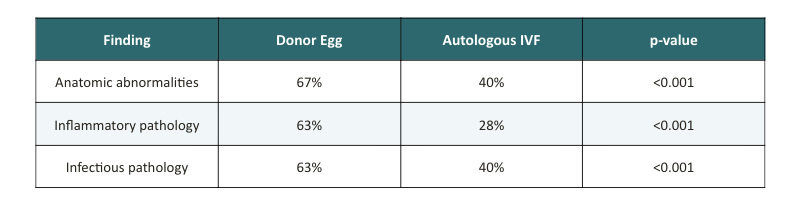
All differences were statistically significant. The proposed mechanism is immune-mediated: the maternal immune system, confronted with a genetically foreign embryo, mounts a response that affects placental development and function. Pena-Burgos et al. (2025) found similar patterns in triplet pregnancies, donor egg pregnancies showed higher rates of preeclampsia, fetal growth restriction, fetal death, chronic villitis, and deciduitis compared to own-egg pregnancies.
Preterm Birth and Perinatal Outcomes
Even in young, healthy donor egg recipients women who would not otherwise be considered high-risk, the perinatal outcomes data shows elevated risk.
Kissin et al. (2019), using national ART surveillance data, found higher preterm births, higher low birth weight.
When no embryos were cryopreserved (a marker of transfer challenges): stillbirth risk 3.73x higher.
Salazar et al. (2025) looked specifically at women aged 38 and older comparing donor egg vs own-egg outcomes:
• PPROM (premature rupture of membranes) increased, preterm birth increased, higher cesarean rate and smaller babies.
The Moreno-Sepulveda meta-analysis (2019) confirmed elevated preterm birth and low birth weight in donor egg singleton pregnancies compared to autologous IVF singletons across multiple studies.
Real-World Complication Data: What It Looks Like in Practice
Published case series data from an Irish fertility clinic (2007–2012), presented by Dr. Boyle's NeoFertility offers a striking picture of what donor egg complication rates look like in clinical practice:
Of 104 donor egg pregnancies:
• 46% experienced major antenatal complications
• 26% of all pregnancies developed hypertension
• 45% of twin pregnancies developed hypertension
• One singleton pregnancy developed severe early-onset preeclampsia at 19 weeks, resulting in liver capsule rupture, laparotomy, and hysterotomy
These are not fringe outcomes. They represent what one experienced Irish IVF clinic saw across over 100 consecutive donor egg pregnancies.
What This Means for Your Prenatal Care
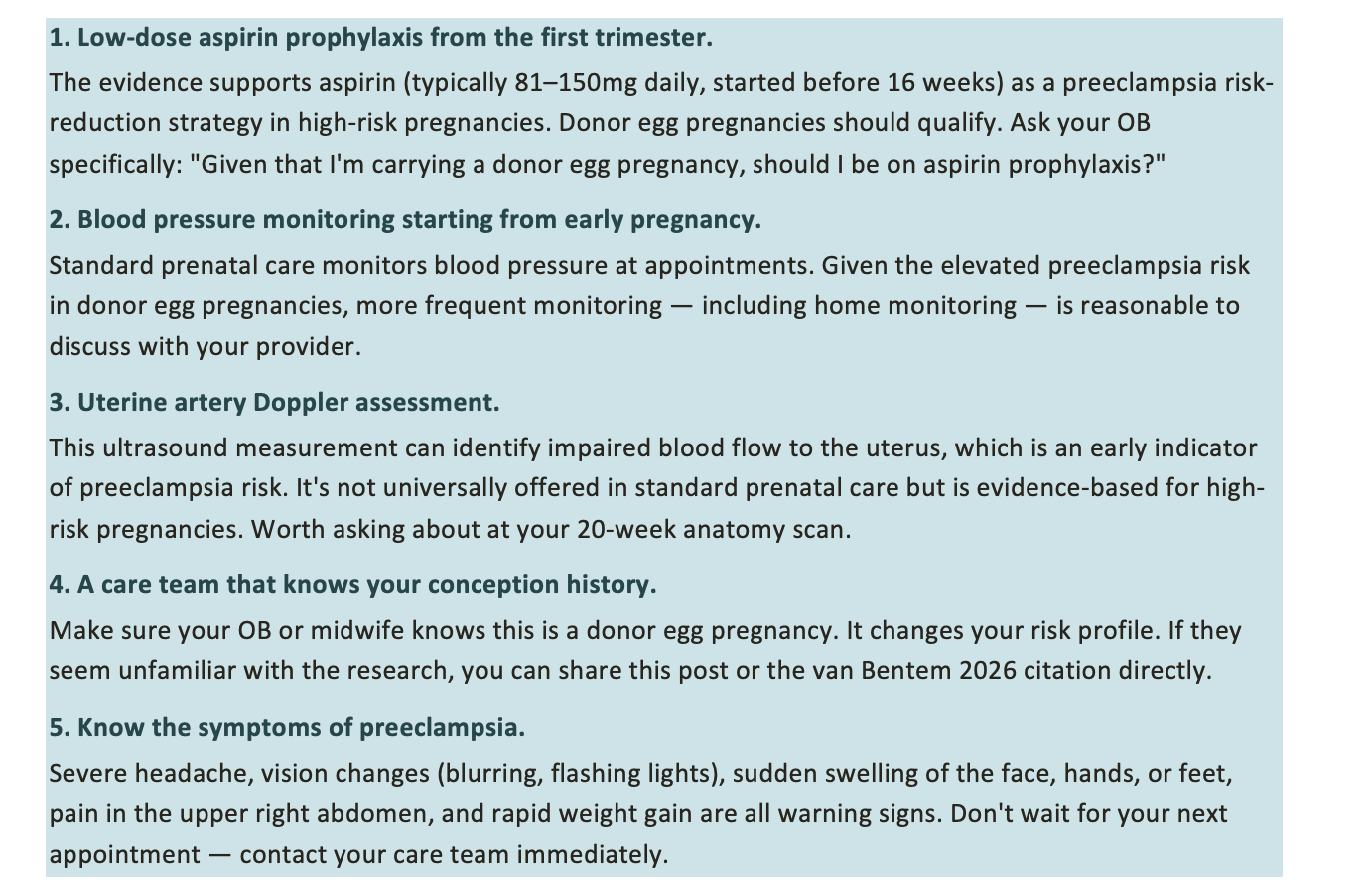
If you are pregnant with a donor egg, or planning to be, this is not information designed to frighten you. It is information designed to help you get the monitoring and care you deserve.
Because here is what the evidence suggests you should be asking for, and in many cases will need to advocate for yourself to receive:
A Note on Guidelines vs. Evidence
I want to be explicit about something, because it matters for how you navigate this.
Current ASRM, ACOG, and international guidelines do not classify donor egg pregnancy as a high-risk condition for hypertensive complications. This means that when you walk into your OB's office as a donor egg recipient, they may not automatically offer you more monitoring, because their guidelines don't require it.
This is a gap between the current evidence and current practice. The van Bentem 2026 meta-analysis says so explicitly. This doesn't mean your doctors are wrong or negligent, it means the guidelines are lagging behind the science, which happens routinely in medicine. And it could be years before clinical practice catches up.
It does mean that you may need to be the one who brings this up. You are allowed to do that. You are allowed to say: "I've read the van Bentem 2026 meta-analysis on donor egg pregnancies and hypertensive complications. I'd like to discuss what monitoring is appropriate for me."
That's not being difficult. That's being an informed patient.
If You're Still Deciding
If you're still in the decision phase, weighing donor eggs against other options, or wondering whether natural conception might still be possible I'd encourage you to read Part 1 of this series, which looks at what the IVF data actually shows for women with low AMH and diminished ovarian reserve, and where alternatives like NeoFertility may fit.
The short version: low AMH does not automatically mean you can't conceive naturally. ASRM's own guidelines state that AMH "only predicts response to ovarian stimulation" and should not be used to counsel against natural conception. A thorough root-cause workup and targeted support approach deserves serious consideration before committing to donor eggs.
For women who aren't eligible for NeoFertility, or who have already decided on donor eggs, this post is for you. Go in informed. Ask for the monitoring you deserve. And know that a healthy pregnancy is absolutely possible.
Tracy
https://blog.tracydonegan.org/blog/low-amh-high-fsh-donor-eggs-what-ivf-clinic-data-shows
https://blog.tracydonegan.org/blog/the-shadow-costs-of-ivf-what-you-dont-know-can-hurt-you
https://blog.tracydonegan.org/blog/what-ivf-clinics-in-austin-wont-tell-you
https://blog.tracydonegan.org/blog/why-women-are-angry-about-unexplained-infertility