Before IVF - Have We Asked Enough Questions?
Why Gaps in Fertility Care Deserve Attention
You want a baby.
You want answers.
And you want to know that before you invest your body, your money, and your hope in treatment, someone has taken the time to understand why pregnancy has been difficult for you.
That is a very reasonable expectation.
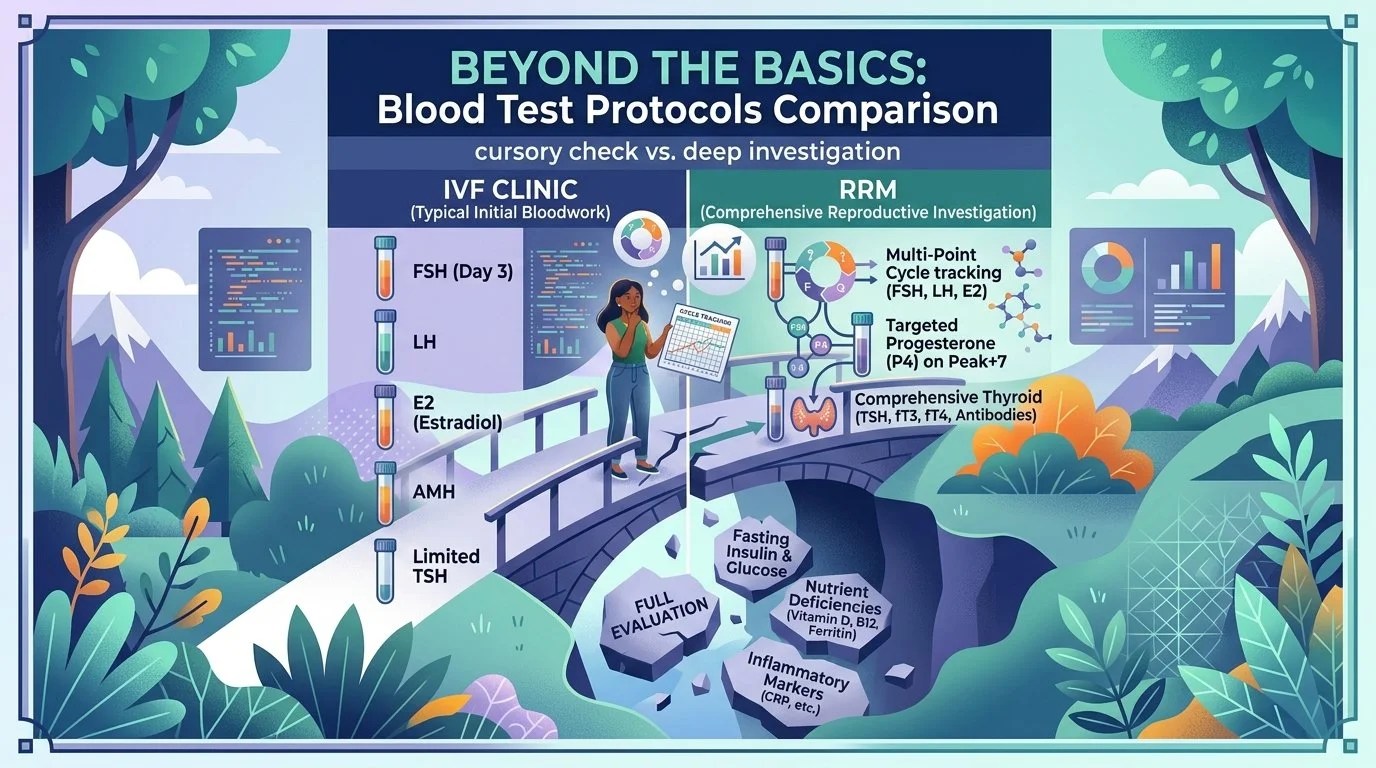
Yet in my experience (and many others involved in a restorative approach to fertility), women are not consistently receiving full investigations through their IVF clinics. They may have had bloodwork, scans, and appointments, but important questions about their cycles, symptoms, and potentially contributing conditions remain unanswered. I see this in about 80% of the health history assessments I review each week for women using PBM for fertility.
That is why a 2026 study examining documented fertility care before IVF caught my attention.
Researchers found low recorded use of several diagnosis-specific evaluations and treatments among patients who ultimately underwent IVF. Their findings raise an important question: Are women receiving meaningful opportunities to investigate and address underlying problems before moving forward?
This is not about making anyone feel guilty for choosing IVF.
It is about accountability - and making sure women have the information and care they need to make that choice.
“We Already Do That” Does Not Match What I See in Practice
The American Society for Reproductive Medicine, or ASRM, argues that restorative reproductive medicine - RRM ‘repackages’ care fertility specialists already provide.
Its fact sheet says conventional fertility care includes “thorough diagnostic workups” and “treatment of underlying conditions.” It describes the suggestion that standard fertility care skips proper diagnosis or healing as a “false narrative.”
But that assurance does not match what many of us in restorative medicine see in our work.
In my experience, women still arrive with significant unanswered questions. Having undergone fertility testing has not necessarily meant having a thorough investigation of the concerns relevant to their individual story. That long list of labs ordered by your clinic might seem comprehensive, and the suggestion of getting even MORE labs might feel frustrating - but in some cases the labs we run aren’t the same or they are more indepth.
There is a difference between having tests and understanding what those tests have - or have not - explained.
There is a difference between receiving a treatment plan and understanding why that treatment is being recommended.
And there is a difference between being told, “We already investigate underlying causes,” and being able to see how that investigation happened in your own care.
If comprehensive evaluation is already standard practice, women should not have to wonder whether their symptoms were considered, whether contributing conditions were addressed, or whether appropriate alternatives were discussed. And this should happen BEFORE your first IVF…not on a 4th round after the first 3 have failed.
They should be able to get clear answers.
What the New Study Found
Tracey Parnell, Monica Minjeur, Craig Turczynski, and Tony Pistilli analyzed commercial insurance claims from 2021 through 2024. They examined diagnosis-specific groups of patients who subsequently underwent IVF, comparing documented evaluations and treatments with IVF initiation over time.
Although the paper’s title refers to a “5-million patient” analysis, approximately five million insured members formed the source population - not five million IVF patients. The paper reports a female infertility total of 9,884 and a male infertility total of 485, with smaller groups for individual conditions.
Because the study used insurance claims rather than complete medical records, it identifies gaps in documented care - not proof that every unrecorded service was omitted.
Even with that distinction, several findings deserve attention.
PCOS/PMOS: Was the Ovulation Problem Addressed?
Among women in the PCOS group, by nine months:
78.4% had initiated IVF.
34.1% had documented letrozole use.
22.1% had documented metformin use.
35.3% had documented gonadotropin use.
Letrozole matters here because the international PCOS guideline recommends it as the first-line medication for ovulation induction in women with PCOS who are not ovulating and have no other infertility factors. In the absence of an absolute indication for IVF, the guideline allows IVF after first- or second-line ovulation-induction treatment has failed.
Not every woman with PCOS needs the same pathway. But women deserve to understand which pathway fits their situation - and why.
If difficulty ovulating is the main problem, has that problem been treated appropriately? If IVF is recommended instead, what other findings make it the better option?
Those are not difficult questions for the sake of being difficult.
They are informed-care questions.
Hormonal Conditions: A Diagnosis Should Come With a Plan
Among women with elevated prolactin - 85.5% had started IVF by nine months. Documented cabergoline use was 25.7%, and bromocriptine use was 8.2%. These medications are alternative treatments.
Among women with hypothyroidism, 75.0% had initiated IVF by nine months, while 61.9% had documented levothyroxine use.
These figures do not establish which individual women needed medication. They do raise questions about whether diagnosed hormonal conditions were consistently evaluated, managed when indicated, and followed over time (read more about the importance of getting a FULL thyroid panel not just the basics).
For a patient, the expectation should be straightforward:
If there is a hormonal condition in my chart, explain whether it matters, whether it needs treatment, and how we will know that it has been addressed.
A diagnosis should not become a label that follows a woman through treatment without an explanation.
Pelvic Pain: Was It Investigated - or Simply Recorded?
In the group with painful periods, which the researchers used as a proxy for suspected endometriosis, 78.8% had initiated IVF by nine months, while 11.6% had documented laparoscopy.
That does not mean every woman in the group needed surgery. Painful periods alone do not establish endometriosis, and ASRM’s guidance does not require surgery before IVF in every case.
But a woman’s pain deserves more than a passing mention in her history.
Was it assessed? Was possible endometriosis considered? Were appropriate investigations and treatment options explained?
Moving forward with fertility treatment should not mean moving past symptoms without a plan.
Male-Factor Evaluation: Women Should Not Carry the Entire Investigation
The study also found low documented use of some male evaluations.
Among men in the general male-infertility group, 57.1% had one documented semen analysis by nine months. Among male partners in the recurrent-pregnancy-loss group, 24.5% had documented karyotype testing and 3.2% had sperm DNA fragmentation testing. The AUA/ASRM guidance quoted in the paper supports the latter evaluations in the recurrent-pregnancy-loss setting, not as a universal requirement for every couple.
The study could not provide a complete couple-level picture. Nevertheless, the findings reinforce the importance of asking whether both partners have received the evaluation appropriate to their history.
A woman should not become the default focus of treatment while relevant questions about her partner remain unresolved.
A Question From the IRRM Conference That Has Stayed With Me
At the recent IRRM conference, someone raised a confronting question: Should starting IVF without first reviewing three months of her cycle charting be considered malpractice?
I am recalling the substance of that comment - not presenting a verified quotation or an established legal standard.
But the challenge behind it deserves attention:
Are we moving into treatment before adequately listening to the woman’s reproductive story?
ASRM’s own guidance recognizes the importance of menstrual history and calls for investigation without delay when there are findings such as irregular cycles, bleeding between periods, or absent periods. Three months of charting is not a universal requirement, and evaluation should not be delayed when prompt care is indicated.
The point is not to create an arbitrary waiting period.
The point is to ask whether relevant information is being meaningfully reviewed.
If a woman has recorded her cycles, bleeding, symptoms, and pain, those records deserve attention. If she has repeatedly raised a concern, she deserves an explanation of whether it warrants investigation - and what will happen next.
“Your clinic already does that” is not an adequate response.
Show her what was evaluated.
Explain what was found.
Tell her what remains uncertain.
And explain why the proposed treatment makes sense for her.
“This study raises concerns that patients may begin IVF without documented completion of important diagnosis-specific investigations and treatments. Appropriate evaluation of underlying causes should be part of the conversation before treatment begins - not an afterthought.”
Women Want Answers About Underlying Causes
The desire for diagnosis-directed care is not limited to RRM practitioners.
A 2026 secondary analysis examined two national U.S. public surveys. The analysis reported that approximately 70% of respondents wanted treatments that addressed underlying causes, while nearly half were unaware of any medical risks of IVF. These were public survey findings - not figures limited to women receiving IVF.
Among respondents in the McLaughlin survey who had undergone IVF, 83% expressed concern about an undiagnosed contributing factor, and 57% reported feeling fast-tracked toward IVF.
That is a message worth hearing.
Women and their partners are not necessarily asking for endless testing. They are asking to understand what is happening and whether something treatable has been overlooked.
They also want information that allows them to weigh their options.
ASRM’s own patient information acknowledges that IVF carries risks, including medication side effects, ovarian hyperstimulation syndrome, and complications associated with procedures. It also notes that serious complications are rare.
Discussing those risks honestly is not anti-IVF.
It is part of respecting the woman deciding whether to undergo it.
The public survey findings do not prove that individual clinics failed to obtain informed consent. They do suggest that public understanding of IVF is incomplete - and that education should be more than an assumption.
The Public Campaign Against Restorative Medicine Deserves Scrutiny Too
The criticism of RRM is not confined to a quiet disagreement between clinicians.
ASRM has published dedicated resources, fact sheets, and public statements describing RRM as misleading and as a threat to timely fertility care. Its materials also include warnings against restricting access to IVF under the banner of restorative care.
I see that sustained public messaging as an attack on the legitimacy of restorative medicine.
ASRM frames it as a defense of evidence-based care and IVF access. Protecting access is important. But defending access to IVF should not require dismissing women’s concerns about the investigations they received.
Two questions can be asked at the same time:
Are patients free to access IVF?
And:
Are patients receiving appropriate evaluation, treatment of contributing conditions, and a meaningful discussion of alternatives?
The answer to one does not settle the other.
RRM should be scrutinized for evidence, safety, and outcomes. So should IVF care. Neither label should place a treatment pathway beyond examination.
Private Equity Makes Transparency Even More Important
There is also a financial context to this debate.
Research reported in late 2025 estimated that approximately 32% of U.S. fertility clinics were private-equity affiliated by the end of 2023. Those clinics performed approximately 54% of IVF cycles. In other words, a majority of IVF cycles occurred at private-equity-affiliated clinics, even though a majority of clinics were not affiliated. Private equity firms are investment companies that own all or part of a fertility clinic. Their goal is to make money by growing the business and selling it later for more than they paid. That does not mean the doctors give poor care. But patients deserve clear answers about whether treatments are recommended because they need them - not because the investors in the clinic want to double their investment.
That does not prove private equity caused the care gaps in this paper.
But it makes questions about ownership, incentives, and transparency legitimate.
Patients should be able to ask:
Who owns this clinic?
Why is this treatment being recommended?
Which alternatives are appropriate in my situation?
Which additional services are necessary, and which are optional?
What evidence supports the proposed approach?
Commercial interests do not automatically invalidate medical care. But they should not be invisible to the people paying for - and undergoing - that care.
When a treatment sector has substantial investor involvement, scrutiny should not stop at the clinic door.
What a Restorative Approach Should Bring to the Conversation
The authors of the care-gap study describe RRM as an approach focused on identifying and treating contributing conditions, preserving reproductive function where possible, and supporting natural conception when feasible. They propose it as a framework for addressing the gaps they observed.
For me, the value of that approach is its insistence that the underlying story matters.
It is not enough to say, “We can help you achieve pregnancy.”
There should also be space to ask, “What is contributing to the difficulty, and what can appropriately be addressed?”
That does not mean every woman needs every test. It does not mean every condition is reversible. And this study did not establish that RRM produces better outcomes than IVF (although in some studies RRM is very similar to IVF if not better).
It means the investigation should fit the patient - not simply the treatment pathway.
In my experience, that is where some women have been left with unanswered questions. It is why I believe restorative care deserves a serious place in the discussion rather than being dismissed with “We already do all of that.” or that a restorative approach is some political fringe ideology. Medicine used to want to find root cause contributors to illness but the same rules don’t apply with some clinics…
Questions to Bring to Your Fertility Appointment
You do not need to arrive looking for a confrontation. You can arrive expecting clarity.
Questions prompted by this research include:
What do we know about why pregnancy has been difficult?
Which symptoms or findings still need explanation?
Have my cycle patterns and relevant records been reviewed?
Are there contributing conditions that should be treated?
Has my partner received the evaluation appropriate to our history?
Which additional tests would genuinely change our plan?
Why is IVF the recommended next step for me?
What are the benefits, risks, costs, and tradeoffs of the appropriate alternatives?
A good conversation should help you understand your care - not leave you feeling uncomfortable for asking.
Women Deserve More Than “We Already Do That”
You can support access to IVF and insist on thorough fertility evaluation.
You can respect fertility specialists and ask whether care gaps need to be addressed.
You can acknowledge the limits of a study and still take its findings seriously.
ASRM says diagnosis and treatment of underlying conditions already belong to standard fertility care. This new analysis raises questions about how consistently that care is documented among patients progressing to IVF.
My experience gives me reason to keep asking those questions.
Women deserve more than reassurance that comprehensive care exists somewhere within the system.
They deserve to know what was investigated in their own case, what was addressed, what remains uncertain, and why their next step is appropriate.
Their symptoms deserve attention.
Their questions deserve answers.
And their fertility care should make room for both their hope for a baby and their need to understand their health.
Tracy
Resources:
https://iirrm.org/real-world-fertility-evaluation-care-prior-to-in-vitro-fertilization/
https://blog.tracydonegan.org/blog/recurring-miscarriage-neofertility-austin-explores-deeper
https://blog.tracydonegan.org/blog/beyond-probably-ovulating-restorative-neofertility-in-austin
This article provides education and professional commentary. It does not determine whether an individual needs a particular investigation or treatment, or establish a legal standard of malpractice.