Cut labor pain almost in HALF…without meds, without leaving home. Your body has a built‑in pain switch. Here’s how to flip it.
If you want to stay home longer in early labor, lower your chances of an unexpected in‑labor cesarean, and avoid a cascade of interventions, you need more than willpower, you need smart, evidence‑informed tools. A TENS unit is one great option, and simple vibrating heat balls or the Fringe Pelvic Wand can work in a similar way, using pain science - specifically gate control theory to help your brain reduce pain. This is not about “orgasmic birth”; it is about comfort, agency, and tapping into your nervous system intentionally.
Why Staying Home Longer Matters
Arriving at the hospital too early in labor is strongly linked with higher intervention rates and more in‑labor cesareans. Studies show that women admitted before about 4 cm dilation are more likely to need augmentation, continuous monitoring, and ultimately cesarean compared with those who arrive later, closer to 5 - 6cm in established active labor. So if avoiding an unexpected cesarean is important to you and/or you feel strongly about avoiding medication in labor - read on.
When you can manage early labor well at home:
· You move, rest, eat, and drink more freely, which supports healthy labor progress.
· You spend fewer hours under hospital protocols that can nudge you toward interventions “just in case.”
· You are more likely to arrive in true active labor, when decisions about medications or surgery are better grounded in how your body is actually progressing.
If staying home to that 5 cm window is important to you, then building a pain‑management toolkit - Doula, TENS, GentleBirth app mental prep, positions, water, breath, heat, vibration, can make that plan realistic instead of wishful thinking.
Gate Control Theory: Putting a ‘Bouncer’ on Your Labor Pain
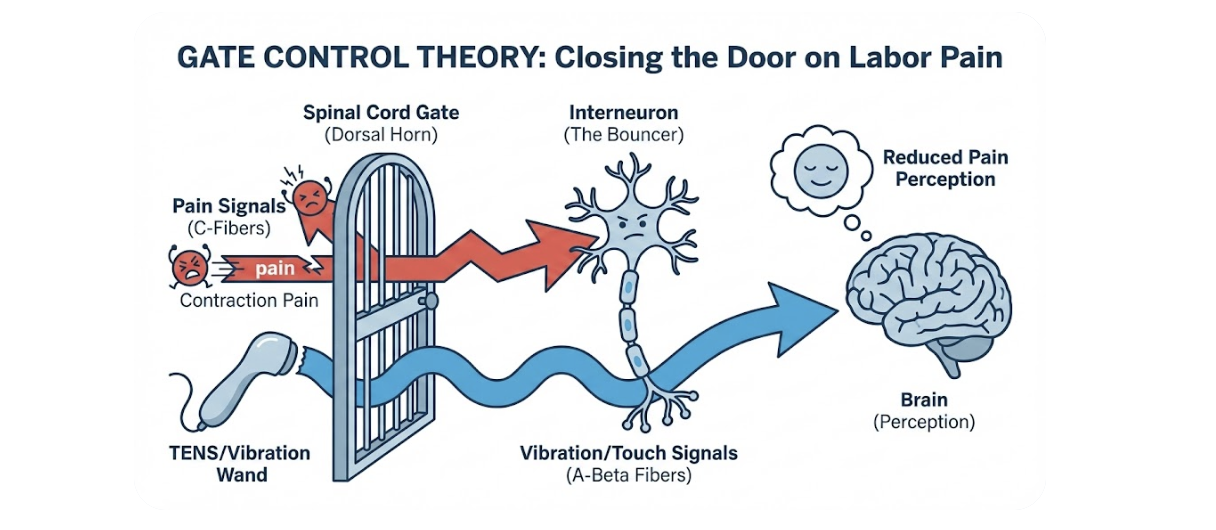
To understand why vibration works, imagine your spinal cord is the entrance to the most exclusive club in town: Your Brain.
For you to "feel" a contraction, that signal has to travel from your uterus, up your spinal cord, and through the front door of the club. (It’s not a ‘pain’ signal - it’s sensation. Your brain determines if it is something to worry about or not). Under normal circumstances, the door is wide open, and the signals are strolling right in and then the brain has to decide - is this sensation associated with safety or danger? (This is where your pregnancy ‘brain training for birth’ with the GentleBirth app comes in).
Think of sensations such as vibration, heat, or cold - as a group of rowdy VIPs arriving at the club at the same time as the signals from your uterus/cervix.
The Crowded Door: Your nerves can only carry so much information at once. When you apply a TENS unit or a vibrating tool to your pubic bone or lower back, you are flooding the "doorway" with fast-moving, sensations that the brain interprets as ‘safe'‘ (a mom’s response to the sensation will influence how the brain interprets the signals).
The Bouncer: Your nervous system acts like a bouncer who can only let a certain number of guests in. Because the sensation of vibration is constant and "loud," the bouncer focuses on those signals and shuts the gate on the slower-moving signals from the uterus.
The Result: The signal is still there, but it’s stuck outside on the sidewalk. It never fully reaches your brain, which means you perceive the sensation as much less intense.
Learn more in my article here about how you can intentionally manage pain perception in labor to stay home longer.
Why This is Your ‘Stay at Home’ Secret Weapon
This isn't just a distraction; it is a physiological hack. By using these tools, you aren't just "toughing it out"—you are literally changing the way your nervous system processes the experience.
When you have a tool that lowers your pain score by 2 or 3 points (as seen in the French study), those early hours of labor at home become manageable rather than overwhelming. This allows you to eat your own food, nap in your own bed, and wait until your labor is "active" before heading to the hospital.
Pro-Tips for Using the Bouncer Strategy:
Start Early: Don't wait until you're really uncomfortable to start the vibration or TENS. Get those "VIP signals" to the door early so the gate is already partially closed.
Keep it Moving: If you feel the effectiveness wearing off, slightly change the location of the vibration. It "surprises" the nervous system and keeps the gate shut.
External Only: Remember, for labor pain management, we are using these tools on the outside (pubic bone, hips, or lower back) to target the nerves closest to the surface.
Pubic Bone Vibration - A New Study with Exciting Results
In a recent pilot study at a French university hospital, researchers tested this idea with vibration over the pubic bone:
· 32 pregnant women were enrolled; 26 used the device at least twice, suggesting it felt acceptable and doable.
· A small, vibrating tool was used externally over the pubic bone area, never inside the body.
· Across 304 correctly treated pain episodes (contraction pain, pelvic girdle pain, postpartum discomfort), women reported relief in about 86% of them.
· On a 0 - 10 pain scale, average pain dropped from around 5.3 before use to 2.6 after—a reduction of roughly 2.7 points.
The study was small and exploratory, so it does not “prove” everything - but those numbers are strong enough to take seriously as a real option for pain management and it’s something experienced doulas and midwives have known for a long time.
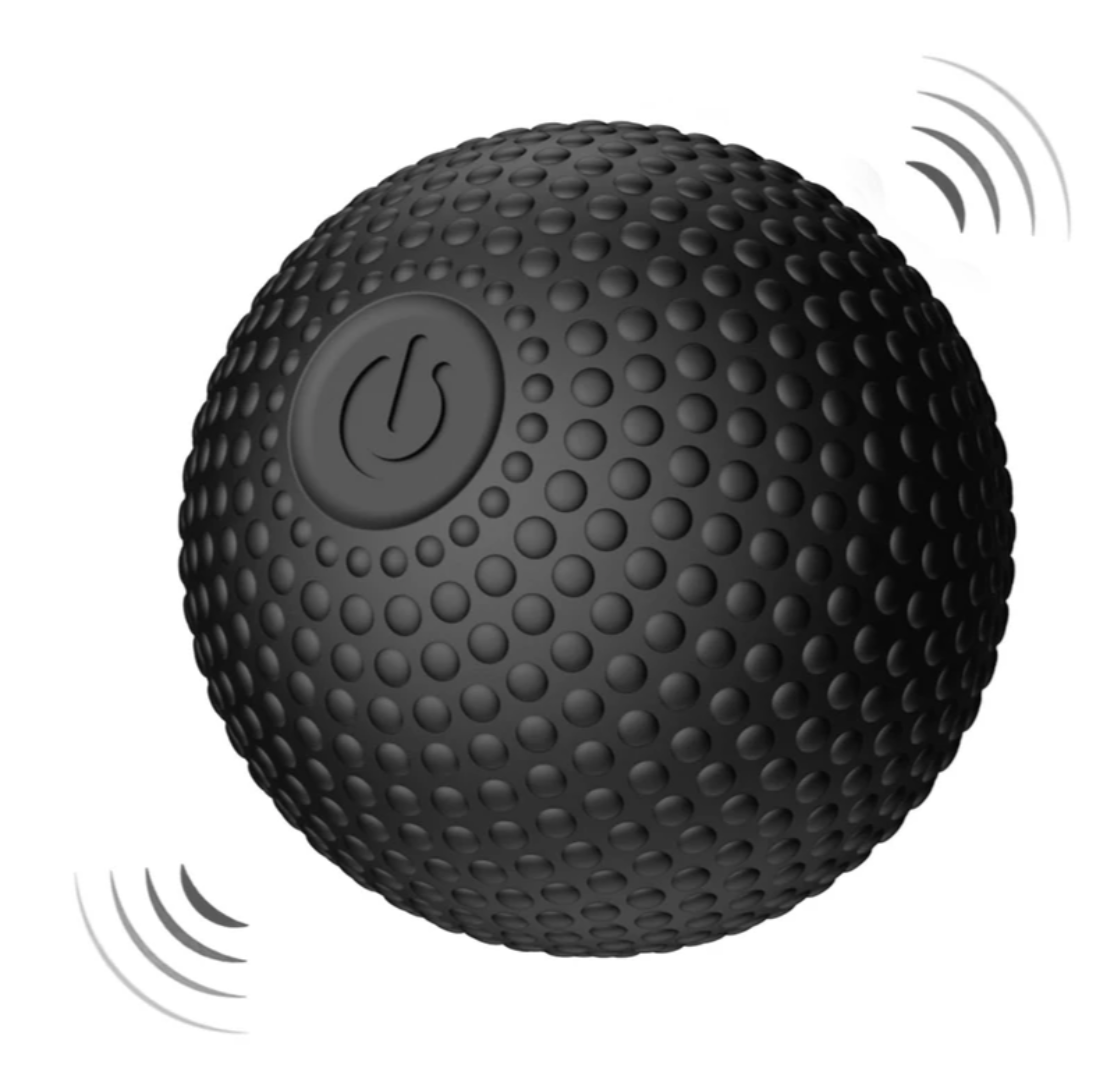
For labor I like these mini therapy balls available on Amazon as they also heat up and can be very soothing when rolled over the lower back and/or hips (and public bone during a surge/contraction). Those EFM/CTG stretchy bands are finally useful for something as they can hold the ball in place over the pubic bone.
What About Red Light Therapy for Birth Prep and/or Labor?
Using the Fringe Pelvic Wand over the pubic bone in labor
While often used for pelvic floor PT, in labor, these tools act as external 'pain scramblers' when held against the pubic bone or sacrum. Think of the Fringe Wand as your handheld, highly focused comfort tool for the front of your pelvis, working on the same basic principle as a TENS unit. You do NOT need to use it internally during pregnancy/labor.
A practical way to use it in labor:
· Placement
o Rest the wand on the firm pubic bone angled toward the center of your pelvis. Only downside is you or someone else has to hold it there.
o Keep it fully external and avoid direct stimulation of the most sensitive tissue.
· Settings
o Early on choose a low, steady vibration that feels calming and stable, not intense or escalating.
o You want a constant, background sensation that “competes” with pain, not a surge of sensation.
· Timing
o Use it in short, focused sessions - around 5 - 15 minutes during contraction waves or flare‑ups of pelvic/back pain.
o Stack it with other comfort tools: movement, your GentleBirth app, shower or bath if available, and continuous support from a partner or doula.
When your labor sensations feel more manageable, you are far more likely to feel safe and confident staying home in early labor, instead of heading in early out of sheer exhaustion or overwhelm.
Using the Fringe Wand for Perineal Prep
The Fringe Wand is also a powerful tool before labor even starts. If traditional perineal massage feels awkward or too intense, using the wand externally can be a gentler, more approachable way to prepare your tissues in late pregnancy. You’ll use Mode 1 and gentle vibration as you practice perineal massage in the laser few weeks of pregnancy.
What it’s doing
o Increasing blood flow: Vibration and red light therapy boosts circulation, bringing more oxygen and nutrients to the tissues, which may support elasticity and resilience when they stretch during birth. (You can also use it post birth for perineal healing if you have a tear or swelling of the vulval tissues - red light therapy works more effectively than ice).
o Relaxing muscles and fascia: The pelvic floor and perineal muscles often hold tension; external vibration helps them release, which can reduce baseline tightness before labor even begins.
o Nervous system familiarization: Calm, regular sensation makes the area feel more familiar and less threatening, so the pressure and stretching of labor are less likely to trigger panic.
o Priming gate control: You are effectively training those nerve pathways to respond positively to non‑painful input, laying the groundwork for better comfort when you use the wand during contractions.
Used this way, the Fringe Pelvic Wand becomes a bridge between late‑pregnancy prep and in‑labor pain relief: same tool, different phase, same core mechanism.
“Partner Tip: Being the ‘Gatekeeper’ isn’t just a metaphor. You can be the one holding the vibrating tool to your partner’s pubic bone or back, giving you an active role in her comfort as well as the double hip squeeze etc etc...”
A Note For Catholic women
For Catholic women, anything involving the pelvic or genital area can carry an extra layer of sensitivity, history, and moral concern. It is important to state this clearly and gently: what is described here is about pain management and tissue preparation, not about seeking sexual pleasure or engaging in masturbation.
Catholic moral teaching supports responsible care of the body, the alleviation of unnecessary suffering, and the use of ethical means to safeguard health and childbirth. When a tool like the Fringe Wand is used within that framework, ordered toward health, dignity, and your vocation as a woman (and, for many, as a wife and mother) - it can be integrated into your birth plan in good conscience.
You deserve more than “just get through it.” With gate‑control‑based tools like a TENS unit and the Fringe Wand, you can build a practical, values‑aligned comfort toolkit that helps you stay home longer, reduce your risk of in‑labor cesarean, and walk into birth feeling informed, supported, and deeply connected to your own body.
Tracy
Resources:
https://journals.plos.org/plosone/article?id=10.1371/journal.pone.0333112
https://blog.tracydonegan.org/blog/red-and-blue-light-therapy-for-postpartum-healing
https://blog.tracydonegan.org/blog/light-vs-ice-the-best-relief-for-perineal-pain-and-healing-after-birth