For a lot of women TTC you've probably heard a lot of talk about weight, BMI and what you "should" be doing. It's a lot, and it can feel personal in ways that sting.
Here's what often gets missed. Underneath the numbers is a more useful story about visceral fat, the deep fat that affects inflammation, hormones and the environment your reproductive system works in. This isn't about blame or judging your body. It's about understanding your body well enough to give it the right support.
In this post, we'll look at what the research says about visceral fat and adipose tissue (belly fat), why tissue thickness matters for light therapy, and why I pair two devices, the Fringe Wand and my Solasta laser, to support your pelvic organs and systemic circulation from the inside and the outside.
Visceral Fat: The Hidden Hormone Organ
Some visceral fat is normal and healthy. It cushions and protects your internal organs. But visceral fat isn't just stored energy. It behaves almost like another endocrine organ, releasing its own mix of hormones and inflammatory signals that affect your metabolism, insulin sensitivity and ovarian function.
When visceral fat runs higher, those signals can disrupt the hormonal balance your reproductive system relies on. Seeing it this way moves the focus off appearance and onto what really matters: a calmer, healthier internal environment that works with your fertility.
A 2025 study of 1,510 women having frozen embryo transfers found that women with higher visceral fat (65 cm² or more) had lower implantation, pregnancy and live birth rates. Live birth was 44.8% vs. 50.8%, even after accounting for age, BMI and baseline hormone levels .
“Visceral fat isn’t just “extra weight” - it behaves almost like another endocrine organ. It releases its own cocktail of hormones and inflammatory signals that quietly influence everything from metabolism to ovarian function. When visceral fat is high, those signals can disrupt the very hormonal balance your reproductive system relies on. Understanding this helps take the focus off appearance and puts it where it belongs: on supporting a healthier internal environment that works with your fertility, not against it.”

Visceral fat unlike subcutaneous fat can reduce circulation to the reproductive organs.
Why BMI doesn't tell the whole story
BMI can't tell what kind of fat you have or where it sits. You can have a "normal" BMI and still carry more visceral fat, which is sometimes called "normal weight obesity." In that same study, the link between visceral fat and poorer outcomes was especially clear in women under 35 and in women with a BMI under 24 . So if you've been told your BMI is "fine" but you're still struggling, or told it's "too high" and felt written off, neither label is the full picture.
Tissue Thickness and Light Penetration
This is the part most women are never told, and it's why I changed how I build protocols.
Light therapy works by delivering energy to your cells. Light shone on your belly has to pass through skin, the fat under the skin and abdominal muscle and fascia before it reaches deeper pelvic tissue. Each layer scatters and absorbs some of it.
Wavelength matters. Near-infrared light reaches deeper than red light, roughly 2 - 15 mm vs. 1 - 3 mm.
Thickness matters. A 2026 study confirmed that near-infrared penetration drops as tissue gets thicker.
Contact matters. Even a small air gap between the device and the skin wastes energy. That's why clinical research uses skin contact, not panels held at a distance.
If your abdominal tissue is thicker, a smaller share of the light from any external device reaches your pelvis. That isn't a failing on your part. It's simply physics, and once we know it, we can plan around it.
Is all belly fat visceral fat?
No, and this is a really important point. Most of the fat you can see or gently pinch on your belly is subcutaneous fat, the soft layer just under your skin. It makes up about 90% of body fat for most people, and for women it's a normal, healthy part of how our bodies are built. Visceral fat sits much deeper, behind your abdominal muscles and around your organs, and you can't see it or feel it.
So a soft tummy doesn't tell us much about your visceral fat, and it certainly isn't something to worry about on its own. How your belly looks isn't a reliable guide either, because bloating, posture and abdominal muscle tone all change its shape. That's why we use measurements instead of guesswork.
Here's how the two types relate to your protocol:
Visceral fat is the type that behaves like an extra endocrine organ and affects your hormones.
Every layer of tissue, including the soft subcutaneous layer, affects how much light from an external device reaches your pelvis.
Your tissue thickness assessment takes both into account. And because a pelvic wand works from the inside, belly tissue doesn't get in its way at all.
Can light reach my ovaries?
I want to answer this honestly, because you deserve a straight answer rather than a marketing one. Not yet. Light from an internal device can't travel 6 - 10 cm to your ovaries in any meaningful amount, and anyone who says a device is "zapping your eggs" is overpromising. The real mechanism is less direct, and much more interesting - learn more here.
How Pelvic Light Actually Works
When red and near-infrared light reaches tissue close to the surface, it's absorbed by an enzyme in your mitochondria, your cells' "battery packs." Those cells then release signalling molecules into the bloodstream, including nitric oxide, ATP and exosomes. You can think of them as text messages carried through your circulation.
A July 2025 study led by Glen Jeffery showed this principle in action. Near-infrared light shone on the torso, with the eyes fully shielded, improved colour vision within 24 hours. That happened even though only 0.004% of the light made it through the body. The light acted locally, and the effect showed up somewhere else.
Why the wand's location is strategic
Around your cervix sits the pericervical vascular plexus, a dense network of blood vessels where blood from the vaginal walls, cervix and lower uterus converges. In about 56% of women, this network connects directly to the ovarian blood supply. In about 4%, the uterine veins are the main supply to the ovaries.
Think of it like a message in a bottle. Dropping it into a river that flows toward the ovaries gives it a far better chance of arriving than dropping it into the ocean.
The back wall of the vagina also sits very close to the pouch of Douglas. This is the lowest point of the pelvic cavity, where fluid collects that bathes the ovaries and tubes, and in endometriosis or pelvic inflammation it can carry inflammatory molecules. Light therapy is known to calm inflammation, but no studies have yet looked at light directed at this area specifically.


Why I Use Two Devices
The Fringe Wand and the Solasta laser reach your pelvis by different routes. They aren't doing the same thing twice.
Why I Use Two Devices
The Fringe Wand and the Solasta laser reach your pelvis by different routes. They aren't doing the same thing twice.
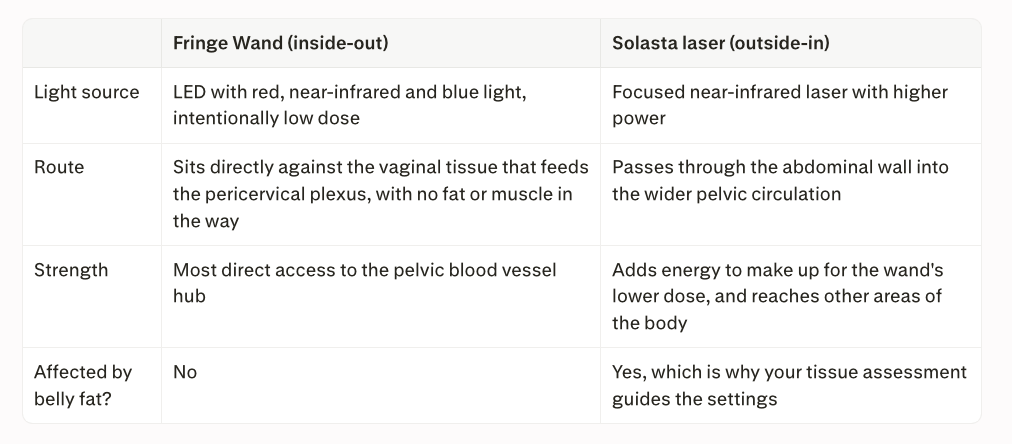
Because the pelvic wand is LED and intentionally delivers a low dose, the Solasta laser makes up the difference. Together they give your pelvis more total light energy, from more directions, than either one alone. Most women use the two devices at separate times of day.
Other areas the laser supports
Neck and groin (Ohshiro method). I always start by "priming" the neck, and other sites, to support circulation and lymph flow before treating the pelvis. Learn more about device stacking.
Lower abdomen. Directly over the uterus.
Injection sites during IVF. To ease the tenderness and bruising that daily injections can bring.
Liver support during IVF. Your liver processes the hormones from fertility medications, so we include it to support your body while it handles that extra workload.
If you've had cervical or uterine procedures
Procedures such as a D&C, LEEP, cone biopsy or cervical clamping may affect the nerve network around the cervix, which helps control how your uterus moves. These procedures are often medically necessary, and many women conceive easily afterwards. If you've had one, though, mention it when we build your protocol. Read more in my pelvic red light therapy guide
Your Personalized Protocol
Because tissue thickness changes how much light reaches your pelvis, I now include a tissue thickness/visceral assessment in every protocol. It's a practical calculation, not a judgment.
A Hopeful, Honest Outlook
Here's where the evidence stands. There's solid reasoning for why each route works. What we don't have yet is a trial comparing wand-only, laser-only and combined protocols head-to-head. What we do know is that lowering visceral fat, even through 5 - 10% weight loss, can meaningfully improve fertility outcomes, and for some women it can restore natural cycles.
Your body isn't working against you. Sometimes it just needs a better environment to do what it already knows how to do.
If you’re reading this while feeling overwhelmed or discouraged, know this: research is on your side, and every positive habit moves you closer to both better health and the family you dream of building.
Keep the faith!
Tracy