Red Light Therapy for Women: Science-Backed Benefits vs. Marketing Hype
A new paper was recently published on red light therapy for wellness and peak athletic performance. This paper is basically one big love letter to red light therapy. It walks through how red and near‑infrared light might help everything from sports performance to brain health, pain, thyroid issues, skin, hair, and even sinus problems. For a big picture overview of the science (with some study weaknesses) this is a great place to start if you’re considering getting a panel Vs a laser. You can read the research free here.
In Plain English
· Red and near‑infrared light help your cells make more energy by boosting the mitochondria (the “batteries” of the cell).
· When cells have more energy, they can repair faster, calm inflammation, and handle stress better.
· The authors share research suggesting red light can:
o Help athletes perform better and recover faster (less soreness, less muscle damage). Obviously this is also a great postpartum tool too.
o Support brain health after concussion, in dementia, stroke recovery, and mood issues like depression and anxiety ( Menopause, postpartum, sleep quality)
o Reduce chronic pain (fibromyalgia, low back pain, arthritis, nerve pain). (Lots for women here).
o Help with thyroid problems, wound healing, skin health, hair growth, and sinus issues. (Thyroid issues anyone….postpartum hair loss?)
They also provide a nice big table of “suggested” settings: which wavelengths (colors of light), how many Joules/cm² (dose), and how often to treat.
So the main take aways is: when you use the right color of light and the right dose, red light therapy can be a powerful, drug‑free tool for a lot of different issues.
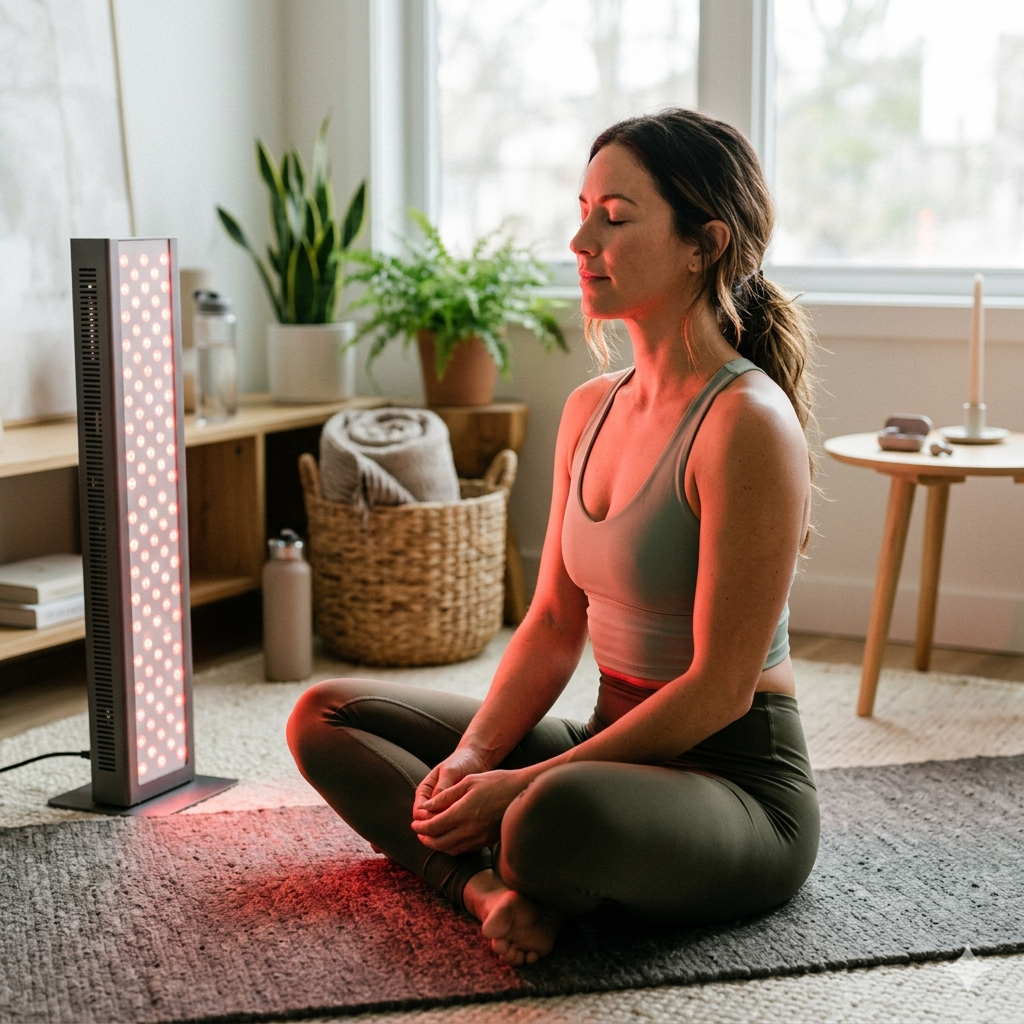
Red light therapy for women - panels, Solasta lasers, red light therapy pelvic wands.
What They Say about Handheld Lasers vs LEDs
The paper does talk about different kinds of devices:
· Handheld lasers
o The authors say lasers are great when you want to treat a deep, specific spot.
o Think: a hip joint, a small deep joint, or a focused area that needs a strong, targeted beam. (Think fertility, postpartum wound healing, carpal tunnel, pelvic girdle pain).
Solasta red light therapy photobiomodulation home laser.
LED devices and full‑body panels/pods.
o They describe LED panels as better for bigger areas and whole‑body goals, like general recovery, mood, and overall inflammation.
o You can stand or sit in front of a panel and treat a large part of the body at once.
They also make a big point that what really matters is the dose and wavelength (how strong, how long, what color), not just whether the light comes from a laser or an LED.
So their simple message is:
· Use lasers for deep, smaller, targeted areas.
· Use LEDs/panels for broad, whole‑body or large‑area treatments.
The Big Issue: They Didn’t Separate Out The Device Types in the Data
Here’s where things get a little tricky.
Even though they talk about lasers and LEDs like they’re different tools in the same toolbox, they don’t actually show you which results came from which device in the studies they’re summarizing…
· In their big protocol table, they list:
o Wavelengths (like 660 nm, 810 nm, 850 nm)
o Doses (like 4–10 J/cm²)
o How often to treat
· But they never indicate: “this protocol is based on a laser study” or “this one came from an LED study.” (This is frustrating to those of us working with real life women with real life problems) who can sit in front of a panel trying to fix their pelvic health problem until the cows come home and are left with ongoing pain, but now with glowing skin).
· In the sections on sports, brain, pain, thyroid, skin, and sinuses, they talk about lots of research, but they mix laser and LED studies together under the general label of “photobiomodulation” or “red light therapy.”
· Even for brain treatments, where some trials used LEDs and others used lasers, they throw them all into one bucket and give one general dose range.
So if you’re trying to answer the question, “Is a handheld laser better than an LED for this specific problem?” — this paper doesn’t really give you that answer. It tells you both can work, but it doesn’t give a clear, side‑by‑side comparison. Other studies do a much better job of parsing out the information which of course helps consumers make informed choices.
Gaps and Limits to This Paper
Think of this paper like a really good intro ‘webinar’ not a full certification course. It’s quite positive and gives you the big picture, but it leaves some important questions open.
Here are the main gaps you’d want to know:
1. It’s more of a “tour,” not a strict scientific breakdown
· The authors say they did a “comprehensive review,” but they don’t show exact search terms, how they chose which studies to include or how strong or weak each study was. So that means it’s more of an overview than a robust step‑by‑step scientific analysis. (But I guarantee you it will pop up on every device manufacturer’s website this week as ‘proof’ that their panel delivers).
2. The protocols in the table are blended, not one‑to‑one
· The suggested settings in the table look very precise, but they’re actually blended from many different studies.
· You don’t see which exact study supports each exact protocol.
· It’s not clear if some of those exact combinations (like dose + frequency + wavelength) were ever tested exactly that way in real patients.
So those numbers are a good starting point, but not “this is proven, do exactly this.”
3. No clear “laser vs LED winner”
· Even though the paper mentions both lasers and LEDs and cites a paper comparing them, it never shows:
o “Here’s what happened with lasers in this group.”
o “Here’s what happened with LEDs in this group.”
o “Here’s which did better at the same dose.”
So if you’re choosing between buying a laser or an LED panel, this article won’t give you a clear “winner” based on hard numbers. As you go through my blog you’ll find individual studies that may be more relevant to you.
4. Very different conditions are treated like they’re the same
Another frustrating aspect to this study was they use the same style of recommendations for:
o Sore muscles after a workout
o Dementia
o Stroke recovery
o Thyroid disease
o Fibromyalgia
o Sinus problems
o Skin conditions
That’s great for seeing the big picture, but each of those conditions has its own details and challenges. The paper doesn’t really slow down to explore those differences.
5. Dose at the skin vs dose at the target
· For deeper areas like the brain, hip, or spine, the paper talks about how much energy hits the skin, but not how much actually reaches the deeper tissue through bone and other layers.
· That matters a lot in real‑world treatment, and they don’t give much help on adjusting for that (I bang on about this daily especially in fertility work).
6. Very positive tone, not much “what didn’t work”
· The paper is very optimistic - lots of “this helps” and “this is promising.”
· It doesn’t spend much time on:
o Studies where red light didn’t help.
o Mixed or neutral results.
o Possible publication bias (studies that never get published if results weren’t impressive).
That doesn’t mean the therapy doesn’t work - it just means you’d still want to look at individual studies if you’re making big decisions on a device.
How to Think about This Paper.
Personally I was excited to read this (the body of research is exploding)…but we need good, methodologically sound research…this is a narrative not a systematic review. So in a nutshell…
· “This paper is a great big‑picture guide that shows just how many areas red light therapy touches.”
· “It gives helpful ranges for color and dose that you can use as a starting point.”
· “It tells us lasers and LEDs both have a place - lasers for deep, focused work and LEDs for broad, whole‑body support.”
· “But it doesn’t clearly separate out which results came from which devices, and it doesn’t give us a head‑to‑head scoreboard.”
So if you’re choosing exact protocols for a panel you have at home, trying to figure out what this red light therapy malarky is all about, this paper is a launching pad, not the final destination.
Tracy