If you’ve been struggling with relentless vaginal burning, yellow discharge, and pain that won't go away, you might have finally heard the term Desquamative Inflammatory Vaginitis (DIV). For many women, getting this diagnosis is a massive relief after months - or even years of being misdiagnosed with recurrent yeast infections or stubborn BV.
But that relief is often short-lived when you realize that the standard medical fix - months of heavy-duty antibiotics and steroids - doesn't always offer a permanent solution. This has led more women and practitioners to consider emerging health technologies such as Photobiomodulation (PBM), commonly known as Red Light Therapy, as a way to support long-term vaginal healing and microbiome health.
What Exactly Is Desquamative Inflammatory Vaginitis (DIV)?
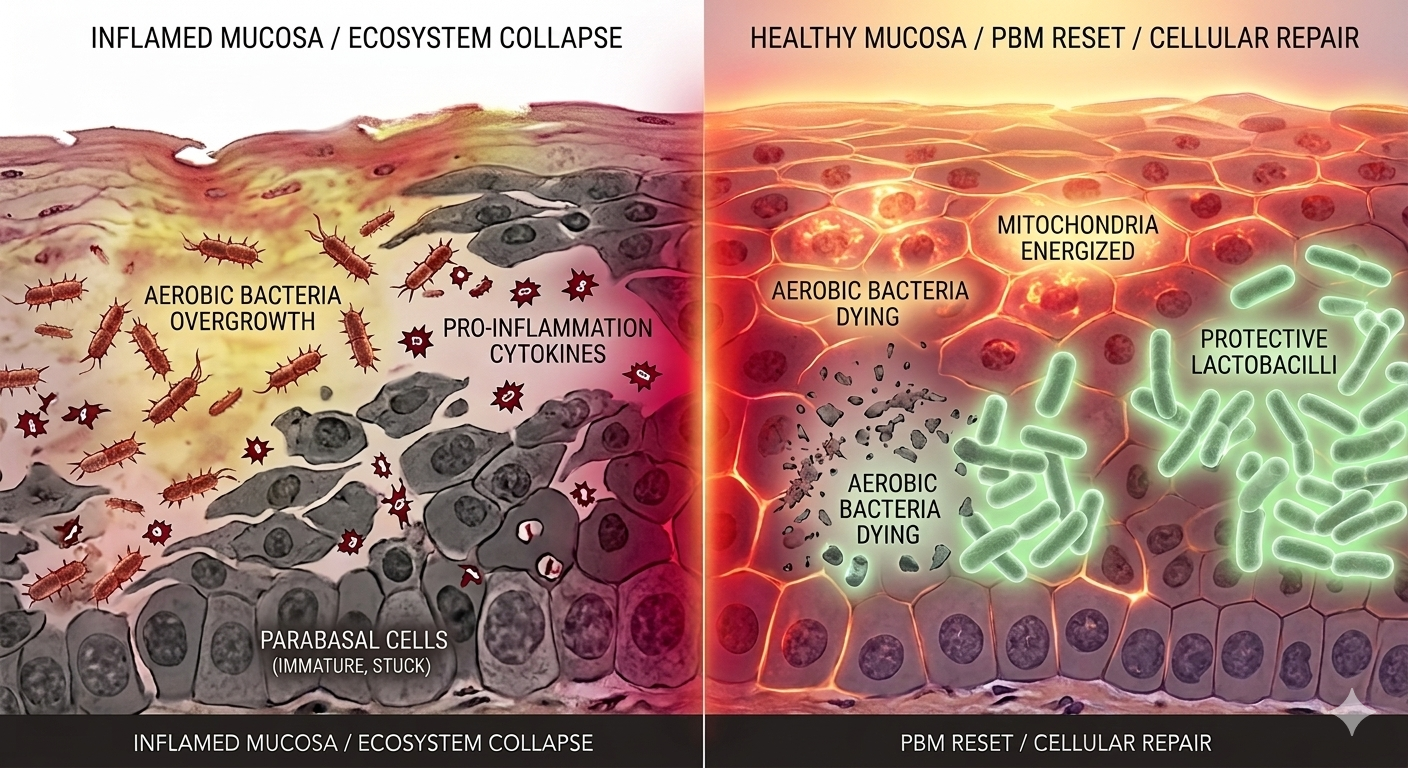
DIV isn’t a standard infection; it’s an ecosystem collapse. In a healthy vagina, Lactobacilli microbes keep the environment acidic and protected. In DIV, that protection vanishes. The vaginal lining becomes thin, inflamed, and literally begins to "shed" (desquamate).
On exam, clinicians usually see:
Intense Inflammation: A "beefy" red appearance of the vaginal walls.
Purulent Discharge: Heavy, yellow or green-tinged discharge that is often non-foul smelling.
Alkaline pH: A vaginal pH usually well over 4.5 (often reaching 5.0 or 6.0).
Cellular Changes: Under a microscope, there is a distinct lack of "good" bacteria and an abundance of inflammatory white blood cells and immature "parabasal" cells.
Because it is officially labeled as "uncommon," many providers aren't trained to look for it, leaving women in a frustrating cycle of failed antifungal treatments and "mystery" pain.
The Mucosal Advantage: Why Red Light Works Best Internally
To understand why Red Light Therapy is so effective for DIV, we have to look at the anatomy of the vagina. The vaginal canal is lined with a specialized epithelial layer (non-keratinized stratified squamous epithelium).
Unlike your external skin, which has a thick, protective "dead" layer of keratin to keep the elements out, mucosal tissue is "live" right up to the surface. This creates a direct access point for healing:
No "Skin Shield": Let’s say you’re using red light on your abdomen, red light must penetrate layers of dead skin that reflect and scatter the light as well as muscle, fascia and fat. In the vagina, the mitochondria in your cells are exposed and ready to absorb light photons instantly.
Maximum Absorption: Because the tissue is permeable and moist, the light energy penetrates deeper and more effectively into the basement membrane, where new, healthy cells are born.
Rebuilding the Barrier: DIV causes the epithelial layer to leak and thin out, exposing raw nerves. PBM stimulates these epithelial cells to mature and thicken, effectively rebuilding your "internal shield." abdomen;
The Problem with the Standard Approach: Why DIV Keeps Coming Back
The go-to treatments for DIV are typically 2% Clindamycin (an antibiotic) and Hydrocortisone (a steroid). While these are vital for cooling down a massive flare, they have a high "bounce-back" rate.
A landmark study followed women with DIV for a year and found that only 26% were actually cured. More than half remained symptom-free only as long as they stayed on "maintenance" medication. For many, the idea of using steroids or antibiotics twice a week indefinitely isn't just a burden - it’s a concern for long-term tissue integrity and your entire gut and vaginal flora. Steroids, while great for inflammation, can eventually thin the mucosal lining, making it even more fragile (we see the same problems with Lichen Sclerosus).
How Red Light Therapy Resets the Vaginal Ecosystem
Red light therapy doesn't work like a drug; it works by providing energy to your cells so they can do their job better. Using specific wavelengths of red and near-infrared (NIR) light (usually between 630nm and 850nm), it helps the vaginal environment in three specific ways:
1. It Puts Out the Cellular Fire
DIV is characterized by "pro-inflammatory cytokines" - the chemical messengers that keep your tissue in a state of alarm. Red light therapy has been shown to modulate these messengers, reducing the "burning" sensation at a cellular level without the side effects of chronic steroid use.
2. It Strengthens the Epithelial Barrier
When the vaginal lining is thin and fragile, it can't support a healthy microbiome. Red light stimulates ATP production (cellular energy) and fibroblasts to produce collagen and elastin. This makes the mucosa more resilient and less likely to "shed" or tear during daily activity or intercourse.
3. It Optimizes the "Soil" for the Microbiome
The vaginal microbiome is highly sensitive to the health of the tissue it lives on. By improving blood flow and reducing oxidative stress, red light helps create a healthier "soil." This makes it much easier for your protective Lactobacilli to move back in, produce lactic acid, and naturally lower your pH back to a healthy 3.5 - 4.5.
Targeted Healing With a Red Light Pelvic Wand & Protocol
While you can use red light panels externally, DIV is primarily an internal condition. This is why the Fringe Pelvic Wand is a game-changer for women managing chronic vaginitis.
The Fringe Wand provides 360-degree internal light delivery, ensuring the red and NIR wavelengths reach the exact areas of the vaginal vault where DIV is most active.
Reach the Source: It targets the deep mucosal tissue that external panels or wraps simply can’t reach.
Dual-Action Therapy: Many women with DIV develop "pelvic guarding" - tight, painful muscles caused by years of chronic irritation. The wand's ergonomic design allows it to be used for gentle pelvic floor trigger point release while simultaneously delivering light therapy. (You’ll also receive an audio resource to reduce that guarding and increase a sense of calm within your nervous system.
At-Home Consistency: Since DIV requires long-term maintenance, having a professional-grade tool at home means you aren't reliant on constant, expensive clinic visits.
My Protocol: Fast Results Without Irritation
Over the last 18 months of writing protocols for women with various vulvovaginal conditions, I have learned that the "more is better" approach backfires. When your tissues are this inflamed, they are incredibly reactive.
My specific protocols focus on therapeutic pacing. If you jump into a high-intensity schedule immediately, you risk "over-stimulating" the already sensitive nerves. Instead, I guide women through a tiered approach:
The Easing In Phase: We start with shorter durations to down-regulate the nervous system and calm the immediate "fire" of the cytokines.
The Rebuild Phase: Once the burning subsides, we gradually increase the light "dose" to focus on collagen synthesis and epithelial thickening.
Microbiome Integration: I teach you exactly when to use your red light in relation to your medications or probiotics to ensure the light reaches the tissue without interference.
By following a structured protocol, my clients often see faster tissue stabilization and a reduction in discharge without the "flare-up" that often comes from unguided DIY attempts.
Frequently Asked Questions (FAQ)
Is it safe to use with my prescriptions?
Yes. Red light therapy is a non-thermal "cold" light. We recommend using the wand on clean tissue before you apply your clindamycin or steroid creams at night. This ensures the light wavelengths can penetrate clearly without being blocked by thick ointments.
How often should I use the Fringe Wand for DIV?
For chronic inflammation, consistency is everything. My protocols start out slow and low - a conservative approach works best and we increase time/dosage over several weeks - always using the feedback of our body to guide us.
Does the wand get hot or cause burns?
No. Unlike surgical or aesthetic lasers, the Fringe Wand uses low-level light therapy (LLLT). You might feel a gentle, soothing warmth from increased circulation, but it will not burn or damage your delicate tissues.
The Future for DIV: An Integrative Approach
DIV is complex, and managing it usually requires a multi-pronged strategy. You don't have to choose between "natural" and "medical." The best results often happen when we use an integrative approach in collaboration with your provider:
Medical Control: Work with a specialist to use prescribed creams to stop the acute "fire."
Cellular Repair: Incorporate a Red Light Pelvic Wand and a professional protocol to help the tissue repair itself and stay resilient long-term.
Microbiome Support: Focus on gentle hygiene, breathable fabrics, and pelvic floor health to allow the ecosystem to return to its natural state.
Stop living in a cycle of "manageable" pain. By addressing the health of the tissue itself, you can finally move beyond temporary fixes and toward a life of comfort.
The Fringe Pelvic Wand and my specialized DIV protocols are designed to bring clinical-grade healing into the comfort of your home. Click here to shop the Fringe Pelvic Wand and receive a personalized protocol based on your health history and current symptoms.
A Note on Current DIV and Red Light Therapy Research: What We Know (And What We Don’t)
When exploring new therapies, it is vital to be transparent about the science.
The Status of DIV-Specific Trials: Currently, there have been no published, randomized clinical trials specifically studying Photobiomodulation (PBM) as a direct treatment for Desquamative Inflammatory Vaginitis (DIV).
If a medical source or product promises that PBM is a proven cure for DIV today, they are misrepresenting the current state of the science.
The "Why" Behind the Hope: Broader PBM Research: While we wait for DIV-specific data, we are not in the dark. Our confidence in PBM as a supportive tool for DIV rests on a massive body of evidence in two key areas:
Vaginal Use for Related Conditions: We do have plenty of research on using PBM internally for conditions that share features with DIV - such as atrophic vaginitis, vulvar pain, and lichen sclerosus. These studies show that internal PBM safely reduces pain, restores tissue elasticity, and improves mucosal lubrication by boosting cellular energy.
Oral Mucosa Analogy: The lining of the vagina is structurally very similar to the oral mucosa (the lining of the mouth). PBM is currently used in leading cancer centers to prevent and treat oral mucositis - a severe, painful inflammatory breakdown of the mucosa. The mechanisms that repair the lining of the mouth are highly relevant to repairing the lining in DIV. This treatment is now being covered by health insurance in 2026.
The Big Picture: While we still need direct clinical trials, the combined success of PBM in healing other vaginal conditions and other mucosal tissues is incredibly encouraging. For many women who have found no relief through years of antibiotics and steroids, this research suggests PBM could finally be the supportive, non-drug answer they have been waiting on.
Resources
Sobel JD, et al. "Desquamative inflammatory vaginitis: A review." Obstetrics & Gynecology.
Antonio FI, et al. (2025). "Photobiomodulation therapy for the treatment of vulvar pain: a randomized controlled trial." The Journal of Sexual Medicine.
Lev-Sagie A, et al. "Low-Level Laser Therapy for the Treatment of Provoked Vestibulodynia." Journal of Lower Genital Tract Disease.
Zupin L, et al. "Photobiomodulation and the vaginal microbiome: Emerging insights into mucosal health." Frontiers in Reproductive Health.
Robitaille A, et al. "Efficacy of High Intensity Laser for Provoked Vestibulodynia." ClinicalTrials.gov.