Lyma vs. Solasta: The No‑Fluff Guide to Red Light Therapy for Skin Care
You might know Solasta because of my fertility work or as an effective tool for pain management - but what you might not realize is that this same small hand‑held laser packs big power for a surprisingly low price, and it’s just as at home supporting skin health, wound healing, and everyday pain relief as it is in your fertility protocol. That versatility is exactly why I recommend it as a long‑term, whole‑body red light tool - not just another pretty gadget for your bathroom shelf.
If you spend any time in beauty land, you’ve seen the Lyma Laser everywhere - on celebrity vanities, in glossy magazine reviews, and all over TikTok “get ready with me” videos. Editors rave about glowier, smoother skin and fewer fine lines after a few months of daily use, and Lyma’s sleek black wand has basically become a status symbol in skincare.
But here’s what most of that press leaves out: how red light therapy actually works, what dose your skin truly needs, and why a high‑output device like Solasta can deliver serious, evidence‑aligned results without the 2k‑3k plus luxury price tag.
Red light therapy 101 (without the science headache)
Red light therapy - also called low‑level laser therapy or photobiomodulation - is a non‑invasive way to nudge your skin cells to behave more youthfully using very specific wavelengths of light. Unlike UV, which can damage DNA, red and near‑infrared light sit in safe ranges that help your cells make more energy, calm inflammation, and repair tissue.
Dermatology and research‑backed health sources report that, with consistent use, red light therapy can soften fine lines and wrinkles, improve texture and elasticity, even out tone, and support the healing of scars and blemishes. The trade‑off is that it’s not a quick fix: you’re playing the long game of 3-5 sessions per week over several months, not a one‑and‑done laser peel. It takes time…lots of time.
Why the color of the light matters for your skin
Most anti‑aging devices, including Lyma operate in two key ranges.
· Red light (roughly 600 - 700 nm)
Great for the surface and just below - think glow, redness, and shallow wrinkles - because it penetrates a few millimeters into the skin.
· Near‑infrared (roughly 780–880 nm)
Invisible to the eye but able to reach deeper structures like the mid‑dermis and underlying tissue, where collagen and support structures live.
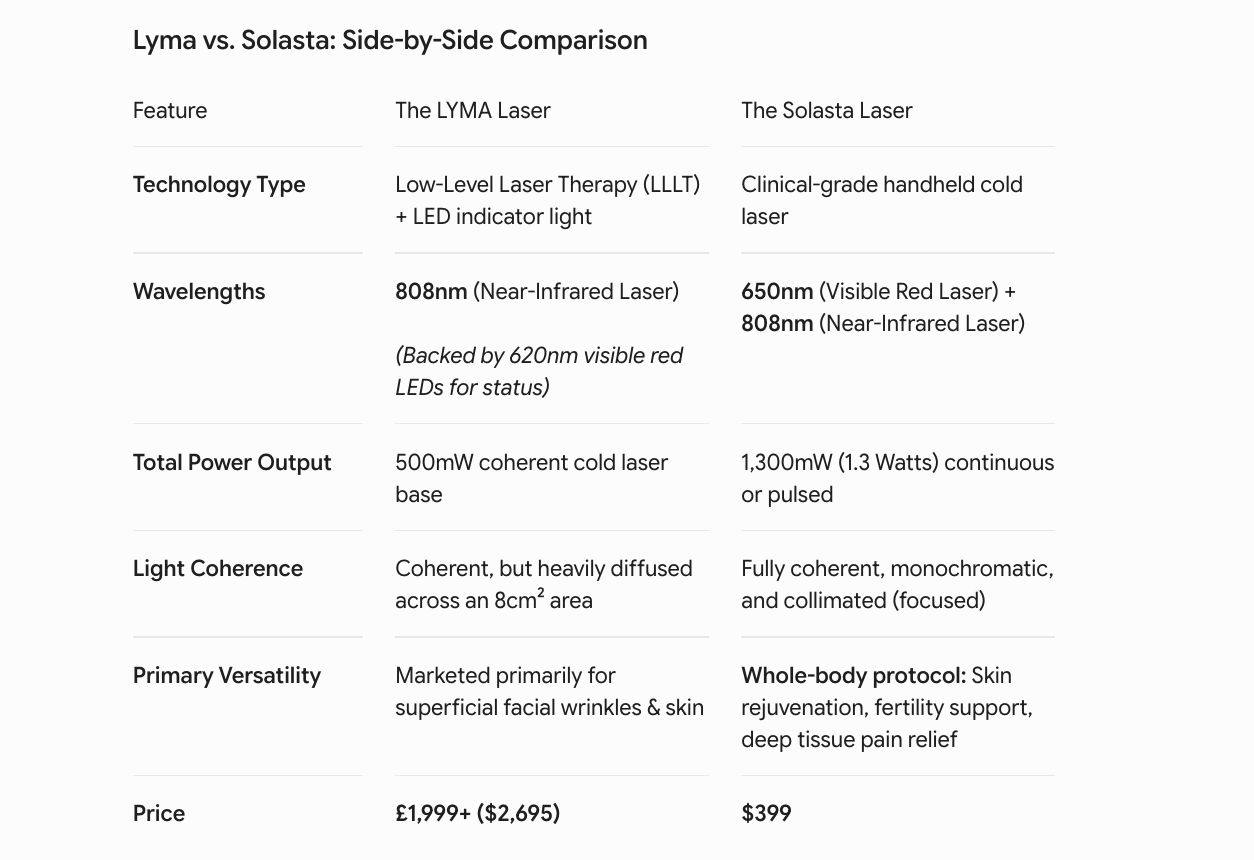
Studies and expert reviews suggest that using these wavelengths consistently can improve collagen production, reduce wrinkle depth, and enhance skin texture and elasticity over time. That’s why the specifics matter: Lyma leans heavily on near‑infrared for deeper stimulation, while Solasta combines 650 nm red with 808 nm near‑infrared so you get both surface brightness and deeper “support beam” benefits in one session.
While Lyma’s 620 nm red light does have baseline research showing it can brighten the top layer of your skin, it's often selected by manufacturers because it is visually brighter and cheaper to produce. If you want true, deep dermal remodeling for wrinkles and ageless skin, you want a device pushing out the more heavily researched, deeper-penetrating wavelengths like 650 or 660 nm alongside near-infrared.
The Lyma Laser: what’s really behind the hype
Lyma markets itself as a “medical‑grade cold laser” that you can safely use on your couch while watching Netflix. Instead of just LEDs, it uses an 808 nm near‑infrared “cold” laser, backed by LED light, to push energy into the skin without heat or damage.
Independent reviews and brand materials say Lyma delivers around 500 mW of low‑level laser power over an area of roughly 8 cm², making it gentler and more diffuse than many clinic lasers. Beauty editors who’ve stuck with it for several months report brighter, more even skin, softer lines, and a generally “lifted” look - especially around the jowls, cheeks, and neck. It’s painless, suitable for all skin tones, and feels more like a luxe ritual than a medical treatment, which is a huge part of its appeal.
The catch? Lyma sits in the $2,000s+ range, which makes it one of the most expensive at‑home beauty devices on the market. And while the brand talks a lot about being “40x more powerful than LED,” it doesn’t clearly publish the exact energy dose in joules per square centimeter (J/cm²) - the way clinical studies measure effectiveness. Consumer feedback also shows a split: some users are obsessed, while others feel the results don’t match the price or had issues with support.
Is Lyma a “real” laser or just fancy LED?
Let’s clear this up, because everyone’s asking.
Yes, Lyma uses a real low‑level laser.
The device has an 808 nm near‑infrared “cold” laser at its core, surrounded by LEDs, delivering around 500 mW of diffused laser power. That puts it in the photobiomodulation / low‑level laser category, not just an LED face mask.
So why isn’t anyone wearing safety goggles?
Lyma uses a patented ultra‑diffused lens that spreads the laser beam over a larger area, which drastically lowers the intensity at any one point. The brand says this makes it safe to use around the eyes with no goggles required, as long as you don’t stare directly into the central aperture. That’s why you see influencers and editors waving it around their face in videos without eye protection.
Is it just a “supermarket laser”?
No - but it’s also not a high‑power clinic‑only laser. It’s stronger and more structured than a basic barcode scanner or pointer, but it’s engineered and certified as a cosmetic cold laser for at‑home skin use, not as a cutting or ablative (hot) device. Some users and pros argue the diffused, eye‑safe design is exactly what makes it gentle and accessible; others question whether that gentleness plus a lack of clear J/cm² dose really justifies the price.
How Solasta handles eye safety (and why that matters)
Solasta sits closer to the “true therapeutic laser” end of the spectrum, even though it’s designed for home use. It combines 650 nm red with 808 nm near‑infrared at around 1.3 W total output, delivered via a focused, contact‑based treatment head rather than a heavily diffused cosmetic beam.
Because of that higher, more concentrated output, Solasta is treated with classic low‑level laser safety principles:
· You use it in direct contact with the skin, not waving it casually around the eyes.
· You wear safety goggles.
· You avoid shining it toward the open eye and follow the safety guidance that comes with the device, which is more in line with how clinics handle therapeutic lasers.
Solasta: a clinic‑style red light laser you can actually understand
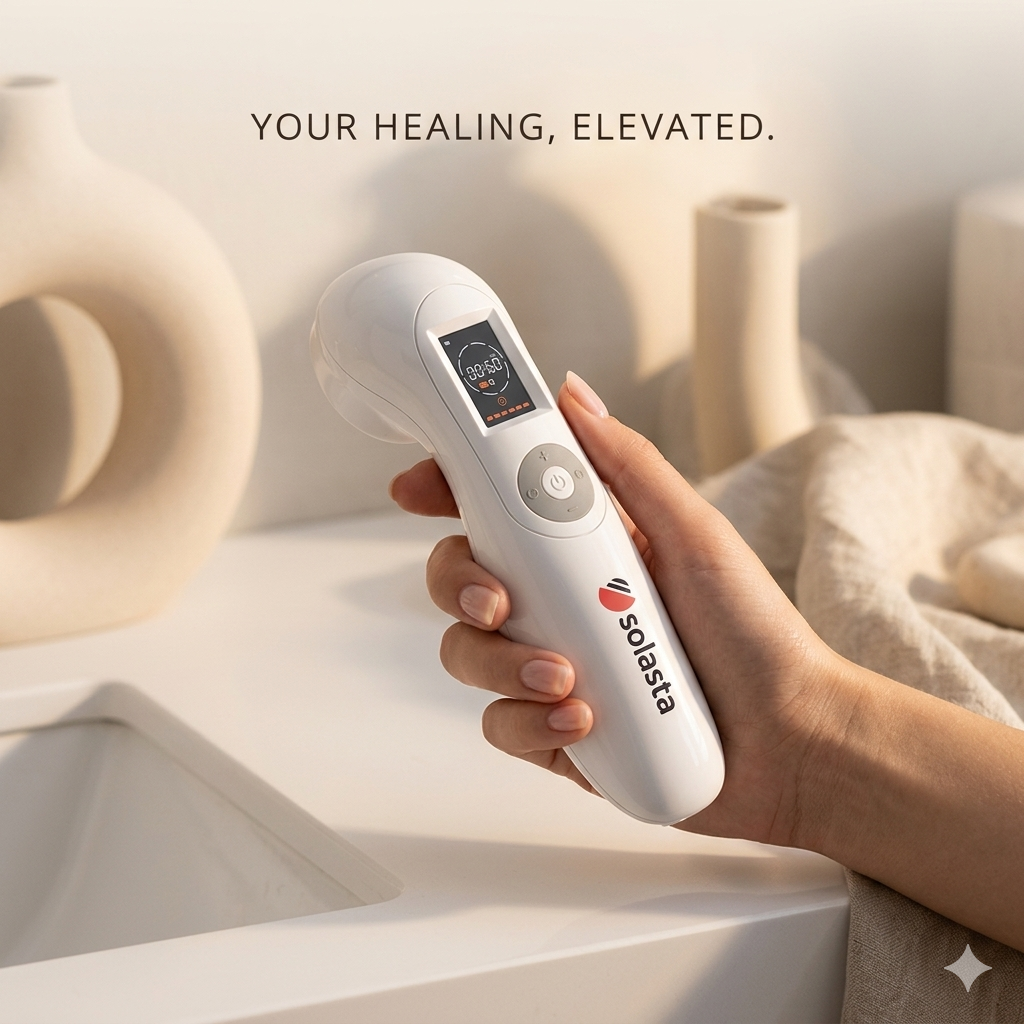
Solasta starts from a different place: instead of building a luxury gadget and then adding the science, it starts with the science and works backward to a device you can use at home. It’s a handheld GaAlAs cold laser that combines 650 nm red light (for glow and surface rejuvenation) with 808 nm near‑infrared (for deeper collagen and tissue support).
Solasta was originally positioned around women’s health and deeper tissue benefits - think fertility, musculoskeletal pain and brain health - but those same wavelengths and power levels directly translate to skin quality, texture, and resilience. You get a more “clinical tool at home” vibe than a spa gadget, which is ideal if you care as much about numbers and research as you do about aesthetics.
Lyma vs. Solasta for beauty: which makes more sense?
Here’s the simple, beauty‑focused bottom line.
· If you want a luxury, effortless ritual
Lyma is beautifully designed, extremely gentle, and backed by glowing editor reviews and celebrity fans, with real‑but‑gradual improvements in skin tone, fine lines, and overall radiance reported over several months. You’re paying as much for the experience and brand as for the hardware.
· If you want clinic‑style dosing and transparency in a versatile tool for your whole body
Solasta gives you dual wavelengths (650 nm + 808 nm), higher total output and clear dosing guidelines mirroring the way red light therapy is studied and used in medical settings. It’s less about unboxing a status symbol and more about owning a serious therapeutic laser that happens to live in your bathroom drawer.
For most beauty‑minded readers, the key is knowing what you’re paying for. If a luxe, zero‑friction routine and a big brand name motivate you to actually use the device daily, Lyma might feel worth it. If you’d rather invest in higher output, dual wavelengths, and clearly defined energy dosing (and still use it consistently), Solasta is the smarter, science‑first, multi-purpose device.
What kind of results can you realistically expect?
Whether you use Lyma, Solasta, or a good in‑clinic device, your skin will change gradually, not overnight. It can take several weeks of consistent use and the greater the skin damage the more months you’ll need to use your device.
Recent evidence‑based reviews from dermatology and aesthetic surgery journals conclude that red and near‑infrared light are legitimately helpful for skin rejuvenation and have an excellent safety profile when used correctly. You’re not replacing injectables, surgery etc - but you are adding a powerful, low‑risk tool to your long‑game anti‑aging strategy.
If you’ve been eyeing the Lyma Laser because everyone seems to own one, now you understand what it’s actually doing for your skin - and where a more transparent, higher‑output device like Solasta fits into the picture.