High FSH and Low Ovarian Reserve: Can We Help the Follicles You Still Have?
Getting a high FSH result can leave you feeling as though a number has decided your future.
Perhaps you were told your ovaries are “working too hard.” Perhaps the conversation quickly moved to fewer eggs, lower treatment success, or options you were not ready to consider.
High FSH associated with diminished ovarian reserve (DOR) deserves attention. But it doesn’t tell the whole story. Ovarian-reserve tests help estimate how the ovaries may respond to IVF treatment; they cannot, by themselves, determine whether you will conceive or tell us the quality of every remaining egg.
That leaves an important question:
Instead of focusing only on how many follicles you have left, can we help those follicles respond and develop as well as possible to stack your odds of conceiving?
Two restorative approaches address different parts of that question: estrogen treatment to reduce elevated FSH signaling, and photobiomodulation are being investigated for its effects on the environment in which follicles grow.
Why does FSH rise when ovarian reserve falls?
FSH stands for follicle-stimulating hormone. It is made by the pituitary gland in the brain and helps stimulate ovarian follicles - the small structures that contain developing eggs.
The ovaries communicate back through hormones, including estradiol and inhibin B. As the follicle pool becomes smaller, inhibin B production can decline. With less feedback telling the pituitary to ease off, FSH rises.
Think of it as the brain turning up the volume on its message to the ovaries.
That louder signal is useful information, but it is not a complete fertility assessment. FSH also fluctuates between cycles and needs to be interpreted alongside estradiol, AMH, ultrasound findings, age, and your treatment history.
Why would a fertility clinician prescribe estrogen for high FSH?
At first, this can sound counterintuitive. If the goal is to help a follicle grow, why give a hormone that reduces the brain’s stimulation signal?
Because more stimulation is not necessarily the answer to every situation.
Estrogen provides feedback to the brain, reducing pituitary FSH release. This FSH-lowering effect is well established. In selected patients, clinicians use it as part of an attempt to improve the hormonal conditions for follicle development.
Some restorative approaches such as NeoFertility may include transdermal estrogen - estrogen delivered through the skin as a strategy to lower FSH and potentially improve receptor function. That does not mean every woman with high FSH needs an estrogen patch; it is one possible clinician-directed approach.
Can estrogen “reset” FSH receptors?
“Resetting the receptors” is a helpful shorthand, but it needs a little explanation.
FSH works by attaching to receptors on the follicle’s supporting cells, particularly granulosa cells. Dr. Jerome H. Check and colleagues proposed that prolonged exposure to very high FSH may cause some receptors to become less available at the cell surface, making the follicle less responsive.
Their treatment rationale was to lower excessive FSH exposure and potentially allow the remaining follicles to respond more effectively again.[scivisionpub]
The aim is therefore not to increase estrogen receptors. It is to improve FSH-receptor responsiveness.
However, “reset” should not be understood as a guaranteed biological reboot. Estrogen reliably lowers FSH; whether it restores receptor availability enough to improve fertility in an individual woman is less certain. The receptor explanation remains a proposed mechanism, rather than something routinely measured and confirmed during treatment.
What did Dr. Check’s work show?
Check and colleagues investigated this approach beginning in the early 1980s. Their publications include reports of ovulation, pregnancies, and live births in women with severe ovarian dysfunction - even with very high FSH or undetectable AMH.
Those reports matter because they show that a very abnormal hormone result does not always mean there is no remaining ovarian activity.
But the limitations matter too. Much of the early work involved women with prolonged absence of periods and ovarian insufficiency, not simply women with low AMH who were still having regular cycles. Case reports and uncontrolled series cannot establish how much treatment improved the chances of pregnancy.
There is another distinction worth knowing: Check’s published regimens used oral estrogens, later emphasizing ethinyl estradiol. NeoFertility’s transdermal estrogen approach shares the FSH-suppression rationale, but it is not the identical protocol.
What happened in Check’s early study?
Five women had gone more than six months without periods, had very low estradiol, and had FSH above 50 mIU/mL. They received oral estrogen to lower FSH, followed by gonadotropin stimulation and an ovulation trigger when a mature follicle developed.
Could remaining follicles respond again?
Check and colleagues explored this question in women whose ovaries appeared to have largely stopped responding. In an early study, they used estrogen to lower very high FSH before adding medication to stimulate follicle development. Three of the five women ovulated during treatment (remember they had no cycles for at least 6 months), and two delivered healthy babies. This doesn’t prove that estrogen restored their egg supply - or directly demonstrate a receptor ‘reset.’ It did show that ovarian activity and pregnancy were possible in some women despite very abnormal hormone results.
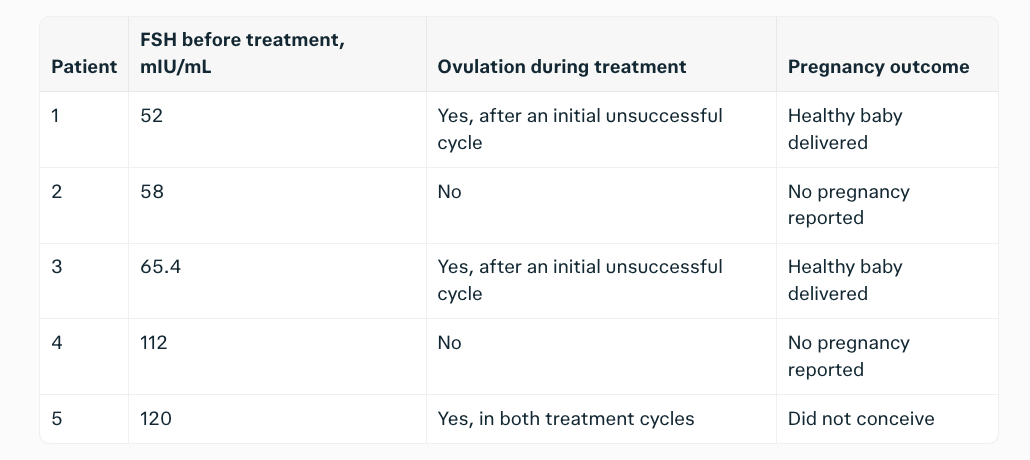
Source: Five cases from Check and Chase’s 1984 study, as summarized in Check and Choe’s 2022 review
Another study offers another reason for interest
A study by Pinelli and colleagues, published in 2018, followed 26 women receiving estrogen pretreatment and compared them with 26 women who had not received pretreatment.
The women were under 40 and in what the researchers described as the transitional phase of premature ovarian insufficiency - a situation in which ovarian activity may still occur intermittently. The treatment used oral estradiol with a progestogen added during the luteal phase.
Four of the 26 women conceived spontaneously during pretreatment. Among those who went on to IVF, the estrogen-pretreated group had more mature eggs retrieved, more fertilized eggs, and a higher clinical pregnancy rate.
That is encouraging, but it was a small retrospective study using historical controls, not a randomized trial. It cannot tell us that estrogen will help every woman with high FSH, and it does not prove that ovarian reserve was restored - but it’s definitely worth a discussion with your clinician.
The sensible conclusion is that estrogen-based FSH suppression may be worth discussing for selected patients - not that a patch is a universal treatment for DOR.
Lowering FSH is not the same as increasing egg supply
This distinction can protect you from a great deal of confusing marketing.
Estrogen can bring an elevated FSH result down without increasing the number of eggs remaining. A better-looking blood test is therefore not enough to show that treatment has improved fertility.
What matters more is what happens next:
Does a follicle develop?
Does it mature and ovulate?
If you are undergoing IVF, are usable eggs and embryos obtained?
Ultimately, does treatment improve the chance of a live birth?
The goal isn’t to make the laboratory report look reassuring. It is to find out whether treatment is helping in a meaningful way.
Where does red light therapy fit?
Estrogen treatment addresses hormonal signaling. Photobiomodulation asks a different question:
Could specific doses of light help support the cells and tissues involved in follicle development?
PBM uses red or near-infrared light to influence cellular processes. In ovarian research, scientists are investigating its effects on mitochondrial function, oxidative stress, inflammation, blood-vessel development, and cell survival. These processes help shape the environment in which follicles grow.
A follicle is not just an egg waiting on its own. It includes supporting cells whose health and activity matter. This is why researchers are interested in the ovarian environment - not only the number of follicles present. Remember we just need ONE egg and ONE sperm for conception.
Importantly, this does not mean you caused DOR through stress, diet, or anything you failed to do. “Supporting the environment” describes a biological research target, not a judgment about your lifestyle.
How might PBM support the ovarian environment?
A 2024 study investigated PBM in naturally aging mice and in a human granulosa-cell line exposed to oxidative stress in the laboratory. It found several effects relevant to follicle health.
Supporting cellular energy
Mitochondria help cells produce ATP, their usable energy supply. In the stressed granulosa-cell model, PBM improved measures of mitochondrial function and increased ATP levels.
In plain language, the treated cells appeared better able to maintain their energy-producing machinery under the experimental conditions.
Reducing oxidative stress and inflammatory damage
Oxidative stress occurs when reactive molecules overwhelm a cell’s protective systems. In the aging mouse ovaries, PBM reduced oxidative stress and markers of chronic inflammation.
These findings suggest a possible way to make the ovarian environment less damaging to its cells.
Supporting cell survival and blood-vessel development
The same study found less programmed cell death and improved blood-vessel development in treated mouse ovaries. Protective effects were also observed in the stressed granulosa-cell model.
Together, these findings offer a biological rationale for studying PBM as a way to support existing follicles. They are not proof that PBM creates new eggs, reverses reproductive aging, or corrects age-related chromosomal changes.
Could estrogen and PBM complement each other?
There is a logical reason to ask.
Estrogen-based treatment aims to reduce excessive FSH signaling and potentially improve follicular responsiveness. PBM is being investigated for its ability to support cellular energy, reduce damaging stress, and influence the local ovarian environment.
They address different biological questions: the signal reaching the follicle and the conditions within the tissue.
What should you ask your fertility clinician?
If your FSH is high and your ovarian reserve is low, useful questions include:
“How do my FSH and estradiol results fit with my AMH and ultrasound?”
“Am I still developing and ovulating follicles?”
“Is estrogen pretreatment appropriate in my particular situation?”
“How would we judge whether it is helping beyond lowering FSH?”
Estrogen needs individualized prescribing, including consideration of your medical history, treatment timing, and any need for progesterone or progestogen. It should not be started simply to bring down a laboratory value. Bringing down the lab value while also addressing the environment the follicles live in might not be the best approach.
You deserve something more useful: an honest explanation, appropriate care, and a treatment plan that looks beyond a single number.
Tracy
(PS Did you know FSH therapy is now an emerging restorative approach from Italian researchers for specific male factor issues - you can read more here).
References:
Practice Committee of the American Society for Reproductive Medicine. Testing and interpreting measures of ovarian reserve: a committee opinion. Fertility and Sterility. 2020;114(6):1151–1157. doi:10.1016/j.fertnstert.2020.09.134.
Check JH, Chase JS. Ovulation induction in hypergonadotropic amenorrhea with estrogen and human menopausal gonadotropin therapy. Fertility and Sterility. 1984;42(6):919–922. doi:10.1016/S0015-0282(16)48266-X.
Check JH, Choe JK. Maximizing correction of infertility with moderate to marked diminished egg reserve in natural cycles by up-regulating follicle stimulating hormone receptors. Gynecology & Reproductive Health. 2022;6(4):1–7. doi:10.33425/2639-9342.1197.
Pinelli S, Artini PG, Basile S, et al. Estrogen treatment in infertile women with premature ovarian insufficiency in transitional phase: a retrospective analysis. Journal of Assisted Reproduction and Genetics. 2018;35(3):475–482. doi:10.1007/s10815-017-1096-y.
He Y, Ye R, Peng Y, et al. Photobiomodulation ameliorates ovarian aging by alleviating oxidative stress and inflammation damage and improving mitochondrial function. Journal of Photochemistry and Photobiology B: Biology. 2024;260:113024. doi:10.1016/j.jphotobiol.2024.113024.
Boyle P. Treatments that may be used in RRM with NeoFertility. May 2025. Educational handout.
This article is educational and does not provide an individualized treatment recommendation. Estrogen and PBM are not proven ways to replenish ovarian reserve or guarantee pregnancy. Discuss hormone treatment and any fertility adjuncts with your treating clinician.