Most of us dread the start of Daylight Saving Time (DST) for the lost hour of sleep and the general feeling ‘off’ that tends to follow for a few days. But for those navigating the delicate window of an IVF cycle, a one-hour clock shift might carry more weight than just an interrupted sleep schedule.
A landmark U.S. study suggests that the "circadian shock" of the clock change could influence early pregnancy outcomes - particularly for women who have already experienced a pregnancy loss.
The Study: Timing the Clock vs. Timing the Transfer
Researchers analyzed 1,654 IVF cycles to see if the timing of an embryo transfer affected success rates when lined up with the spring DST shift.
At first glance, the "big picture" numbers looked steady, with overall pregnancy rates hovering around 41 - 42% regardless of the season. However, when researchers zoomed in on the specific window following the "spring forward" shift, they found some startling data…
The 60% Finding
For women with a history of prior miscarriage, the data told a much more urgent story. The risk of another loss increased up to 60% if their embryo transfer occurred in the 21 days following the spring time change.
In contrast, those who had transfers before the time change or during the fall "set back" saw significantly lower miscarriage rates. This suggests that the biological stress of losing an hour of sleep - and the resulting desynchronization of our internal clocks - might create a vulnerability window for early pregnancy maintenance.
Why the "Body Clock" Matters for Fertility
Every cell in the human body - including those in the lining of the uterus - operates on a 24-hour biological clock governed by the Suprachiasmatic Nucleus (SCN) in the brain. Early morning light (even on cloudy days) anchors your circadian rhythm. When you receive a protocol from me I’ll ask you about your light ‘diet’ as well as your nutrition. It helps me see how much junk light you’re consuming every day.
When we "spring forward," we aren't just tired; we are technically desynchronized from our environment. Our reproductive hormones are released in specific pulses, and when that rhythm is interrupted, it can impact how the body supports new life.
Using Light to "Buffer" the Circadian Shock
You can’t control the calendar, but most women can control their environment. Light is the primary signal that tells your brain what time it is. By prioritizing specific types of light, you can help "cushion" your body against the disruption of a time change.
1. The Morning "Anchor"
The most effective way to stabilize your rhythm is to get 10–20 minutes of direct sunlight (no windows or sunglasses) within 30 minutes of waking. This triggers a healthy spike in cortisol and sets a "timer" for melatonin production later that night.
2. Circadian Lighting at Home
Treat your indoor lighting like the sun:
Daytime: Use high-intensity, "cool" blue-toned lights to mimic the bright sky and keep your hormones on track.
Evening: Transition to "warm" amber or red-toned lighting. This protects your melatonin, which is a powerful antioxidant that supports embryo quality and a healthy uterine environment. This is the company I buy my lightbulbs from.
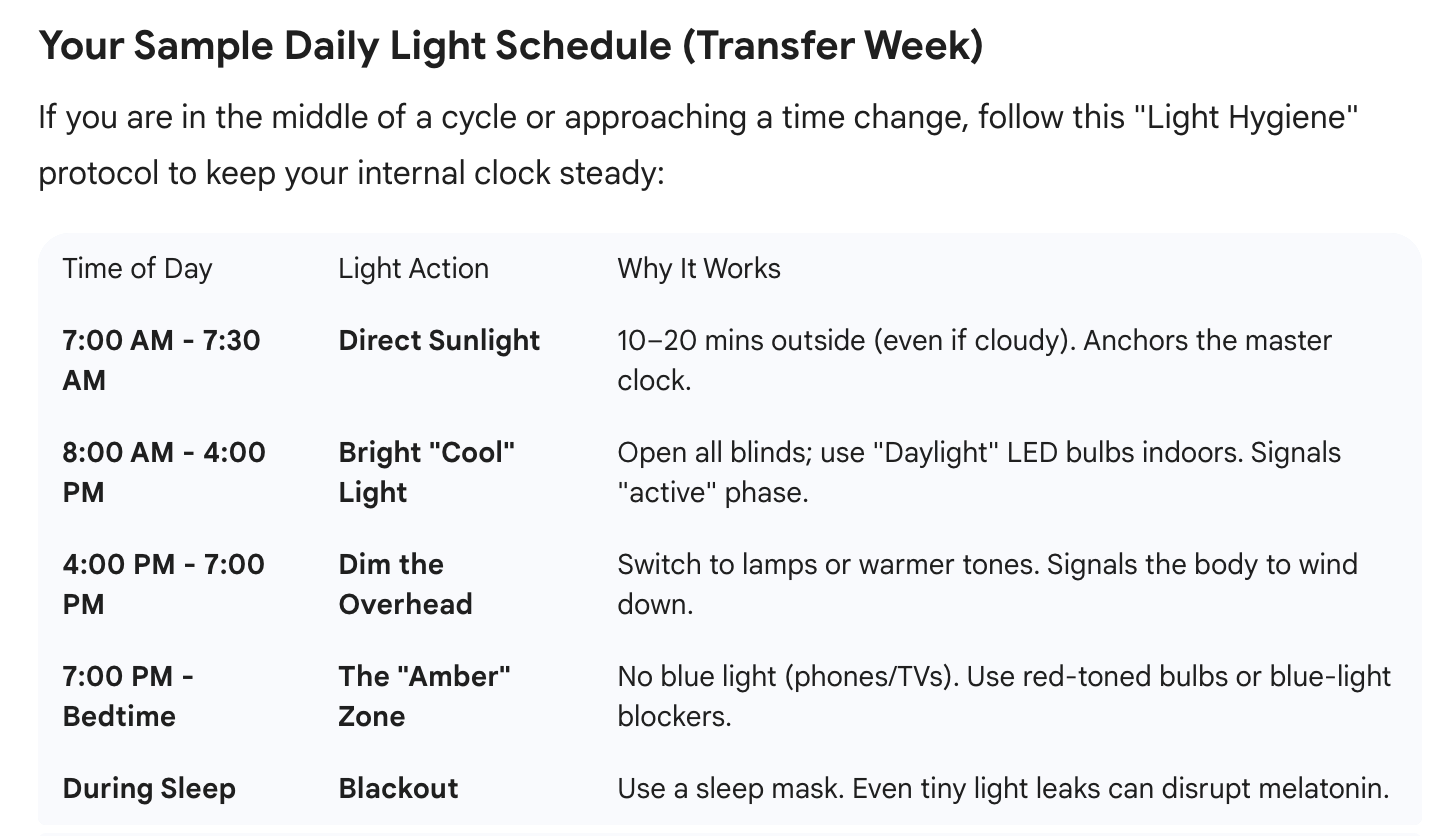
Transfer Week
While the 60% statistic is concerning, it highlights just how much our environment impacts our biology. By using morning sunlight and circadian-friendly lighting, you can give your body - and your embryo - the most stable foundation possible during a delicate time.
Resources:
Impact of daylight savings time on spontaneous pregnancy loss in in vitro fertilization patients. Chronobiology International. 2017;34(1):101–107. doi:10.1080/07420528.2016.1246457.