Red Light Therapy for Oral Mucositis at Home
If you or someone you love is facing cancer treatment, you may already know the word oral mucositis — the painful mouth sores and inflammation that chemotherapy, radiation to the head and neck, and stem-cell transplants can cause. It's the side effect that can make eating, drinking, and even talking feel impossible.
So let me answer the question directly: yes, red light therapy (photobiomodulation, or PBM) can be done at home for oral mucositis — with the right kind of device, conservative dosing, and your oncology team's knowledge. What the research supports, what home devices can and can't do, and how to do this safely are exactly what I'll walk you through here.
I'm a certified photobiomodulation practitioner, and I support people through cancer treatment with the same approach I'm describing here: I supply a dual-wavelength cold laser (650 nm red + 808 nm near-infrared) with a written, individualized protocol, full instructions, and ongoing follow-up — all delivered remotely, so you don't need to live near me to work together. That means I'll also tell you where the honest limits are - because this is an area where hope and marketing sometimes run ahead of the evidence.
What the Evidence Actually Supports
Light therapy for oral mucositis is not fringe science. It's one of the best-studied uses of red and near-infrared light in medicine:
· The international mucositis guideline body (MASCC/ISOO) recommends PBM for preventing oral mucositis in patients receiving head and neck radiation and stem-cell transplants (guideline summary; Zadik et al., 2019).
· In March 2026, the Oncology Nursing Society updated its guidance to "recommended for practice" for these patient groups (ONS).
· A 2026 meta-analysis found diode red-light treatment roughly halved the risk of severe mucositis in head and neck cancer patients (Supportive Care in Cancer).
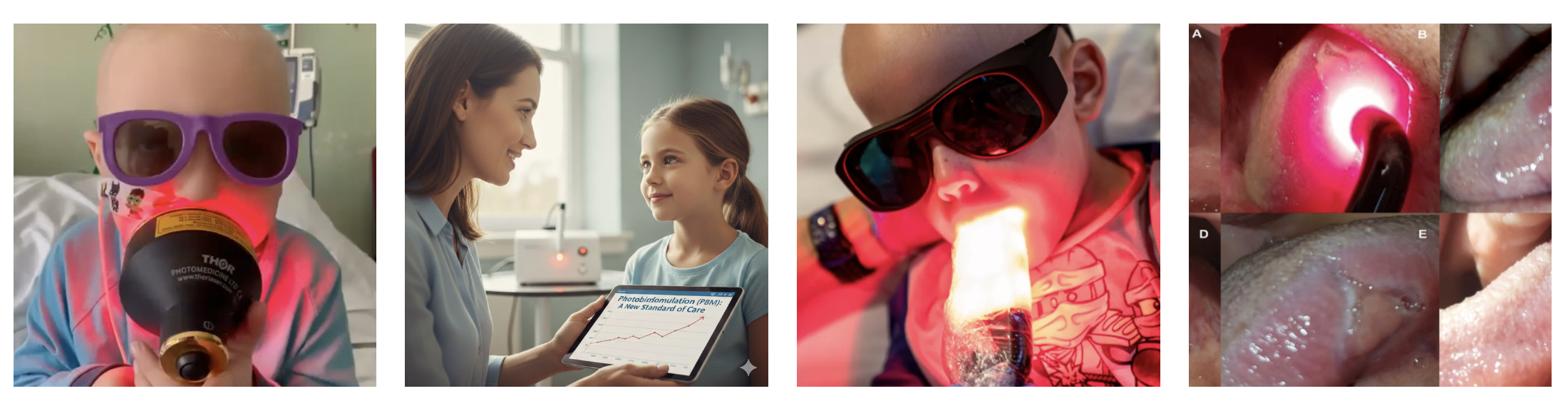
· And importantly for the at-home question: a 2026 pediatric trial found that light applied outside the mouth (through the cheeks) performed comparably to inside-the-mouth treatment when the dosing was equivalent (Supportive Care in Cancer, Oct 2026). Treating through the skin is a recognized clinical approach, not a home-made shortcut — the NHS describes laser probes used "inside your mouth or outside your mouth, close to your cheek" (NHS). In November 2026 a new pediatric study suggested that administering the light from outside the mouth was associated with “lower cumulative OM occurrence, shorter application time, and good tolerability, supporting its use as a promising, less burdensome preventive strategy in pediatric oncology.”
When cancer centers deliver PBM, treatment takes about a minute per area, and the results are striking: at Texas Children's Hospital, the share of transplant patients needing intravenous nutrition after treatment fell from 61% to 18% after PBM became routine.
What Home Devices Can't Do
Now the honest part — because the studies above were done with clinical equipment and trained providers, and that matters.
No home device is FDA-authorized for oral mucositis. In late 2025, the FDA authorized the first device for this condition — the MuReva OM, a mouthpiece system for adults receiving head and neck radiation. That was a genuine milestone, but it is one device, one narrow indication, delivered in hospitals — and its rollout has only just begun. It does not make "red light therapy" broadly approved, and it doesn't cover the devices you can buy online.
Most consumer mouth devices don't publish their dose. The research benefits come from specific dosing — wavelength, power, and energy delivered. Many consumer devices state a wavelength and a timer, but no fluence. If the manufacturer can't tell you the measured output power and the size of the emitting area, the actual dose delivered is unknown. That's the difference between photobiomodulation and just sitting near some red lights.
Light loses strength passing through the cheek. Research on trans-buccal (through-the-cheek) delivery measured that only a small fraction of surface-applied infrared energy reaches tissue 6 - 12 mm deep. This is why I treat through the skin with a dual-wavelength device — the near-infrared component penetrates deeper — and why any honest home protocol describes the dose delivered at the skin over the treatment area, not as if it were equivalent to inside-the-mouth treatment.
And a guideline caveat: for chemotherapy-only regimens (no radiation, no transplant) and for treating sores that are already established, the guideline bodies haven't made a formal recommendation yet — the evidence looks promising but isn't formalized (Zadik et al., 2019). If that's your situation, your oncology team's judgment is essential.
The $20,000 Hospital System
Here's the market reality, and why this question is so confusing for families.
Hospital-grade light therapy systems cost around $20,000 per device — one reason most cancer centers still don't offer the treatment. The hospital system is the gold standard most patients can't reach. The next option is a properly specified device used with a written, evidence-informed protocol — calculated dose, defined treatment fields, symptom tracking, and your cancer team in the loop. That is exactly what I do, and it's what I'd insist on if it were my own family.
Safety Rules Before You Start at Home
If you're going to do this, do it with these boundaries:
1. Tell your oncology team first. Not for permission so much as coordination — they need to know what you're adding, and some situations (tumors near the treatment area, certain medications) change what's safe.
2. Never aim light at a tumor site, your thyroid, or your eyes. Protective eyewear matters with true lasers.
3. Review your medications for photosensitizing drugs — some antibiotics, heart medications, and herbal supplements interact with light therapy (usually UV light not red light).
4. Don't irradiate the mouth of someone who is neutropenic and feverish without medical guidance — mouth pain with fever is a medical situation, not a laser situation.
5. Track symptoms at every session. If your mouth is getting worse, the answer is a call to your cancer team — not more treatment time.
Questions to Ask Before You Buy Anything
· What wavelength(s) does the device emit?
· What dose will be delivered per treatment area?
· Is the person guiding this willing to coordinate with my oncology team?
· What does the follow-up look like? (If the answer is "none," walk away.)
If You're Considering Home Treatment
This is what I do: I supply the laser I've described — a dual-wavelength (650 nm red + 808 nm near-infrared) cold laser — together with a written protocol tailored to your treatment calendar, full instructions, and ongoing follow-up as your treatment progresses. Everything happens remotely, so you don't need to live anywhere near me; if you can use a video call, we can work together. The approach is almost always extra-oral, always with calculated dosing, and always alongside your oncology team's care. If you're starting treatment soon, the best time to begin is before the first infusion, because prevention is where the evidence is strongest.
Mouth pain that makes eating impossible during cancer treatment is not a small thing. You deserve more than a two-year wait for your hospital to buy the right equipment.
Tracy
Resources:
VIDEO of UK use of PBM in pediatrics.
Oncology Nurse shares her experiences in Pittsburgh
I'm Tracy Donegan — a midwife and certified photobiomodulation practitioner (University of Montpellier training) based in Round Rock, Texas. This article is educational and reflects how I practice; it is not medical advice, and nothing here replaces care from your oncology team.
Sources
· MASCC/ISOO mucositis guidelines: https://mascc.memberclicks.net/assets/Guidelines-Tools/Mucositis/Mucositis_Guidelines_Overall_Summary_Doc.pdf
· Zadik Y, et al. (2019), systematic review & guidelines: https://pmc.ncbi.nlm.nih.gov/articles/PMC7540329/
· ONS Voice (Sept 2026), PBM in oral mucositis care: https://www.ons.org/publications-research/voice/news-views/09-2026/photobiomodulation-shines-new-light-oral-mucositis-care
· Meta-analysis, diode PBM in head and neck cancer (2026): https://link.springer.com/article/10.1007/s00520-026-10575-4
· Extra-oral vs intra-oral pediatric RCT (2026): https://link.springer.com/article/10.1007/s00520-026-11372-9
· Polish Society for Laser Dentistry umbrella review (2025): https://dmp.umw.edu.pl/en/article/2025/62/6/1157
· Trans-buccal LED power delivery study: https://pmc.ncbi.nlm.nih.gov/articles/PMC11853966/
· Texas Children's PBM implementation study: https://onlinelibrary.wiley.com/doi/full/10.1002/pbc.30966
· NHS, Mucositis: https://www.nhs.uk/conditions/mucositis/
· FDA De Novo authorization, MuReva OM: https://www.accessdata.fda.gov/cdrh_docs/pdf24/DEN240077.pdf