Myofascial Pain Relief: At-Home Red Light Laser Guide
While many people try standard red light therapy panels for muscle knots, broad LED lights cannot penetrate deep enough into the fascia to release a locked trigger point. For true myofascial pain syndrome relief, you need a targeted, clinical-grade at-home cold laser - like the Solasta Handheld Laser - which combines 650nm red light with deep-penetrating 808nm near-infrared laser technology.
Tired of Neck and Jaw Pain - but Not a Fan of Pills? Meet Myofascial Pain Disorder Syndrome (and a Drug‑Free Option You Haven’t Tried Yet)
If you’ve ever ended a long day with a tight neck, aching shoulders, or a jaw that feels like it chewed through concrete, you are not alone. And if your main options so far have been “take another pill” or “just live with it,” this blog is for you.
Today we’re talking about myofascial pain disorder syndrome (MPDS) - what it is, what the research is saying about light‑based therapy, and why my Solasta laser has become one of my favorite tools for clients who want less pain without relying on daily medication.
How to Release Myofascial Trigger Points Fast with Red Light Therapy
Let’s keep this simple.
“Myofascial” just means muscles plus fascia - the web of connective tissue that wraps around your muscles like cling film. When you have MPDS, certain spots in those muscles and fascia (called trigger points) become extra irritable. They can cause:
Deep, aching pain in the neck, shoulders, or jaw
Stiffness and limited range of motion
Headaches that seem to start at the base of your skull
Pain that feels like it’s “referred” elsewhere - like a jaw trigger point causing a headache
If you’ve ever pressed on a knot in your shoulder and felt pain shoot up into your head, you’ve already met myofascial pain.
Traditional treatment often includes stretching, physical therapy, massage, trigger‑point injections, sometimes medications like NSAIDs or muscle relaxers. These can absolutely help, but not everyone wants to live on pills, and not everyone responds well to injections or strong medications long term.
This is where photobiomodulation - aka therapeutic light comes in.
The Research: Can Red Light Actually Help Myofascial Pain?
I know what you might be thinking: “Is shining a light on my neck really going to do anything?”
Researchers have been wondering the same thing… and they’ve been testing it.
Here’s what the science is telling us:
A recent 2026 triple‑blind randomized controlled trial (that’s gold‑standard research) on people with MPDS found that photobiomodulation therapy reduced pain and improved how wide patients could open their mouths, with results similar to conventional conservative care.
Studies combining PBM with other therapies, like dry needling, show that light can enhance pain relief and help calm down those overactive trigger points even more.
A broader systematic review of PBM for chronic pain concluded that PBM has real analgesic potential with a good safety profile, especially in situations where medication isn’t ideal long‑term.
In plain English? Therapeutic light can help reduce pain and improve function in myofascial pain conditions - and it does it without numbing your whole system or straining your liver the way many medications do.
The Secret to Melting Muscle Knots: Photobiomodulation (PBM) Home Laser
Let’s talk about the Solasta laser, and why I love it for clients who say, “I’ll do the work… but I don’t want to be on meds forever.”
Here’s what makes Solasta such a helpful partner for MPDS:
It goes straight to the source. Instead of swallowing something and hoping it reaches your neck or jaw, you place the laser right over the tight muscles and trigger points, including specific spots like the base of your skull, the top of your shoulders, and that key C7 “Ohshiro point” at the base of your neck.
It supports healing, not just numbing. PBM works by supporting mitochondrial function (your cells’ energy factories), improving micro‑circulation, and nudging inflammatory mediators in a calmer direction. You’re not just turning down the volume on pain; you’re also helping the tissue repair environment.
It’s gentle and repeatable. Most of the research uses repeated sessions over weeks, and your Solasta lets you bring that same “slow and steady” approach home - without needing chronic medication to get through the day.
It fits beautifully with other tools. Stretching, posture work, stress‑reduction, physical therapy - Solasta doesn’t replace these; it amplifies them. Many clients tell me that after a laser session, they can finally stretch or move without their muscles instantly tightening up again.
And practically? You’re talking about short, focused sessions a few days a week sitting on the couch, not hour‑long appointments you have to drive across town for. The whole session can take 15 - 20 minutes and can easily become part of an evening wind‑down routine - paired with a gentle stretch or a calming audio, instead of another episode of doom‑scrolling and a couple of pain pills.
Experience Clinical-Grade Myofascial Release - At Home.
Your deep tissue pain requires deep tissue technology. Knock out stubborn trigger points and recover faster with the portable power of Solasta - free protocol included.
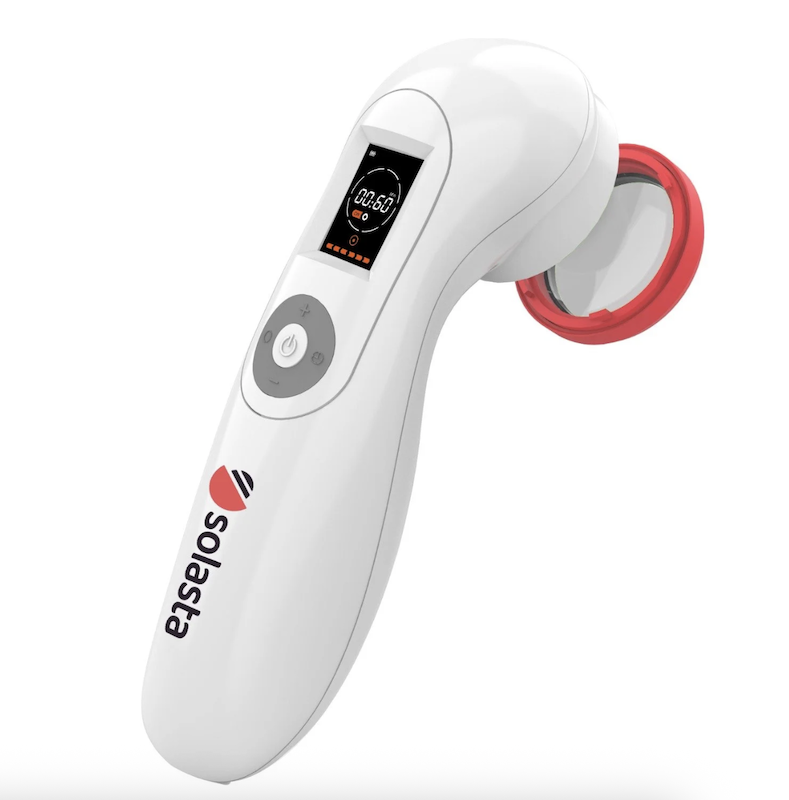
Safe home treatment with our 3B laser.
Who This Is (and Isn’t) For
Solasta is a fantastic fit if you:
Have recurrent neck, jaw, or shoulder pain from MPDS
Want to reduce your reliance on daily pain medication (with your clinician’s guidance)
Are willing to show up for yourself a few days a week with a short, intentional home routine
It isn’t a stand‑alone emergency tool. If you have red‑flag symptoms (sudden severe pain, neurological changes, trauma, fever, difficulty swallowing, or anything that feels “off”), you need medical evaluation, not just at‑home light therapy.
But for the many people stuck between “I don’t want to live on meds” and “I can’t keep living with this pain,” a structured Solasta protocol can be the missing middle ground - evidence‑informed, gentle, and aimed at actually helping your tissues and nervous system heal.
Myofascial Laser Therapy: Your Questions Answered
Q: Can a handheld laser actually reach deep muscle knots?
A: Yes, but it depends entirely on the wavelength. Standard red light therapy panels only penetrate a few millimeters, meaning they barely get past the top layer of skin - most of the light bounces off the skin. To reach deep myofascial trigger points, you need near-infrared (NIR) cold laser light between 808nm and 830nm. These specific wavelengths travel up to 5 centimeters deep into the tissue, allowing the laser energy to interact directly with the locked muscle spindles and deep fascia.
The Science: A systematic review published in the Journal of Bodywork and Movement Therapies found that Low-Level Laser Therapy (LLLT) directly applied to trigger points resulted in immediate, significant pain relief and instantly improved range of motion.
Q: How exactly does a cold laser "release" a trigger point?
A: A myofascial trigger point is essentially a localized energy crisis. The muscle tissue is stuck in a permanent micro-contraction, which cuts off blood flow, causing a lack of oxygen (hypoxia) and a buildup of painful waste products like lactic acid.
When you apply the Solasta Laser to the knot, the 808nm laser photons strike the cells' mitochondria. This triggers a biological process called photobiomodulation, which:
Boosts ATP (cellular energy) production so the muscle has the power to physically unlock.
Promotes microcirculation, flooding the tight knot with fresh oxygen.
Stimulates endorphin synthesis to dull localized and referred pain.
The Science: A randomized controlled trial evaluated the efficacy of 808nm diode laser therapy on chronic myofascial pain syndrome. The study found that patients receiving the 808nm laser treatment experienced drastically lower resting and activity pain scores, reduced trigger point sensitivity, and a much higher pressure pain threshold compared to the control group.
Q: Is at-home laser therapy safe for neck and shoulder pain?
A: Absolutely. For decades, target laser therapy was only available in high-end chiropractic and physical therapy clinics. Devices like the Solasta Handheld Laser pack that same clinical power into a safe, non-invasive, at-home device.
Unlike invasive treatments like dry needling or trigger point injections, cold laser therapy is completely painless, non-thermal (it won't burn the skin), and carries zero risk of tissue scarring or serious complications.
The Science: Clinical research comparing lasers to traditional needle therapies notes that laser therapy at myofascial trigger points is an exceptional, highly effective, and safe alternative for cervical pain, completely avoiding the anatomical risks (like pneumothorax) associated with deep dry needling.
Resources:
Venâncio, R. de A., Camparis, C. M., & Lizarelli, R. de F. (2023). "The effects of low-level laser in the treatment of myofascial pain syndrome: a systematic review." BrJP (Brazilian Journal of Pain), 6(1). [Available via BrJP/SciELO].
Chen, Y.-S., & Lin, C.-H. (2020). "Comparison of the effects between lasers applied to myofascial trigger points and to classical acupoints for patients with cervical myofascial pain syndrome." Journal of Clinical Trials, ClinicalTrials.gov Identifier: NCT01516502.
(Note: This randomized clinical trial verified that targeting trigger points with an 810nm - 808nm cold laser significantly relieved active cervical myofascial pain and immediately restored neck range of motion).
Ferreira, M. de O., Guimarães, J. P., Carvalho, A. C., & De Paula, V. (2021). "Clinical Effectiveness Evaluation of Laser Therapy and Dry Needling in Treatment of Patients with Myofascial Pain." Journal of Academic Research in Medicine / MDPI Musculoskeletal Disorders, 44(1), 2-9.